How much DNA is needed for sequencing?
Common sequencing workflows use about 1 nanogram to 1 microgram of DNA, but the right amount depends on the library kit, genome size, fragment length, and whether PCR is used.
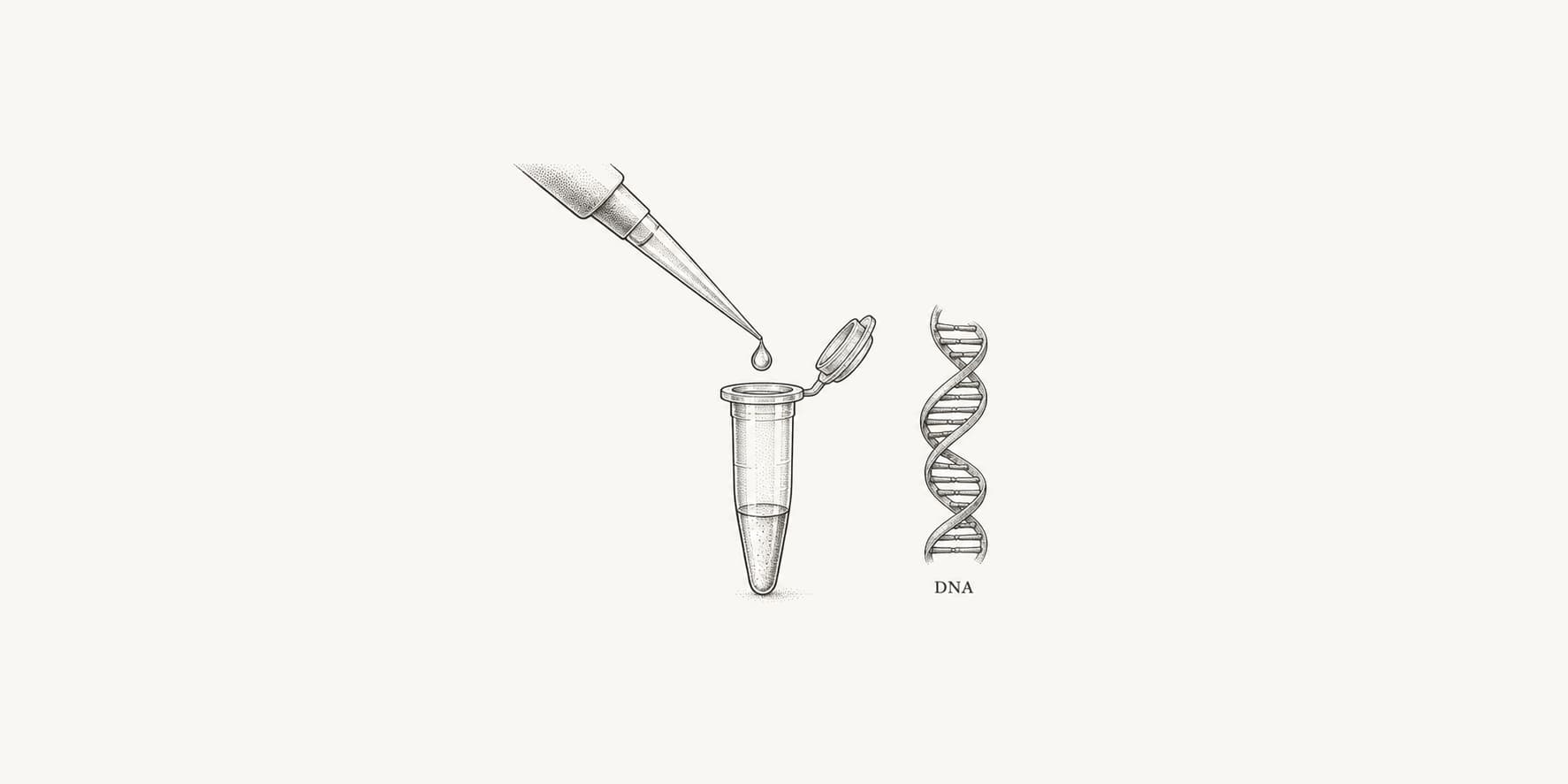
Most DNA sequencing workflows start with 1 nanogram to 1 microgram of DNA. The 1,000-fold range reflects how little material an amplified short-read library can use and how much intact DNA PCR-free and long-read methods often require.
The library-preparation protocol sets the input. Genome size, DNA quality, fragment length, and the use of PCR can change the requirement by orders of magnitude.
How much DNA is needed for sequencing?
Most sequencing library preparations require between 1 ng and 1 µg of DNA.
Illumina DNA Prep accepts 1–500 ng or more. It recommends 100–500 ng for human and other large, complex genomes, but permits 1 ng for small genomes such as bacteria.[1] Oxford Nanopore recommends 1 µg for ligation libraries made from DNA fragments longer than 10 kb.[4]
These figures describe DNA entering library preparation, rather than the finished library loaded onto a sequencer. A sample can meet the mass requirement and still fail if the DNA is degraded, contaminated, or measured with an assay that also counts RNA and free nucleotides.[3]
The chart compares selected published benchmarks rather than universal minimums. The 0.5 ng forensic value is an optimum PCR input, the gel value is a detection threshold, and the cloning value is the vector mass in one standard ligation. The five values span 2,000-fold, which is why the chart uses a logarithmic scale.[9][7][8][1][4]
How much DNA is needed for Illumina and whole-genome sequencing?
For an Illumina human whole-genome library, 100–500 ng is a common recommendation when PCR amplification is included; current PCR-free workflows can use 25–300 ng, while older TruSeq PCR-free preparation requires 1 µg.
Illumina DNA Prep recommends 100–500 ng for a large genome such as the human genome. Below 100 ng, the protocol requires input quantification, extra PCR-cycle adjustment, and separate library normalization.[1]
The current Illumina DNA PCR-Free Prep lists 25–300 ng of input. The older TruSeq DNA PCR-Free workflow lists 1 µg.[2][3] Whole-genome input requirements therefore follow the exact kit and protocol revision.
Nanopore input is also fragment-dependent. Oxford Nanopore's current ligation chemistry recommends 200 femtomoles for fragments under 1 kb, 100–200 femtomoles for fragments from 1–10 kb, and 1 µg for long-fragment libraries above 10 kb.[4] Mass and molecule count are not interchangeable: the same mass contains fewer molecules when the DNA fragments are longer.
Input mass is only one part of planning a run. Coverage, platform capacity, and analysis determine sequencing cost, while library preparation and batching affect sequencing time.
How much DNA is needed for Nanopore and Sanger sequencing?
Nanopore ligation sequencing typically uses 1 µg of long-fragment DNA, while a Sanger reaction may use 1–50 ng of a purified PCR product or 150–300 ng of double-stranded DNA.
For Sanger sequencing, the recommended PCR-product mass rises with product length: 1–3 ng for 100–200 bp, 3–10 ng for 200–500 bp, 5–20 ng for 500–1,000 bp, and 20–50 ng above 2,000 bp. Thermo Fisher's BigDye guide recommends 150–300 ng for a double-stranded DNA template and 2–3 µg for bacterial genomic DNA.[5]
Sanger sequencing reads one template population per reaction, so a clean template matters as much as mass. Mixed PCR products or plasmids with more than one insert can produce overlapping peaks even when the submitted DNA quantity is correct.
Nanopore protocols care more about molecule length because read length reflects the DNA fragments supplied. Harsh pipetting, vortexing, repeated freeze-thaw cycles, and degraded extraction can reduce read length even when the tube contains 1 µg of DNA.[4]
How much DNA is needed for PCR, gels, cloning, and forensic identification?
A typical 50 µL PCR uses 5–50 ng of genomic DNA or 0.1–1 ng of plasmid DNA; an agarose gel can detect about 10 ng in a band; standard cloning often starts with 50 ng of vector; and forensic STR profiling has an optimum PCR input near 500 pg.
| Application | Published DNA amount |
|---|---|
| PCR | 5–50 ng genomic DNA or 0.1–1 ng plasmid DNA |
| Agarose gel | About 10 ng detection limit; up to 100 ng for a sharp band |
| Two-fragment cloning | 50 ng vector with a 3:1 insert-to-vector molar ratio |
| Forensic STR profile | About 500 pg optimum input, equal to roughly 80 diploid cells |
The PCR figures come from Thermo Fisher, the gel values from QIAGEN, the cloning example from New England Biolabs, and the forensic value from a 2021 cell-count study.[6][7][8][9]
PCR needs more complex genomic DNA than a small plasmid because the target occupies a much smaller share of the total molecules. Too much template can also increase nonspecific products. Primer specificity is therefore as important as mass; Primer3 can design primer pairs against a known target sequence.
For cloning, the insert amount depends on fragment length. A standard NEB ligation uses a 4 kb vector at 50 ng and a 1 kb insert at 37.5 ng, producing a 3:1 insert-to-vector molar ratio.[8] Copying “50 ng” without recalculating the insert can give the wrong number of molecules.
For forensic identification, 500 pg is the optimum DNA mass entering STR amplification, not the amount that must be collected from an object. The study equates 500 pg to about 80 diploid cells, but swabbing, transfer, extraction, and purification can lose 20–80% of the DNA. A practical sample therefore needs more biological material than the final PCR input suggests.[9]