How long does PCR take?
A PCR machine usually runs for about 45 minutes to 2 hours, although the full laboratory workflow takes longer. Protocol, amplicon length, cycle count, and thermocycler speed determine the exact time.
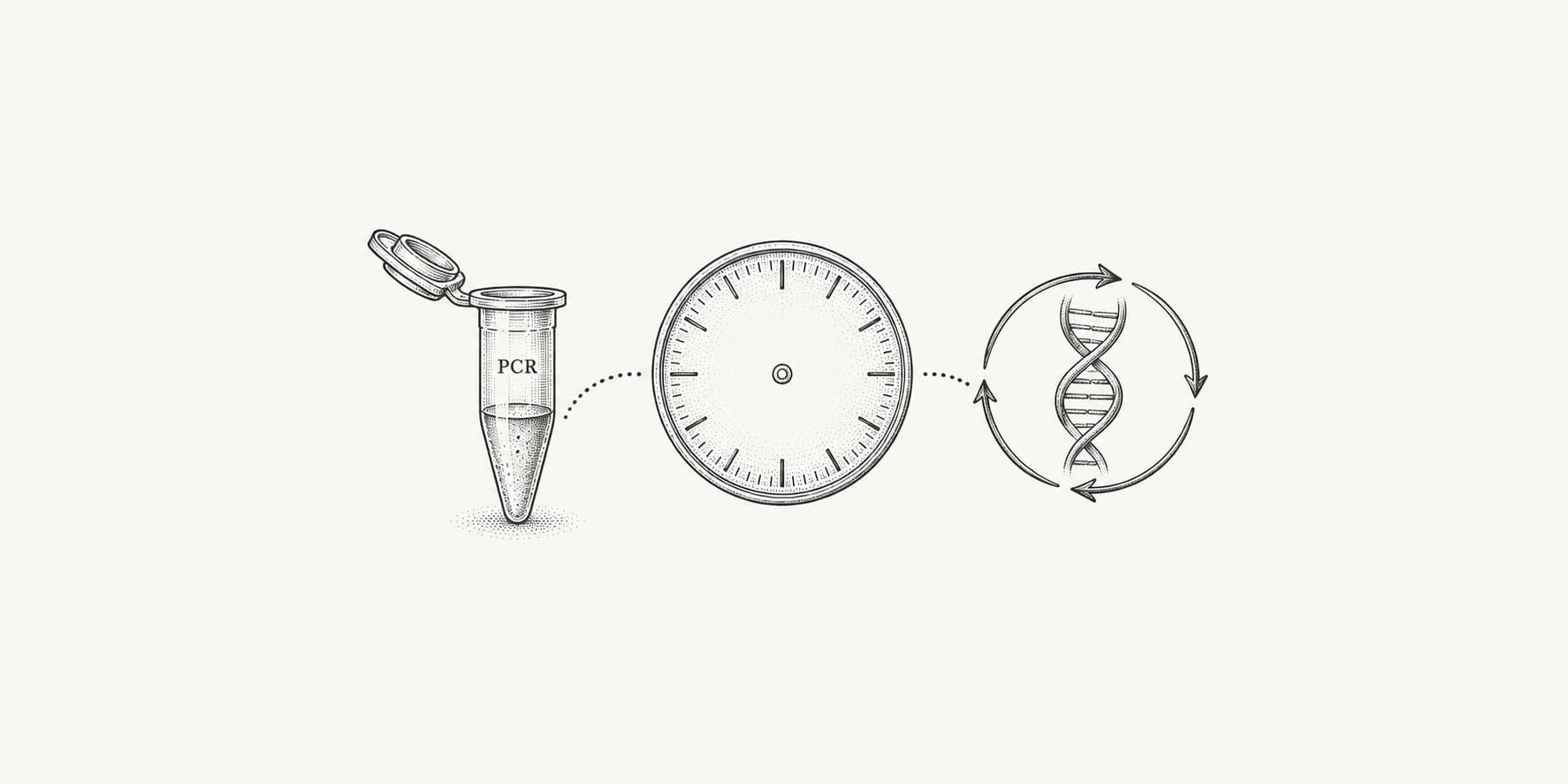
A PCR machine usually takes 45 minutes to 2 hours to amplify DNA. Fast protocols can finish sooner, while long targets and slower enzymes can keep a thermocycler running for several hours.
That is machine time, not the full laboratory workflow. Preparing the reaction, extracting nucleic acid, and checking an endpoint PCR product on a gel all add time.
How long does a PCR reaction take?
Most modern PCR reactions finish thermal cycling in about 45 minutes to 2 hours, while conventional protocols can take a few hours.[1][2]
The broad range comes from the protocol and instrument. A thermocycler must repeatedly heat and cool the sample, then hold it at temperatures for denaturation, primer annealing, and DNA extension. A 40-cycle experiment reported in the literature took about 45 to 60 minutes depending on the instrument and conditions.[2]
The result may not be ready when the machine stops. Conventional endpoint PCR often needs gel electrophoresis or another downstream check. Clinical turnaround can be longer still because transport, accessioning, nucleic-acid extraction, batching, review, and reporting happen outside the PCR run.
What determines how long a PCR machine takes?
PCR run time is set mainly by the number of cycles, the duration of each temperature step, the length of the target, and the thermocycler's heating and cooling speed.
Target length matters because the polymerase needs time to copy each DNA strand. New England Biolabs recommends about 15 to 30 seconds per 1,000 base pairs for Q5 and Phusion polymerases, compared with 1 minute per 1,000 base pairs for OneTaq, Vent, and Deep Vent.[3] Primer annealing temperature also changes the program, so Primer3 and an oligo analysis are useful before the run rather than after a slow, failed reaction.
The chart sums the programmed holds in three official 1-kilobase protocols. Q5 or Phusion takes 22.2 minutes, Vent or Deep Vent takes 43 minutes, and OneTaq takes at least 50.5 minutes when its shortest recommended annealing hold is used.[3] These are calculated minima, not measured run times: 0.5 minutes of initial denaturation, every cycle hold, and 5 minutes of final extension are included; temperature ramping and the indefinite 4–10°C hold are excluded.
High GC content, secondary structure, or a long amplicon may require longer holds or protocol optimization. A fast machine cannot compensate for conditions that do not amplify the intended target.
How long do qPCR and RT-PCR take?
A 40-cycle qPCR run commonly takes about 1 hour, although the protocol and machine can move the total below or above that figure. QIAGEN reports about 60 minutes for 40 cycles on its Rotor-Gene Q.[4]
Quantitative PCR, or qPCR, measures fluorescence during cycling. Data acquisition and an optional melt curve can add time, but qPCR usually avoids the post-run gel needed to inspect conventional endpoint PCR.
Reverse-transcription qPCR, written RT-qPCR, adds a step that converts RNA to complementary DNA. A current Thermo Fisher protocol specifies 5 to 15 minutes for reverse transcription, 2 minutes for activation, then 40 to 45 cycles with 5 seconds of denaturation and 15 to 60 seconds of annealing and extension.[5] In a one-step assay, those stages run in the same tube. A two-step workflow performs reverse transcription separately and therefore takes longer at the bench.
The abbreviations are easy to confuse. The MIQE reporting guidelines use qPCR for quantitative real-time PCR and RT-qPCR for reverse-transcription qPCR.[8]
How many PCR cycles are needed?
Most conventional PCR protocols use 25 to 35 cycles; qPCR and low-copy targets often use about 40 cycles.[3][6]
More starting template generally requires fewer cycles. QIAGEN's guidance ranges from 25 to 35 cycles for more than 50,000 single-copy targets to 40 to 45 cycles for only 10 to 100 targets.[6]
Under ideal doubling, one starting DNA molecule would produce about 33.6 million copies after 25 cycles, 1.07 billion after 30, and 34.4 billion after 35. These values are calculated as 2cycles. Real reactions produce fewer copies because amplification efficiency declines and eventually reaches a plateau.[1]
Adding cycles is not a free way to rescue a weak assay. A peer-reviewed PCR protocol notes that going beyond 35 cycles can enrich unwanted secondary products.[7] Template quantity, primer specificity, polymerase choice, and the intended detection method should determine the cycle count. For typical PCR input ranges, see how much DNA is needed.