How much does it cost to sequence a genome?
A research-grade 30x human genome can cost about $200. Consumer whole-genome tests are about $550 to $600, while clinical interpretation can raise the full cost into the thousands.
Sequencing a human genome now costs about $200 for a research-grade service and roughly $550 to $600 for a consumer test. A clinical genome can cost several thousand once medical interpretation and reporting are included.
There is no universal price because “genome sequencing” can describe very different products. Coverage, read technology, sample preparation, analysis, and whether the result is for research or diagnosis all change the bill.
How much does it cost to sequence a human genome?
As of July 2026, research-grade 30x human genome sequencing starts at about $200 per sample, current consumer 30x tests are listed at about $550 to $600, and published clinical microcosting estimates run into several thousand per genome.
| Setting | Listed cost | What the price covers |
|---|---|---|
| Research, 30x short reads | $199 | External rate at the University of Minnesota; sample QC, PCR-free library preparation, sequencing, data QC, and analysis |
| Consumer, 30x whole genome | $549 | Sequencing.com test kit with downloadable genome data and consumer analysis |
| Consumer, 30x whole genome | $595 sale price; $895 standard price | Nebula Pro test with reports and downloadable CRAM and VCF files |
| Clinical whole genome | About £2,114 to £4,423 per genome | Range in 2024 British pounds from published microcosting studies that included sequencing, bioinformatics, and clinical interpretation |
The research and consumer prices were listed by the providers on July 22, 2026. The clinical range comes from a 2026 systematic review, but its underlying microcosting studies used data no later than 2019, so it is evidence of the scale of a full diagnostic workflow rather than a current laboratory quote.[1][2][3][4]
The practical answer is therefore about $200 to $600 for non-diagnostic human whole-genome sequencing. A medically interpreted test is a different service and should not be compared with a research or consumer price on sequencing alone.
Why do genome sequencing prices differ?
Genome sequencing prices differ because the same label can refer to raw sequence production, a consumer report, or a clinical diagnostic process.
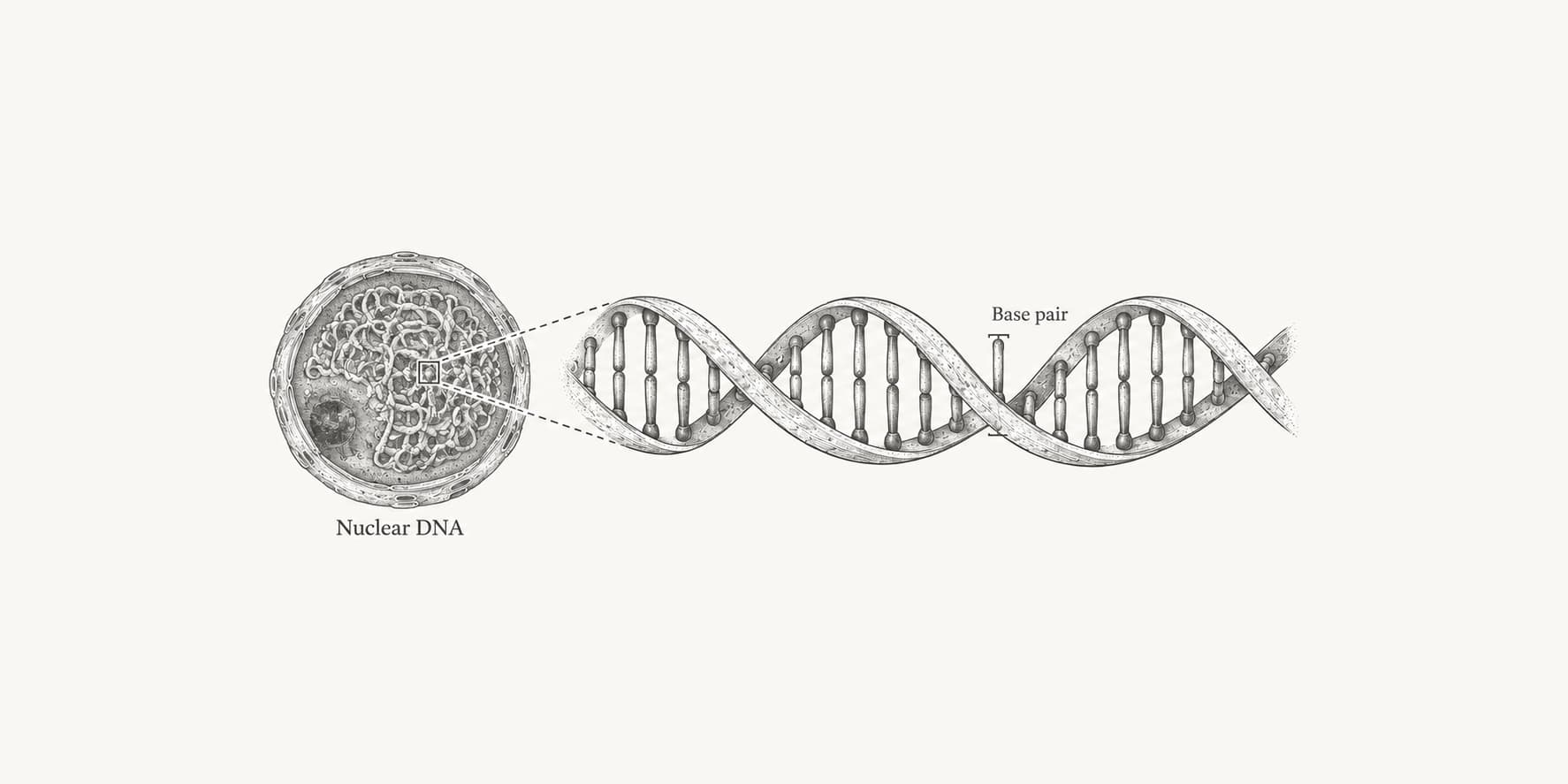
The first difference is coverage. A 30x genome reads each position about 30 times on average, producing far more data than low-pass sequencing at 1x or 2x. Higher coverage generally improves confidence, but it also uses more sequencing capacity. The human genome is about 3.1 billion base pairs, so every extra pass adds billions of bases.
Read length and purpose matter too. Short reads are efficient for finding many small variants against a reference genome. Long reads can resolve repeat-rich regions and structural variants more directly, but quoted costs are not always comparable. PacBio, for example, reports a $345 sequencing cost for a 20x human genome while explicitly excluding library preparation, instrument capital, labor, laboratory overhead, storage, and computing.[8]
The National Human Genome Research Institute's benchmark includes production labor, reagents, equipment, utilities, initial processing, and related indirect costs. It excludes project-specific quality control, downstream assembly and alignment, variant identification, interpretation, and management.[5] Those omitted steps are often the expensive part of a clinical test.
Raw reads also differ from usable findings. They normally arrive as FASTQ files, which retain a quality score for every called base. Converting FASTQ to FASTA removes those scores for workflows that only need sequence letters, but neither file answers a medical question without further analysis.
For nonhuman species, genome size and the availability of a reference are major cost drivers. Resequencing a person against an established human reference is easier than assembling a new genome from scratch. This is especially important for organisms among the largest known genomes, which can be dozens of times larger than the human genome.[5][7]
How much has the cost of genome sequencing fallen?
On the NHGRI's comparable production benchmark, the cost of sequencing a human-sized genome fell from about $95.3 million in 2001 to $525 in 2022, a decline of more than 180,000-fold.[5]
The chart uses annual values published by Our World in Data from the NHGRI sequencing-cost series. Its logarithmic axis is necessary because the values span more than five orders of magnitude.[5][6]
The sharpest break came after sequencing centers moved from Sanger sequencing to next-generation platforms around 2008. NHGRI notes that the decline then began to outpace the Moore's Law benchmark commonly used for computing progress.[5]
The first human reference sequence is a different comparison. NHGRI estimates that the initial draft cost about $300 million, while mapping, finishing, and related sequencing work put the first reference at roughly $500 million to $1 billion. The full U.S. Human Genome Project cost about $2.7 billion because it also funded technology development, genome mapping, model organisms, ethics research, and program management.[7]
Modern services produce a person's draft genome by comparing reads with an existing reference. They do not repeat the work of building the first reference from scratch. That is why today's cost and the Human Genome Project's budget are not like-for-like numbers. The related sequencing timeline has contracted just as dramatically, from years to hours or days for data generation.