How PepGate narrowed 30 peptides to one lead
ProteinIQ stability screening helped researchers compare AI-designed ACE inhibitors before biochemical and animal testing.
- Authors
- Wanhao Sun, Xihe Yang, Xin Huang, Neng Xiong, et al.
- Published in
- Journal of Medicinal Chemistry · 2026-08 · Zhejiang University
- ProteinIQ in this study
- ProteinIQ scored the predicted stability of 30 de novo ACE inhibitory peptide candidates.
- Tools used
- Protein Stability
PepGate could generate new peptide sequences. The harder question was which ones deserved to leave the computer and enter the laboratory.
Researchers at Zhejiang University used ProteinIQ stability screening as one part of the answer. Their selection pipeline reduced a large set of AI-designed ACE inhibitors to 30 candidates, then carried the strongest prospects through docking, biochemical assays, simulated digestion, and animal studies.
At a glance
| Candidates screened | Highest stability score | Best ACE docking pose | Acute SBP reduction |
|---|---|---|---|
| 30 | 86.2 | -11.4 kcal/mol | 48 mmHg |
From generation to a testable shortlist
Short peptides that inhibit angiotensin-converting enzyme, or ACE, could provide new routes to controlling high blood pressure. Discovery has traditionally depended on extracting peptides from natural proteins and testing them one by one, which restricts the sequences researchers can explore.
The Zhejiang team built PepGate to design ACE inhibitory peptides from scratch. Its short-peptide language model and discrete diffusion generator could search beyond known natural sequences, while two classifiers predicted whether generated peptides were likely to inhibit ACE and estimated their IC50 values.
Generation solved only half the problem. A peptide can look active in a prediction and still be a poor candidate if it is unstable, toxic, insoluble, or quickly degraded. PepGate therefore needed a way to compare biological promise with practical developability before the team committed to synthesis and testing.
The researchers evaluated 30 shortlisted peptides for predicted activity, toxicity, half-life, hydrophobicity, solubility, allergenicity, and docking energy. In the methods, they state that "ProteinIQ (https://proteiniq.io) was employed to predict peptide stability."
Protein Stability assigned a score to each candidate. The reported values ranged from 40.2 to 86.2. MIW and YIPVPF shared the highest score, 86.2. This was a screening result, not proof that either peptide would survive digestion or remain active in an animal. Those questions still required experiments.
YIPVPF paired its 86.2 stability score with a predicted IC50 of 3.8 micromolar and a predicted half-life of 269.264 minutes. The supplement also reports that it was soluble in ultrapure water, phosphate-buffered saline, and DMSO. Its lowest-energy ACE docking pose was -11.4 kcal/mol, the most favorable value reported among the 30 candidates.
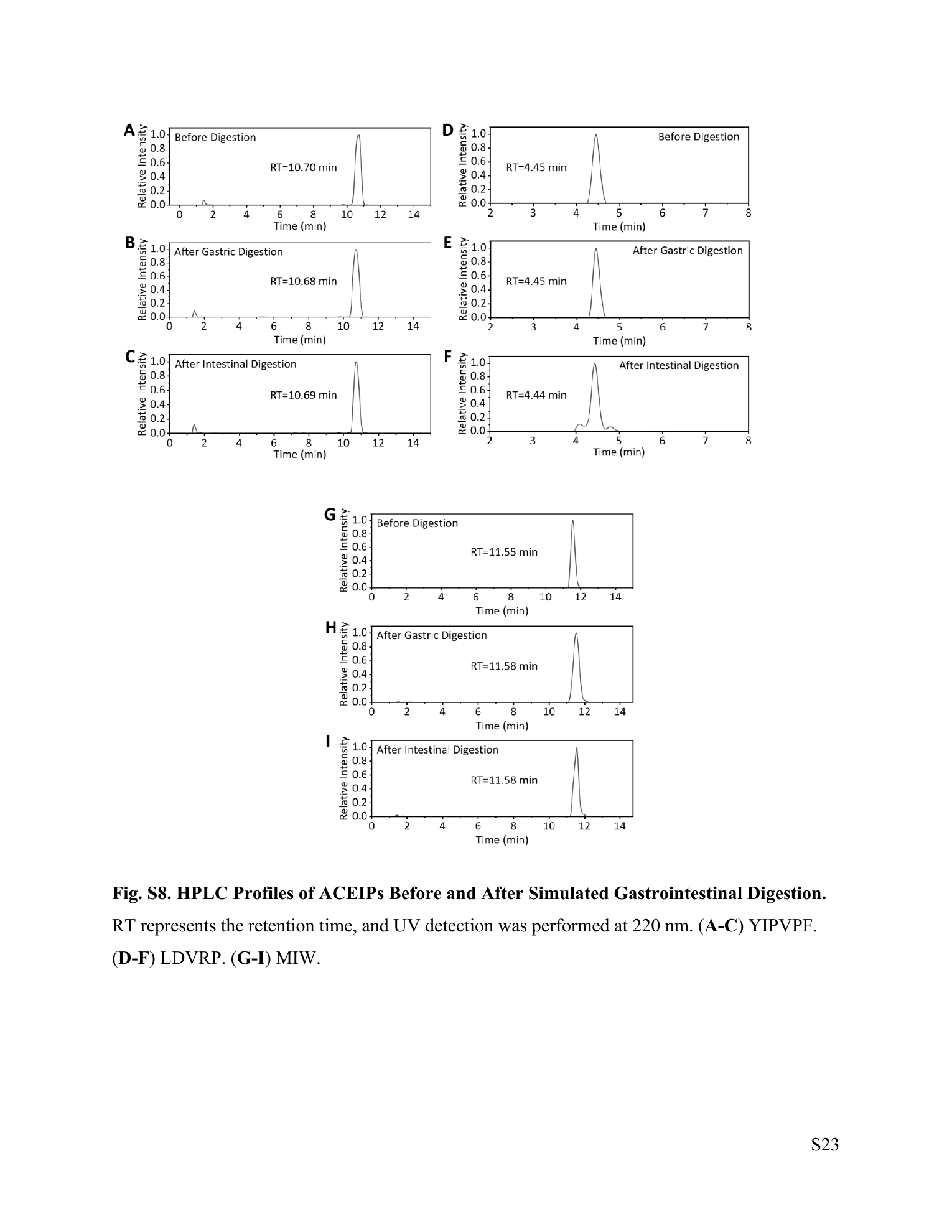
No single number selected the lead. YIPVPF stood out because stability, activity, solubility, half-life, and docking all pointed in the same direction. The researchers then examined the peptide in ACE inhibition assays and simulated gastric and intestinal digestion instead of treating the computational ranking as the conclusion.
From prediction to blood-pressure reduction
Across the full shortlist, PepGate reported a median IC50 of 4.79 micromolar. Enzyme kinetics for YIPVPF produced a Ki of 1.62 mM, and further computational analysis suggested possible activity across several blood-pressure-related targets beyond ACE.
The strongest evidence came from spontaneously hypertensive rats. YIPVPF reduced systolic blood pressure by 48 mmHg after acute administration and by 43 mmHg during chronic testing. ProteinIQ was one bounded step in that path: it helped compare the stability of generated sequences before the paper tested whether the selected peptide worked in biological systems.