How many SNPs are in the human genome?
A typical person has about 5 million single-nucleotide variants, while roughly 10 million SNP sites are common in the human population. dbSNP contains far more records because it combines variants found across many studies.
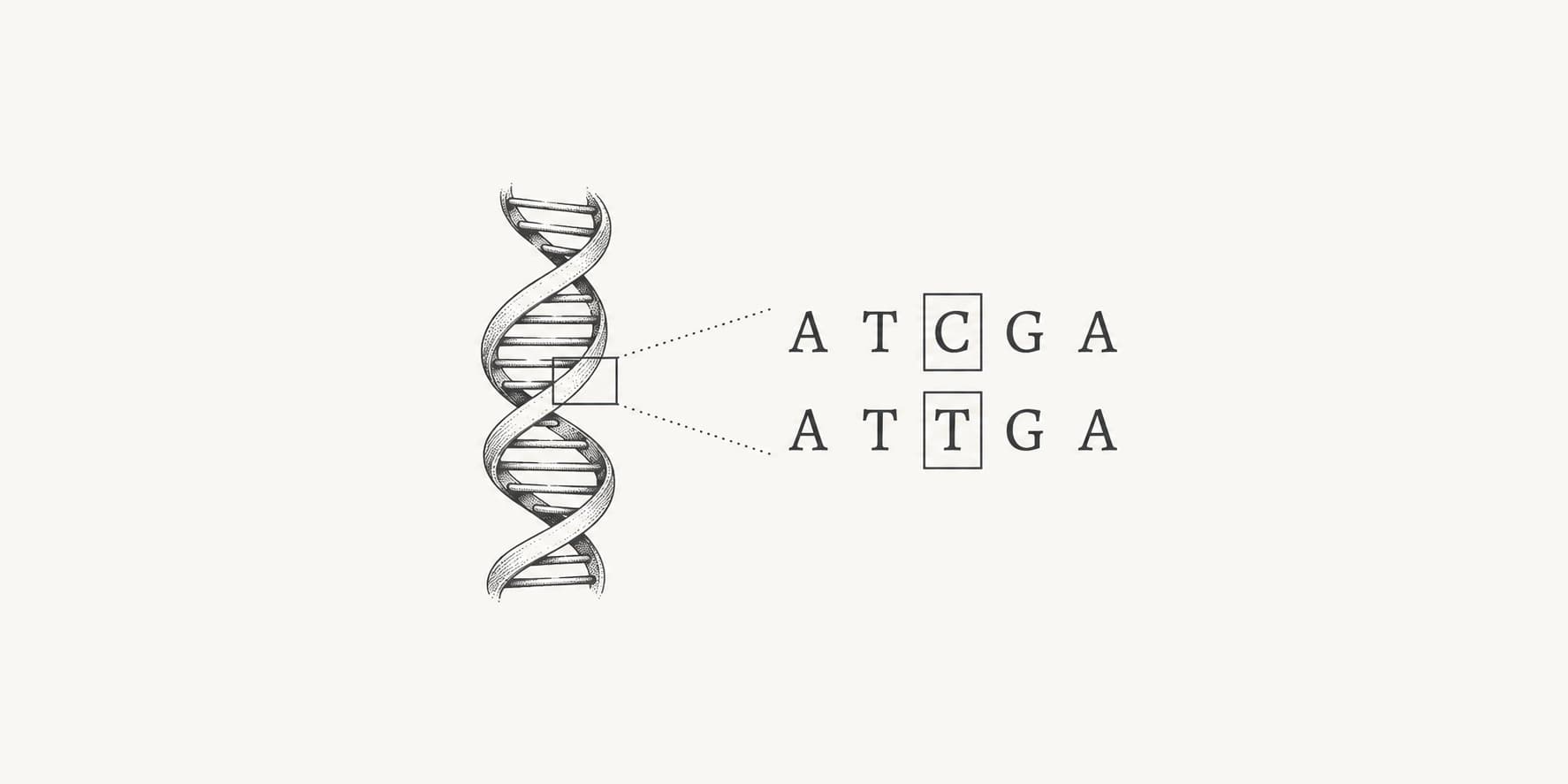
A typical person has about 5 million single-nucleotide variants compared with a reference genome. Under the traditional definition, roughly 10 million single-nucleotide polymorphism sites are common across the human population.
Those are different counts. The first describes one person; the second combines common variation across many people. dbSNP Build 157 contains 1.172 billion live reference records because it collects rare as well as common variants from many studies.
How many SNPs are in the human genome?
A typical human genome contains about 5 million single-nucleotide variants relative to a reference, but only a subset meet the strict population-frequency definition of a SNP.[1]
The National Human Genome Research Institute estimates about 5 million single-nucleotide variants, 600,000 small insertions or deletions, and 25,000 structural variants in a person's diploid genome. The count is based on comparison with a reference, which represents one chromosome set rather than both copies carried by a person.[1]
The 1000 Genomes Project reached a similar scale. Across 2,504 people from 26 populations, an individual genome differed from the reference at 4.1 million to 5.0 million sites. More than 99.9% of those variant sites were SNPs or short indels.[2]
The exact number varies with ancestry, the reference assembly, sequencing technology, and the rules used for variant calling. The human genome contains about 3.1 billion base pairs per chromosome set, so a few million single-base differences still leave human genomes overwhelmingly alike.
How many heterozygous SNPs does one person have?
A person commonly has roughly 2 million to 3 million heterozygous single-nucleotide variants, meaning the two chromosome copies carry different bases at those positions.
In the Genome in a Bottle sample HG002, a 2025 analysis found 3,956,307 single-nucleotide variants and a heterozygous-to-homozygous ratio of 1.56. Those reported values imply about 2.41 million heterozygous and 1.55 million homozygous non-reference SNVs.[3]
An earlier diversity survey estimated one heterozygous position per 1,331 bases when comparing two chromosomes. Applied to a 3.1-billion-base haploid genome, that rate gives about 2.3 million heterozygous positions.[8]
This is a calculation from one well-studied genome, not a fixed human constant. Counts differ among people, and genomes with more African ancestry generally contain more variant sites relative to the standard reference because human genetic diversity is greatest in African populations.[2]
A heterozygous site compares the two chromosome copies within one person. A homozygous non-reference site has the same alternative base on both copies. Both can appear in a variant call file, while a pairwise genome comparison with MUMmer4 can identify sequence differences without determining how frequent they are in a population.
Why does dbSNP contain more than a billion records?
dbSNP Build 157 contains 1,172,689,405 live Reference SNP records and 4,849,775,973 submitted records, far more than the number of variants in any one person.[4]
A submitted record, identified by an ss number, represents a study's submission. NCBI merges submissions that describe the same mapped variant into a non-redundant Reference SNP cluster with an rs number. This is why the submitted-record total is about four times the reference-record total.
Despite its name, dbSNP is not limited to common SNPs. Its reference clusters can represent single-nucleotide variants, multi-nucleotide variants, insertions, deletions, and small indels. The database also includes rare variants, so the Build 157 total should not be described as 1.172 billion common SNPs.[5]
The classic estimate is about 10 million common SNP sites when “common” means that both alleles occur in at least 1% of the population.[6] The exact count depends on the frequency cutoff and the populations sampled. In the 1000 Genomes dataset, about 8 million variants had a global frequency above 5%, while the project catalogued 84.7 million SNP sites across all frequency levels.[2]
The chart compares reported counts with different scopes: a rounded per-person SNV estimate, the HapMap estimate for SNPs with at least 1% frequency, all SNP sites found by the 1000 Genomes Project, and all live dbSNP Build 157 reference records.[1][2][4][6]
Are SNPs the same as mutations?
A SNP is a single-base variant observed in a population; a mutation is the biological event that created a DNA change. The terms describe related ideas, but they are not interchangeable.
The National Human Genome Research Institute reserves “SNP” for a single-nucleotide variant present in at least 1% of a population. Under that rule, a rare one-base change is an SNV but not a SNP.[1] Population choice matters: the same variant can be common in one ancestry group and rare in another.
“Mutation” can refer to the event that changes DNA or to the resulting sequence change. It does not say how large the change is, how common it is, or whether it affects health. The Human Genome Variation Society therefore recommends neutral terms such as “variant” or “sequence variant” when pathogenicity and origin are not established.[7]
Most inherited variants are not known to cause disease. When a single-base change falls in regulatory DNA, AlphaGenome can estimate its effects on molecular signals, but a computational prediction does not by itself establish that the variant is pathogenic.