AI now appears in regulatory submissions, public trial registries, structural biology databases, screening benchmarks, and peer-reviewed clinical reports. The numbers show real adoption, but they do not yet prove that AI has broadly improved late-stage clinical success.
This article keeps "AI in drug development" separate from "AI-discovered drugs." A submission that uses AI for imaging, dose selection, manufacturing, or real-world-data analysis is not the same as a medicine whose target or molecule was discovered by AI. That distinction also matters when comparing AI claims with broader drug discovery trends.
FDA and regulatory statistics
FDA's clearest public adoption metric is over 500 submissions with AI components from 2016 to 2023. Those submissions can involve discovery, nonclinical work, clinical development, manufacturing, or postmarket safety, so they should not be read as a count of AI-discovered drugs.[1]
Sponsors now include AI-derived evidence in formal drug-development packages rather than limiting it to internal research.
- FDA said CDER's 2025 AI guidance was informed by over 500 submissions with AI components from 2016 to 2023.[1]
- FDA said the same guidance was informed by more than 800 external comments on the May 2023 AI discussion paper.[1][2]
- FDA's 2016-2021 CDER analysis found 1 AI/ML-related submission in 2016, 1 in 2017, and 132 in 2021. The 2021 count was about 10 times the 2020 count.[3]
- FDA says AI-related drug submissions span 4 broad lifecycle phases: nonclinical, clinical, postmarketing, and manufacturing.[1]
- FDA established the CDER AI Council in 2024 to coordinate CDER's internal and external AI-related activities.[1]
- FDA described its January 2025 AI document as the agency's first guidance on using AI to support regulatory decisions about drug or biological product safety, effectiveness, or quality.[2]
Clinical-stage AI drug statistics
A 2024 Drug Discovery Today analysis counted 75 AI-discovered molecules that had entered clinical trials since 2015, including 67 still in ongoing trials as of 2023. These are early clinical pipeline numbers, not approval numbers.[4]
Most clinical evidence remains early-stage. The same analysis reported stronger Phase 1 outcomes than historical drug-development averages, but Phase 2 and Phase 3 remain harder tests, as broader clinical-trial failure rates show.
- The 2024 analysis reported an 80-90% Phase 1 success rate for AI-discovered molecules. Using the paper's counts, 21 successful Phase 1 completions divided by 24 completed Phase 1 trials equals 87.5%.[4]
- The same analysis reported a 40% Phase 2 success rate, calculated from 4 successful Phase 2 completions divided by 10 completed Phase 2 trials.[4]
- A 2025 Nature Medicine paper stated that, as of its publication, no AI-discovered or AI-designed drug had progressed through Phase 3.[5]
- ClinicalTrials.gov returned 239 drug or biological studies matching "artificial intelligence" or "machine learning" on July 1, 2026. This is a keyword registry count, not a curated count of AI-discovered medicines.[6]
- ClinicalTrials.gov returned 127 active drug or biological studies matching the same AI/ML query and recruiting, not-yet-recruiting, or active-not-recruiting statuses on July 1, 2026.[7]
- Rentosertib's Phase 2a IPF trial randomized 71 patients for 12 weeks across 30 mg once daily, 30 mg twice daily, 60 mg once daily, and placebo arms.[5]
- In that trial, the 60 mg once-daily arm had a mean forced vital capacity change of +98.4 mL after 12 weeks, compared with -20.3 mL in the placebo group.[5]
- ClinicalTrials.gov lists NCT05938920 as a Phase 2 completed study with 71 actual participants, a June 19, 2023 start date, and an August 8, 2024 completion date.[8]
Whether those gains reduce total costs at approval scale remains unproven. AI can shorten target discovery, molecule generation, and triage, but clinical testing, failures, capital costs, and manufacturing after early discovery dominate drug development cost.
Data infrastructure behind AI discovery
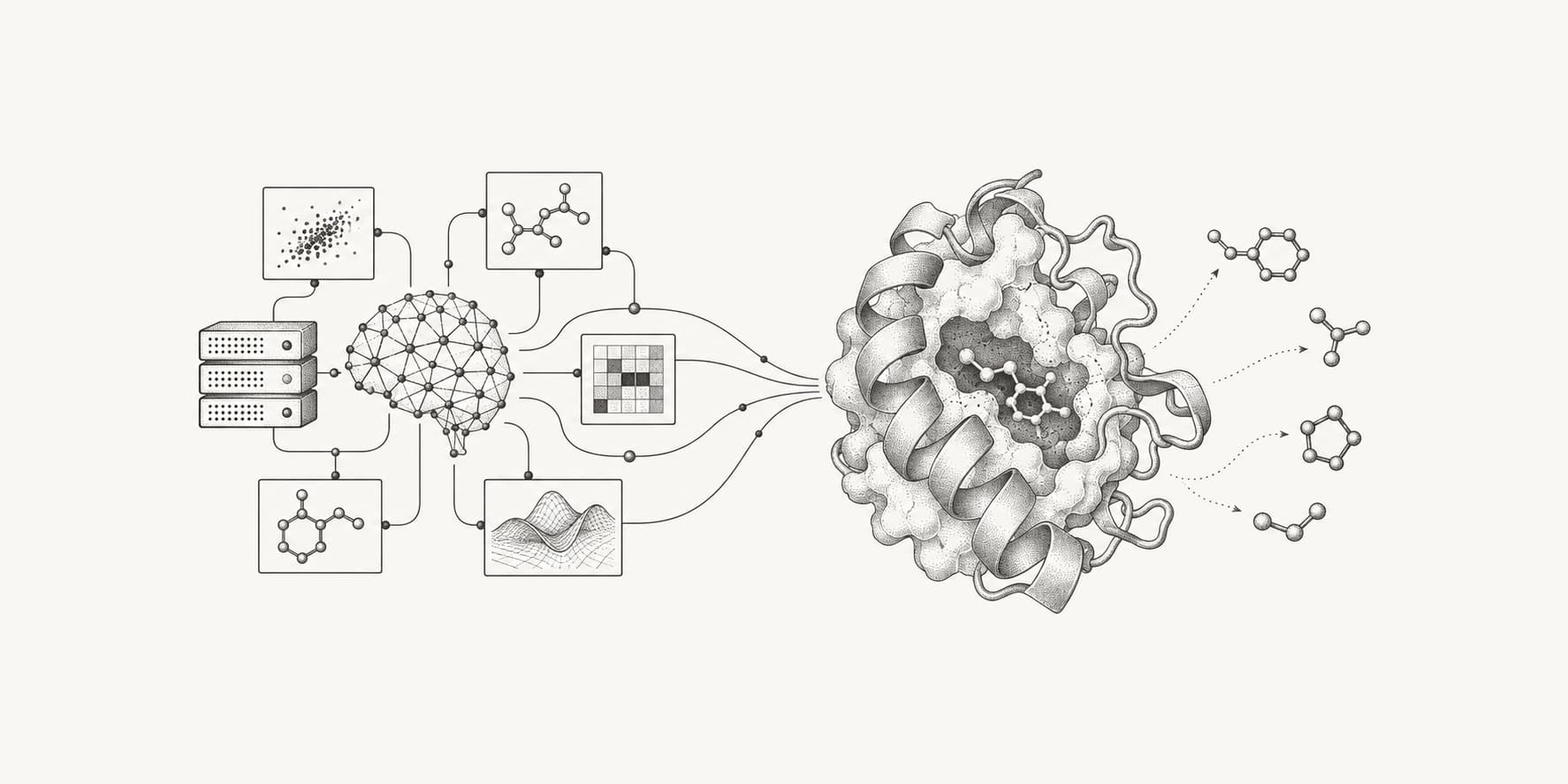
AI drug discovery draws on datasets with 241,070,489 predicted protein structures in AlphaFold DB v6, plus hundreds of millions of chemical records and tens of millions of measured bioactivities. The available chemical space, biological annotations, and validation data constrain what these systems can learn and search.[13]
The database numbers below are dated snapshots. PubChem, ChEMBL, AlphaFold DB, and trial registries change as records are added, retired, or reclassified.
- PubChem returned 123,929,509 compound records through NCBI E-utilities on July 1, 2026.[9]
- PubChem returned 347,057,467 substance records through NCBI E-utilities on July 1, 2026.[10]
- PubChem returned 1,884,783 BioAssay records through NCBI E-utilities on July 1, 2026.[11]
- ChEMBL_37, released on May 1, 2026, listed 2,921,148 distinct compounds, 24,527,044 activities, and 18,552 targets in the ChEMBL status API on July 1, 2026.[12]
- AlphaFold DB v6 contains 241,070,489 predicted protein structures, including 40,054 isoforms, in the October 21, 2025 release synced to UniProt 2025_03.[13]
- AlphaFold DB v6 added 65,711,653 proteins, removed 39,324,993, changed 276,539, and carried forward 175,082,297 unchanged entries relative to v4.[13]
- In March 2026, the AlphaFold complex-structure collaboration said it had calculated predictions for 30 million complexes, added 1.7 million high-confidence homodimers to AlphaFold DB, and made 18 million lower-confidence homodimers available for bulk download.[14]
- In a May 19, 2026 update, EMBL said AlphaFold DB had added almost 80,000 high-confidence heterodimer predictions and made 8.1 million lower-confidence heterodimer predictions available for bulk download.[14]
- Google DeepMind reported in November 2025 that the AlphaFold Protein Database had been used by over 3 million researchers in more than 190 countries, including over 1 million users in low- and middle-income countries.[15]
- Google DeepMind reported in November 2025 that AlphaFold Server had produced more than 8 million folds for thousands of researchers worldwide.[15]
These structure and sequence resources complement broader AlphaFold statistics and PDB statistics. Predicted structures can support protein design and structure-based screening, but downstream biology still requires experimental validation.
Virtual screening and ADMET benchmarks
A 2024 Scientific Reports study evaluated AtomNet across 318 virtual high-throughput screening projects, making it one of the clearest large-scale public benchmarks for AI-assisted hit finding before clinical trials. Hit rates and validation rates are useful discovery metrics, but they are not the same as patient benefit.[16]
In small-molecule discovery, screening and ADMET models help rank compounds before synthesis or wet-lab testing.
- The AtomNet study covered 318 projects, including 22 internal targets and 296 academic targets.[16]
- In the 22 internal AtomNet projects, the average dose-response hit rate was 6.7%, compared with 8.8% from single-dose screens.[16]
- In the 296 academic AtomNet projects, the model identified at least one bioactive compound in 215 projects, a reported 73% success rate. The calculation is 215 divided by 296, or 72.6% before rounding.[16]
- The same academic screen physically tested an average of 85 compounds per project, discovered 4.6 active hits per project, and reported an average hit rate of 5.5%.[16]
- For 207 of 296 academic targets, or 70%, AtomNet training data lacked an active molecule for the target or a closely related protein. Those targets still produced a 5.3% average hit rate.[16]
- AtomNet dose-response validation covered 49 AIMS projects and validated at least one single-dose hit in 84% of experiments, with a median activity of 15.4 uM and 13% of measurements below 1 uM.[16]
- ADMET-AI was trained on 41 ADMET datasets from Therapeutics Data Commons and ranked first on average across the TDC ADMET leaderboard described in the 2024 Bioinformatics paper.[17]
- ADMET-AI predicted 1 million molecules in 3.1 hours locally and was 45% faster than the next fastest public ADMET web server in the 2024 Bioinformatics comparison.[17]
Methodology and citation
Live API counts were checked on July 1, 2026. This article combines regulator pages, peer-reviewed papers, ClinicalTrials.gov API queries, NCBI E-utilities counts, and EMBL-EBI database APIs.
Calculated values are labeled where they appear. The 87.5% Phase 1 calculation divides 21 successful AI-discovered molecules by 24 completed Phase 1 trials. The 40% Phase 2 calculation divides 4 successful AI-discovered molecules by 10 completed Phase 2 trials. The 72.6% AtomNet academic-screening calculation divides 215 successful target projects by 296 academic projects.
Treat these figures as dated snapshots because live database counts and clinical-trial registry queries can change.
ProteinIQ. "AI drug discovery statistics [2026]." Updated July 1, 2026. Accessed [your access date]. https://proteiniq.io/guides/ai-drug-discovery-statistics