RFdiffusion3
All-atom generative diffusion for designing binders, enzymes, and symmetric protein assemblies
What is RFdiffusion3?
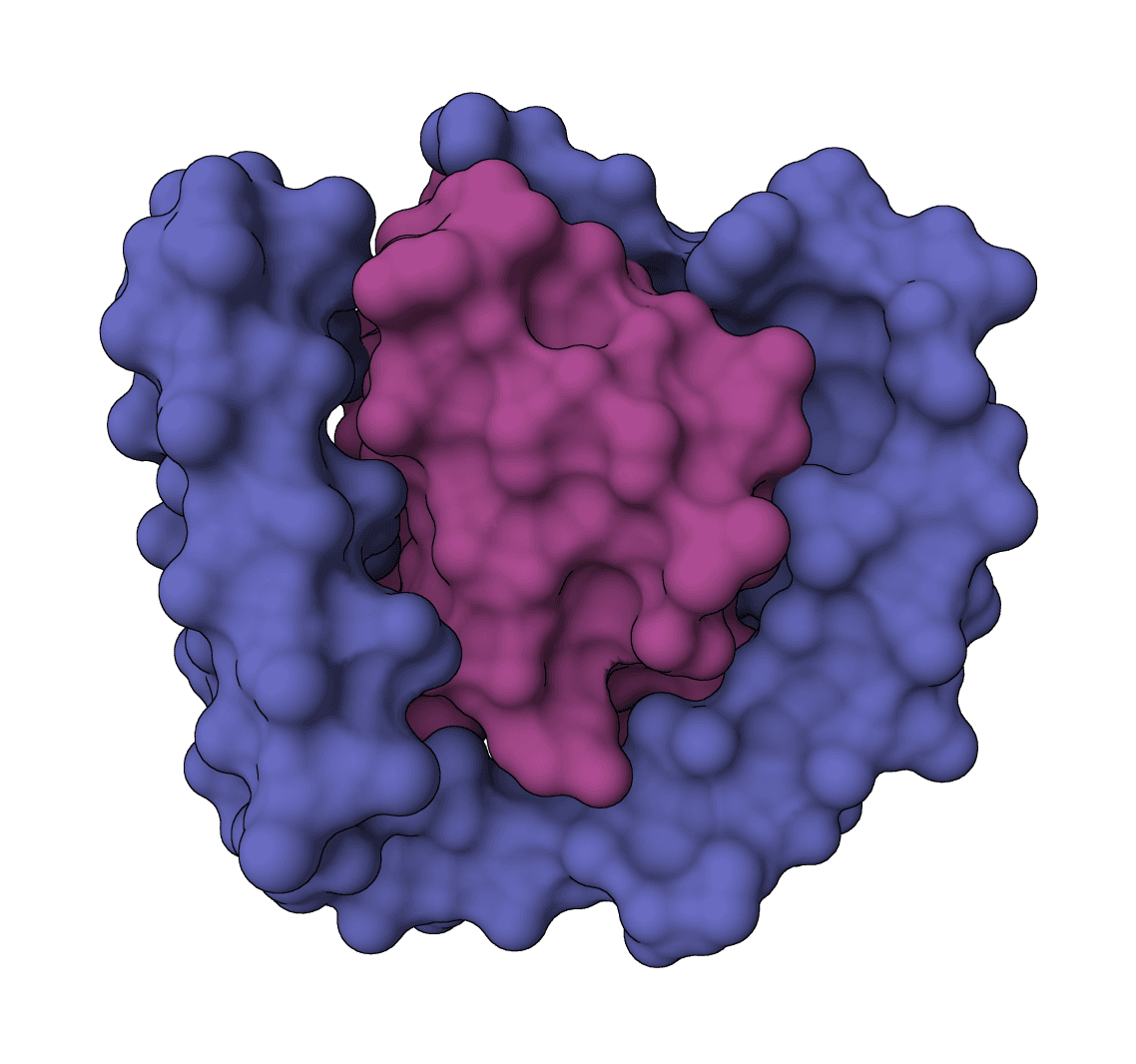
RFdiffusion3 (RFD3) is a generative diffusion model for de novo protein design. Unlike structure prediction tools that fold existing sequences, RFD3 creates entirely new protein backbones through an iterative denoising process. The model can generate proteins from scratch or design new chains that interact with specified targets.
RFD3 extends the original RFdiffusion architecture with all-atom capabilities, enabling design tasks involving small molecules, metals, and other non-protein components. The model learns to reverse a diffusion process that gradually adds noise to protein structures, generating novel backbones that satisfy specified constraints.
For sequence design after generating backbones, pair RFD3 with LigandMPNN to optimize amino acid sequences. To validate designed structures, use RosettaFold3 or Boltz-2 for structure prediction.
How does RFdiffusion3 work?
Diffusion process
RFD3 operates on a diffusion framework where protein structures are progressively corrupted with Gaussian noise during training. At inference time, the model reverses this process:
- Initialization: Start from random coordinates (pure noise)
- Denoising: Iteratively predict and remove noise at each timestep
- Refinement: Final coordinates converge to a valid protein backbone
The number of diffusion steps controls the quality-speed tradeoff. More steps (100-200) produce higher quality structures but take longer, while fewer steps (10-50) enable rapid prototyping.
Constraint satisfaction
RFD3 can incorporate various constraints during generation:
Structural constraints: Fix specific residue positions from a template structure while designing new regions around them. The contig specification language allows precise control over which regions are fixed versus designed.
Hotspot targeting: For binder design, specify which target residue atoms should be contacted by the designed protein. The model orients the new chain to maximize interactions with these hotspots.
Length constraints: Control the size of designed proteins or protein regions using length ranges. The model samples within the specified range during generation.
Inputs and settings
Target structure (optional)
Provide a target protein structure for constrained design tasks like binder design. Upload a PDB/CIF file or fetch directly from RCSB using a PDB ID (e.g., 4ZXB). The target structure defines the binding interface for binder design or provides structural motifs for scaffolding tasks.
For unconditional generation (creating proteins from scratch), leave this empty and RFD3 will generate novel folds based solely on the specified length.
Design task
Select the type of protein design:
- Binder Design: Design a new protein that binds to the target structure. Requires a target structure input.
- Enzyme Design: Design proteins with functional active sites. Often combined with hotspot specification.
- Symmetric Assembly: Generate proteins with internal symmetry (homo-oligomers).
- Unconditional Generation: Create novel protein folds without any structural constraints.
Number of designs
Generate multiple independent designs (1-50) in a single job. Each design samples a different trajectory through the diffusion process, producing structural diversity. More designs increase the chance of finding high-quality candidates but require more computation time.
Diffusion steps
Controls the number of denoising iterations (10-200). Higher values produce more refined structures:
| Steps | Use Case |
|---|---|
| 10-20 | Quick prototyping, initial exploration |
| 50 | Standard quality (default) |
| 100-200 | High-quality final designs |
Design length range
Specify the length of designed protein regions as a range (e.g., 50-100). The model samples within this range during generation. For binder design, this controls the size of the designed binder chain.
Advanced options
Custom contig
The contig specification provides fine-grained control over the design:
Format: new_chain_length,/0,target_chain_residues
Examples:
50-100,/0,A1-95- Design 50-100 residue binder for chain A residues 1-9540-80,/0,B10-150- Design binder for chain B residues 10-150100- Generate 100-residue protein unconditionally
The /0 separator indicates a chain break between the designed region and the fixed target.
Hotspot residues
Target specific atoms on the target protein for binder design. This focuses the designed interface on functionally important residues.
Format: JSON object mapping residue IDs to atom names
{
  "A64": "CD2,CZ",
  "A88": "CG,CZ",
  "A96": "CD1,CZ"
}
Residue ID format: ChainResidueNumber (e.g., A64 = chain A, residue 64)
Common atom names:
- Backbone:
N,CA,C,O - Aromatic:
CD1,CD2,CE1,CE2,CZ - Aliphatic:
CB,CG,CD - Charged:
NZ(Lys),OD1/OD2(Asp),OE1/OE2(Glu)
Hotspot selection dramatically improves binder design success rates by ensuring the designed protein contacts critical interface residues.
Orientation strategy
Controls how the designed chain is positioned relative to the target:
- Hotspot-based (default): Orient based on specified hotspot atoms. Recommended when hotspots are defined.
- Center of Mass: Orient based on the target's center of mass. Use when no specific hotspots are known.
Understanding the results
Output structures
Each design generates a PDB file containing the designed backbone coordinates. Files are named sequentially (e.g., design_0.pdb, design_1.pdb). The structures contain:
- Full backbone atoms (N, CA, C, O) for all residues
- Designed chain(s) with placeholder sequence (typically poly-glycine or poly-alanine)
- Target chain(s) if provided in the input
Interpreting designs
RFD3 outputs are backbone-only structures requiring sequence design:
- Visualize: Check that designs have reasonable topology and target contact
- Filter: Remove designs with obvious clashes or disconnected regions
- Sequence design: Use LigandMPNN to assign optimal amino acid sequences
- Validate: Predict structure with RosettaFold3 to verify foldability
Quality indicators
While RFD3 doesn't provide explicit confidence scores like folding tools, design quality can be assessed by:
- Compactness: Well-designed proteins have tightly packed cores
- Secondary structure: Presence of regular helices and sheets indicates valid topology
- Interface contacts: For binders, check that the designed chain contacts the target
- Sequence design scores: LigandMPNN confidence scores indicate designability
Use cases
RFD3 excels at:
- Therapeutic binders: Design proteins targeting disease-relevant receptors
- Enzyme scaffolds: Create new protein architectures for catalytic function
- Symmetric assemblies: Generate homo-oligomeric protein cages and rings
- Protein diversification: Explore the space of foldable proteins
Example workflow: Binder design
- Prepare target: Upload target protein structure (e.g., receptor extracellular domain)
- Identify hotspots: Select key interface residues from known binding data or structural analysis
- Configure: Set binder length (e.g., 50-100), specify hotspots, select "Binder Design" task
- Generate: Run RFD3 with 10-50 designs
- Design sequences: Use LigandMPNN on promising backbones
- Validate: Predict structures with RosettaFold3, filter by pLDDT
Limitations
- Backbone only: RFD3 generates backbones without sequences; requires separate sequence design
- No side chains: Output structures lack side chain atoms until sequence is assigned
- Computational cost: High-quality designs require significant GPU time
- Success rate varies: Not all designs will fold correctly; generate multiple candidates
- Limited small molecule support: While RFD3 has all-atom capabilities, complex ligand interactions may require specialized tools
Related tools
- LigandMPNN: Design sequences for RFD3-generated backbones
- RosettaFold3: Validate designed sequences by structure prediction
- Boltz-2: Alternative structure prediction with binding affinity estimation
- ProteinMPNN: Sequence design without ligand awareness
- ESMFold: Fast structure prediction for designed sequences
- ColabDock: Protein-protein docking for complex modeling
Based on: Watson JL, Juergens D, Bennett NR, et al. (2023). De novo design of protein structure and function with RFdiffusion. Nature. DOI: 10.1038/s41586-023-06415-8