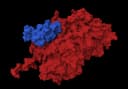
Flexible protein-protein docking with a multi-track iterative transformer.
Flexible protein-protein docking with a multi-track iterative transformer.
GeoDock predicts a protein–protein complex from two separate protein structures. ProteinIQ runs the Gray Lab release with its DIPS 0.3 checkpoint and offers the source tool’s OpenMM refinement method.
Upload one structure for each partner, or fetch each by its RCSB PDB ID.
| Input | Accepted structures | Limit |
|---|---|---|
| Receptor (first protein partner) | PDB, ENT, CIF, or mmCIF | 1000 protein residues |
| Ligand (second protein partner) | PDB, ENT, CIF, or mmCIF | 1000 protein residues |
The combined limit is 1200 protein residues. Both partners are proteins; the ligand slot is not for small molecules. For small-molecule docking, use GNINA.
GeoDock reads the first coordinate model and includes all protein chains in that model. Original input files remain available for download. Parsing, residue recognition, alternate-location selection, and missing-backbone handling follow the native tool. Missing backbone atoms are not repaired before prediction; prepare suitable structures for the biological question you want to test.
For PDB and ENT files, every ATOM and HETATM record in the first model needs an occupancy value in columns 55–60 and a B-factor value in columns 61–66. Blank values are rejected before the job is created or credits are charged. Export a complete PDB from your structure software or supply mmCIF.
If you have sequences rather than structures, predict the partners first with ESMFold or AlphaFold 2.
| Setting | Default | Meaning |
|---|---|---|
| Refinement | On | Refine the predicted complex and retain the unrefined prediction as a separate download. |
| Refinement method | OpenMM | Native OpenMM minimization. |
The collapsed Refinement options section contains the selected method’s controls:
| Method | Setting | Default | Meaning |
|---|---|---|---|
| OpenMM | Restraint stiffness | 10 kcal/mol/Ų | Position restraints on N, CA, C, and CB atoms. Zero disables their force. |
| OpenMM | Force tolerance | 2.39 kcal/mol/nm | Positive minimization convergence threshold, approximately 10 kJ/mol/nm. |
OpenMM uses PDBFixer, the amber14 ff14SB force field, hydrogen addition, and CPU minimization. Refinement can change atom content, coordinates, and PDB annotations; inspect both the prediction and the refined structure. Refinement may vary between runs and can take substantially longer than docking, particularly for large partners.
GeoDock returns one predicted complex. The Viewer displays structure files; Data shows confidence summaries; Files provides the original inputs, results, and provenance. Logs shows the scientific run record.
| File | Contents |
|---|---|
geodock_complex.pdb | Refined complex when refinement is on; otherwise the unrefined prediction. |
geodock_complex_unrefined.pdb | Prediction before refinement, returned when refinement is on. Native per-residue pLDDT values are in its B-factor column. |
receptor_input.*, ligand_input.* | Original partner files in their submitted formats. |
provenance.json | Source revision, compatibility patch, model and dependency identities, settings, and input hashes. |
run.log | Run status, protein residue counts, completed phases, settings, and confidence summary. |
Mean, minimum, and maximum pLDDT always describe the unrefined GeoDock prediction. They do not measure the quality of the refined coordinates. Use the unrefined PDB to inspect per-residue confidence: refinement can overwrite B-factors or change residue content.
The native pLDDT scale runs from 0 to 100. Higher values indicate higher model confidence, but a confident local structure does not establish that the proteins bind or that the interface is correct. Evaluate the interface against experimental evidence and other structural predictions.
The workflow output is the primary geodock_complex.pdb; reference structures, confidence-bearing raw output, provenance, and the Run log remain downloadable from the job.
GeoDock uses a multi-track iterative transformer to model residue features and pairwise geometry. The served checkpoint uses four recycling iterations. ProteinIQ preserves the native model output and optional refinement results rather than rebuilding their coordinates or scores.
For the method and its evaluation, see Flexible Protein–Protein Docking with a Multi-Track Iterative Transformer and the GeoDock source repository.

Structure-based protein-protein docking with AF2Dock flow-matching refinement

Dock protein-protein complexes with diffusion-based sampling and learned energy ranking.

Rigid protein-protein docking with a diffusion model and confidence ranking.

Dock rigid protein-protein complexes using SE(3)-equivariant geometric modeling.

Protein-protein docking guided by experimental restraints using AlphaFold2

Protein-protein, protein-peptide, and protein-DNA docking using Glowworm Swarm Optimization

Surface-based deep learning for paratope-antigen interaction prediction

All-atom protein-peptide docking with unranked samples.

Surface-informed diffusion generative model for reliable and accurate protein-ligand complex prediction

Predict protein-ligand binding poses and confidence scores without a predefined binding site.