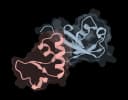
Structure-based protein-protein docking with AF2Dock flow-matching refinement
Structure-based protein-protein docking with AF2Dock flow-matching refinement
AF2Dock is a Gray Lab method for structure-based protein-protein docking. It adapts AlphaFold2-style co-folding to start from two protein structures, then refines receptor-ligand placement through flow matching and ranks sampled complexes with iPTM.
Use AF2Dock when you already have receptor and ligand structures and want a set of ranked complex models without manually defining interface restraints. The default hosted model uses the AF2Dock_base checkpoint.
Upload a receptor and a ligand protein structure in PDB or mmCIF format, or fetch them from the Protein Data Bank. The ligand is a protein docking partner. AF2Dock uses the first coordinate model and ignores heterogen-only residues. The hosted limits are 1,500 residues per partner and 2,200 residues combined.
The optional receptor and ligand A3M inputs map resolved residues to full sequences. For each structure chain A, provide >A_full for the full sequence and >A for the resolved-residue mapping, with gaps marking unresolved positions. Both records must have the same aligned length. If a header repeats, AF2Dock uses its final record.
Select Structures with native MSAs to supply unpaired and paired MMseqs-style A3M files. These are separate from residue mappings. Each file begins with a numeric query header such as >101; multi-query files may contain null-separated query blocks. Upload one file or up to 62 files per MSA input, each up to 10 MiB. Multiple files are passed as a directory with their contents preserved.
AF2Dock defaults to 40 samples and 10 flow-matching steps, with no merged steps, extra refinement steps, or input pLDDT filtering. An empty random seed lets AF2Dock choose a seed. Set a seed explicitly when comparing runs.
The model setting selects the official base checkpoint or the without-ESM and without-fine-tuning ablations. The without-ESM checkpoint also disables ESM embeddings. Changing checkpoints changes the model being evaluated.
Advanced users can provide a JSON object of flattened native configuration keys, for example {"data.predict.max_msa_clusters": 128}. AF2Dock applies these values through its configuration loader. They must be compatible with the selected checkpoint. DeepSpeed4Science attention and the long-sequence mode are unavailable in this hosted runtime.
Sampled complexes follow the native CSV order, ranked by descending iPTM. Downloads include predicted complexes, PDB files with original chain identifiers and residue numbering, confidence pickles, native CSV files, requested intermediate outputs, and complete stdout and stderr logs.
Mean PAE and Max PAE summarize the observed predicted-aligned-error matrix in ångströms. PAE bin ceiling is the upper bin value returned by OpenFold, which can exceed every observed matrix value. It is retained separately for compatibility with saved results. Confidence scores help compare predictions; they do not establish experimental binding or affinity.
AF2Dock source code is MIT-licensed. Its default ESMC 600M embeddings use weights subject to the Cambrian Non-Commercial License; commercial hosting requires separate permission.
Upload a receptor protein structure and a ligand protein structure, or fetch each partner from RCSB. AF2Dock accepts .pdb and .cif files. RCSB entries are fetched as CIF structures by default because AF2Dock checks file suffixes directly and supports pdb and cif.
If either structure has unresolved residues that must be mapped back to a full chain sequence, add the optional A3M alignment for that partner. The A3M must include two records for every chain: for chain A, name them A_full and A. Those records must have the same aligned length, and the non-gap positions in the chain record must equal the resolved residue count in the uploaded structure.
| Input | Accepted format | Description |
|---|---|---|
Receptor | .pdb, .cif, or RCSB ID | First protein docking partner. Protein ATOM records are required. |
Ligand protein | .pdb, .cif, or RCSB ID | Second protein docking partner moved during docking. Protein ATOM records are required. |
Receptor A3M alignment | .a3m | Optional mapping from resolved receptor residues to full receptor sequence when residues are missing. |
Ligand A3M alignment | .a3m | Optional mapping from resolved ligand residues to full ligand sequence when residues are missing. |
| Setting | Default | Description |
|---|---|---|
Number of samples | 40 | Number of sampled complexes to generate. This preserves the AF2Dock source default; reduce it when a faster exploratory run is sufficient. |
Flow-matching steps | 10 | Native --num_steps value. More steps increase refinement time. |
Merge first steps | 0 | Native --merge_first_n_steps value. Leave at 0 for the standard run. |
Additional refine steps | 0 | Native --additional_refine_steps value. Adds refinement after interpolation. |
Random seed | blank | Blank lets AF2Dock choose a random seed. Enter a non-negative integer for reproducibility. |
Filter low-pLDDT residues | false | Leave off to preserve the default behavior of no input pLDDT cutoff. |
ProteinIQ caps hosted jobs at 40 samples, 50 flow-matching steps, 2,200 total residues, and 62 combined receptor-ligand chains to bound runtime and output size while respecting AF2Dock's PDB output format.
AF2Dock writes a target folder for each submitted receptor-ligand pair. ProteinIQ returns every generated file from that folder.
| File pattern | Description |
|---|---|
*_iptm.csv | Ranked sample table sorted by iPTM from high to low. |
*_sN.pdb | Final predicted complex for sample N, with pLDDT values written into the B-factor column. |
*_sN_ori_chain.pdb | Predicted complex with original residue and chain mapping restored when AF2Dock can recover it. |
*_sN_out.pkl | Confidence and auxiliary output dictionary for sample N, including pLDDT, pTM, iPTM, weighted pTM, PAE, final atom positions, and final atom mask. |
*_sN_t0_template.pdb | Initial template written before a subsequent pose-update step. A one-step run without refinement does not produce this file. |
The Metrics tab is sorted by iPTM and also reports pTM, weighted pTM, mean/minimum/maximum pLDDT, and mean/maximum PAE from each final confidence file. Higher iPTM generally indicates a stronger model confidence signal for the sampled interface within the same AF2Dock job. Treat these values as model-confidence and pose-ranking signals, not as experimental affinity measurements.
Start with the top-ranked complex in the 3D viewer, then compare nearby ranks for alternative interfaces. The *_ori_chain.pdb files are useful when you need to trace residues back to original chain IDs, while the *_out.pkl files preserve detailed confidence arrays for offline analysis.
When inference includes a subsequent pose-update step, AF2Dock returns the first-step *_t0_template.pdb even when full intermediate output saving is disabled. If you enable intermediate prediction or confidence settings, additional step-level PDB or pickle files may be included.
| Tool | Best fit | Why choose it |
|---|---|---|
AF2Dock | Protein-protein docking from two structures with AF2-style refinement | Returns ranked complex structures and AF2-style confidence outputs. |
| DFMDock | Fast rigid docking without MSAs or AlphaFold-style templates | Useful for exploratory structure-only docking with learned energy ranking. |
| ColabDock | AlphaFold2-guided docking with manual or reference-derived restraints | Better fit when restraint information should steer complex prediction. |
| DockQ | Evaluate a predicted complex against a known reference | Use after docking when a native or benchmark complex is available. |
| PPAP | Estimate protein-protein affinity for a predicted complex | Use after docking when ranking or triaging protein interfaces by affinity is needed. |
AF2Dock is most useful when receptor and ligand structures are available and the docking question benefits from AlphaFold2-style confidence outputs. It is less suitable for non-protein ligands, nucleic-acid partners, cofactors, large induced-fit motions, or structures whose missing residues cannot be mapped with an A3M file.
Based on Graylab/AF2Dock v1.0.0 and the AF2Dock_base model checkpoint.

Dock protein-protein complexes with diffusion-based sampling and learned energy ranking.

Rigid protein-protein docking with a diffusion model and confidence ranking.

Dock rigid protein-protein complexes using SE(3)-equivariant geometric modeling.

Flexible protein-protein docking with a multi-track iterative transformer.

Protein-protein docking guided by experimental restraints using AlphaFold2

Protein-protein, protein-peptide, and protein-DNA docking using Glowworm Swarm Optimization

Surface-based deep learning for paratope-antigen interaction prediction

All-atom protein-peptide docking with unranked samples.

Surface-informed diffusion generative model for reliable and accurate protein-ligand complex prediction

Predict protein-ligand binding poses and confidence scores without a predefined binding site.