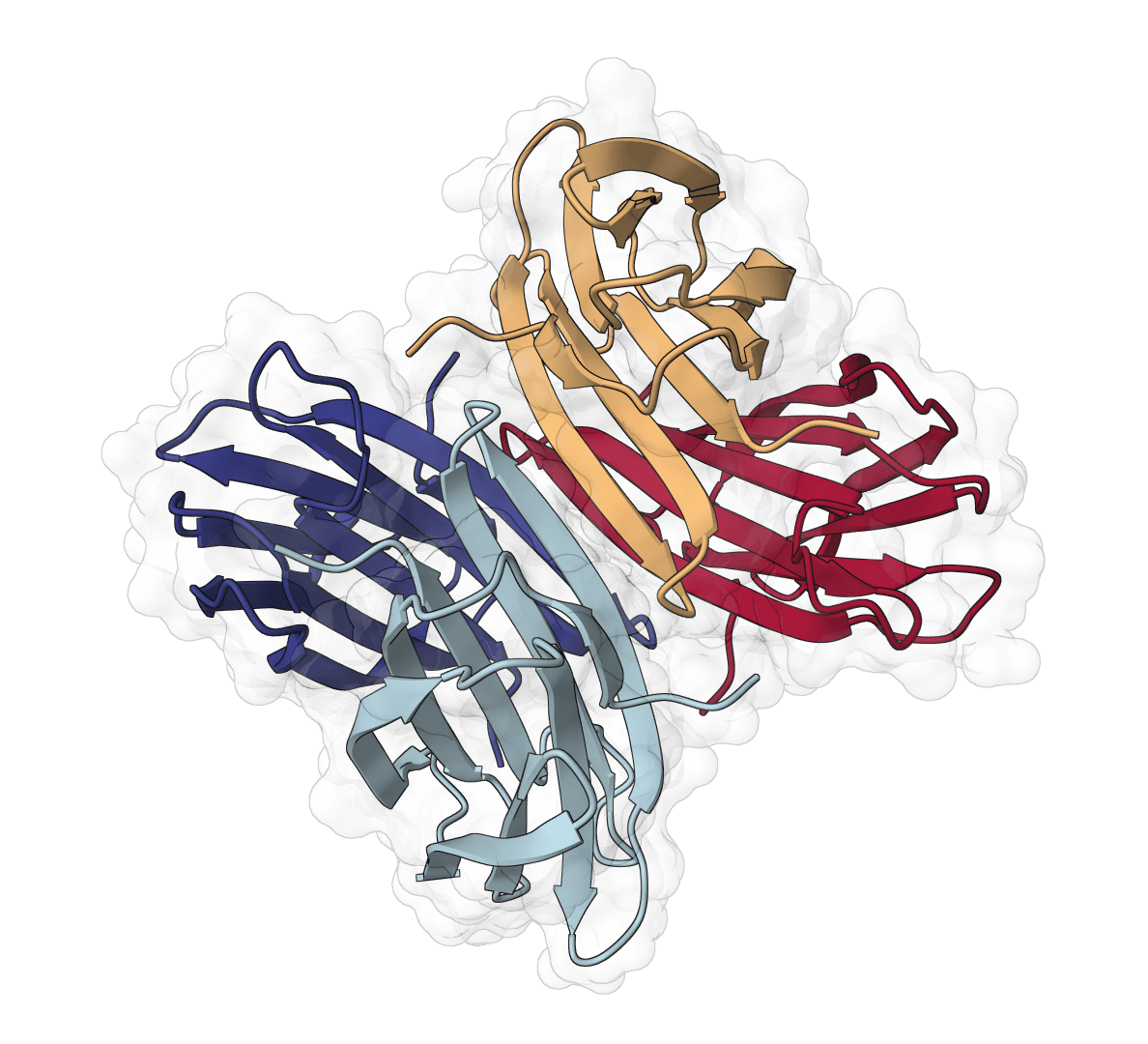
Deep learning-powered protein-protein binding affinity prediction Learn more
Input
What is PPAP?
PPAP (Protein-Protein Affinity Predictor) estimates protein-protein binding affinity from an assembled PDB complex. It returns the model's −ΔG score in kcal/mol and a dissociation constant (Kd) calculated at 25 °C.
The model combines protein-interface graph features with per-residue embeddings from ESM2-3B. It predicts affinity for existing protein-protein interfaces; it does not dock partners or score protein-small-molecule binding.
Input requirements
Upload one PDB or ENT structure containing 2–4 protein chains in its first model. ProteinIQ applies the same structural assumptions used by PPAP before starting the GPU run:
- Only the first
MODELis analyzed. - Every standard amino-acid residue needs N, CA, C, and O backbone atoms.
- Each chain can contain up to 1,022 residues, matching the ESM2 context limit.
- A run can contain up to 2,000 residues and six requested partner pairs.
- Each requested partner pair must form a protein interface that PPAP can featurize.
Ligands, waters, ions, and nucleic-acid chains are not binding partners for this tool.
Chain-pair settings
With Analyze all chain pairs enabled, PPAP evaluates every two-chain combination in the first model. A four-chain structure produces six pairs: A_B, A_C, A_D, B_C, B_D, and C_D.
Disable that setting to enter specific partners as comma-separated receptor_ligand groups:
A_Bcompares chain A with chain B.HL_Ytreats chains H and L together as one partner and chain Y as the other.AB_CD, A_Crequests two grouped comparisons.
A chain cannot appear on both sides of the same comparison, and duplicate comparisons are rejected.
Outputs
The results table contains one row per requested partner pair:
| Column | Meaning |
|---|---|
Chain Pair | The submitted receptor_ligand grouping. |
−ΔG (kcal/mol) | PPAP's positive negative-binding-free-energy score. Larger values indicate stronger predicted binding. |
Kd (25 °C) | Dissociation constant calculated by PPAP at 298.15 K. Lower values indicate tighter predicted binding. |
PPAP uses Kd = exp(−(−ΔG)/(RT)). This is why its displayed −ΔG values are positive, while conventional ΔG values for favorable binding are negative.
Downloads include the native output/result.xlsx, a chain-label-preserving CSV, and logs from both official PPAP entrypoints.
Reproducibility and interpretation
ProteinIQ runs the PPAP graph-preparation and prediction software from source commit f4b264e, with the official checkpoint pinned and checksum-verified. Graph preparation adds small random coordinate noise and provides no seed setting, so repeated runs can differ slightly.
Predictions are computational estimates rather than experimental measurements. Use them for ranking or hypothesis generation, and confirm quantitative conclusions with SPR, ITC, or another suitable affinity assay.
Limitations
- PPAP requires an already assembled protein-protein complex and does not model association or conformational change.
- A requested pair without a featurizable interface causes the run to fail; the native error report and graph log are returned for diagnosis.
- Results depend on the submitted coordinates and may be less reliable for interaction classes unlike the model's training data.
- The source fixes Kd conversion at 25 °C; temperature is not configurable.
Related tools
CleaveNet
Official CleaveNet tool for matrix metalloproteinase cleavage prediction and peptide generation. Predict cleavage z-scores plus uncertainty across 18 MMP variants, evaluate against truth z-scores, or generate candidate peptides unconditionally or from MMP z-score profiles.
Aggrescan3D
Static-mode Aggrescan3D analysis for per-residue aggregation propensity from a single protein structure.
Boltz-2
Boltz-2 is a biomolecular foundation model for structure and binding affinity prediction. Supports proteins, ligands, DNA, and RNA in multi-component complexes. Automatically scales GPU resources for large complexes. Predicts binding affinity with near-FEP accuracy at 1000x faster speed.
Protein charge plot
Plot net charge vs pH for protein sequences. Visualize how protein charge changes across pH 0-14 and identify the isoelectric point (pI) where the net charge crosses zero.
Chou-Fasman
Predict protein secondary structure using the classic Chou-Fasman algorithm based on amino acid propensities
EvoIF
Score protein mutations with evolutionary profiles from homologous sequences and inverse folding. EvoIF returns a dimensionless log-odds score for each submitted single or multi-site mutation.
FindPept
Match experimental peptide masses against theoretical digest fragments of a protein sequence. Identify peptides from mass spectrometry data by peptide mass fingerprinting.
FlowDock
FlowDock predicts protein-ligand complex structures and binding-affinity scores using geometric flow matching.
Hydropathy plot
Generate Kyte-Doolittle hydropathy plots to visualize hydrophobic and hydrophilic regions along protein sequences. Identify transmembrane domains and surface-exposed regions.
Hydrophobicity plot
Generate hydrophobicity plots using 24 different amino acid scales. Visualize hydrophobic and hydrophilic regions for protein analysis, epitope prediction, and membrane protein studies.