PLACER
Sample local ligand and side-chain conformations
Sample local ligand and side-chain conformations
Not available for new jobs
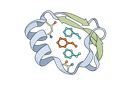
PLACER samples local protein-ligand and side-chain conformations. ProteinIQ uses the published PLACER project at commit 7dc5563, with its official model by default. New jobs remain unavailable while dependency licensing and verification are completed.
Ligand coordinates must already exist in the input structure. For apo side-chain analysis, select a target residue. Each output model contains the sampled local crop, rather than the complete input structure.
The configured runtime rate is 27 credits per minute, with a maximum billable runtime of one hour. Checkpoint preparation and native computation contribute to elapsed runtime. Pricing remains provisional pending runtime calibration and activation.
| Number of samples | Current estimated reservation |
|---|---|
| 1 | 29 credits |
| 10 | 41 credits |
| 100 | 162 credits |
These estimates use the current sample-count calculator. They are spending reservations, not final charges. Other scientific settings and custom checkpoints do not change the rate or the current estimate; actual runtime can differ. The playground calculates the reservation before submission when admission is available.
| Input | Formats | Required | Purpose |
|---|---|---|---|
| Protein structure | .pdb, .cif, .cif.gz | Yes | Protein coordinates and any placed ligands. RCSB retrieval uses mmCIF. |
| Ligand chemistry references | .sdf, .mol2 | Optional | Atom typing and connectivity for ligands already present in the structure. |
| Custom residue definitions | .json | Optional | Mapping residue names to sdf, atom_id, leaving and pdbx_align. |
| Custom PLACER model checkpoint | .pt | Optional | params and a dense tensor model state. Leave empty to use the official model. |
Each file is limited to 50 MiB. Reference files need unique filenames without directory paths. Map each reference residue name to its uploaded filename in ligand_reference. The mapping also accepts CCD or native inline SDF/MOL2 text. Reference files supply chemistry; ligand positions come from the structure.
Custom checkpoints preserve their parameter values, shared data references, tensor names, shapes, dtypes and values. Parameters can contain primitive values, lists, tuples, dictionaries and ordered dictionaries. Cyclic data and custom Python parameter objects are unsupported. Training optimizer and scheduler data are unnecessary for inference. Decoded checkpoint metadata is limited to 1 MiB and tensor data to 1 GiB.
The distributed official checkpoint includes training state and exceeds the upload limit. Its inference-only params and model data occupy about 20 MiB. The default official model is already installed, so it requires no upload.
PDB models are passed to PLACER together. Input structures that violate its parser or chemistry requirements may be rejected. Batch runs support up to 10 structure inputs, subject to the plan's batch limit; each structure starts a separate job.
| Parameter | Type | Default | Description |
|---|---|---|---|
Number of samples (nsamples) | integer | 10 | Positive sample count, bounded by the runtime limit. |
Model ordering (rerank) | enum | none | Sampling order, prmsd ascending, or plddt / plddt_pde descending. |
Predict and score multiple ligands (predict_multi) | boolean | false | Predict the selected ligands together. |
Exclude common crystallography additives (exclude_common_ligands) | boolean | false | Use PLACER's common-ligand skip list. An explicit skip_ligands list takes precedence. |
Include small molecules (use_sm) | boolean | true | Turn off for apo analysis and specify a target residue. |
Ignore reference ligand hydrogens (ignore_ligand_hydrogens) | boolean | false | Apply native hydrogen matching behavior. |
Ligand and residue selection (native_options) | object | {} | JSON containing the native controls below. |
| Parameter | Type | Default | Description |
|---|---|---|---|
predict_ligand | array | optional | Select ligands using names, chains, [name3,resno] or [chain,name3,resno]. Other ligands stay fixed. |
fixed_ligand | array | optional | Select fixed ligands using the same selector shapes. |
target_res | array | optional | Use [chain,resno] to select an apo crop center. |
fixed_ligand_noise | number | checkpoint default | Noise on fixed ligand coordinates. Explicit 0 is preserved. |
skip_ligands | array | optional | Residue names to exclude. |
crop_centers | array | optional | Centers as [chain,resno,name3,atom] or [x,y,z]. |
corruption_centers | array | optional | Centers using the same atom or coordinate shapes. |
bonds | array | optional | Entries of [atom1,atom2,length]; atoms use [chain,resno,name3,atom]. |
mutate | array | optional | Entries of [chain,resno,name3]; supply custom residue definitions when needed. |
ligand_reference | object | optional | Map residue names to uploaded reference filenames, CCD or native inline text. |
When both center controls are supplied, PLACER warns and uses the crop centers for both. Its native warning is retained in the run log. Selections and identifiers are passed literally without renumbering atoms or residues.
| Output | Contents |
|---|---|
| Scores | Every native score row, in the selected model order. |
placer_model.pdb | Complete ensemble of sampled local crops. Per-atom predicted deviations occupy the B-factor column. |
placer.csv | Original native score CSV. |
placer-api-output.pt | Complete native API return, including tensors and centers, in original sampling order. Reopen with the matching PLACER environment. |
| Run logs | Complete native stdout and stderr. |
| Run provenance | Input hashes, submitted scientific settings, source commit and custom-checkpoint data hashes when supplied. |
| License and runtime files | PLACER's license, third-party notices and the inference package inventory. |
Ranking changes the CSV and PDB model order. The API archive is saved before ranking and retains the original native return.
| Field | Meaning |
|---|---|
fape | Native all-atom frame-aligned point error. |
lddt | All-atom lDDT comparing the sampled model with the input coordinates. |
rmsd | Ligand RMSD relative to its input position. |
kabsch | Ligand RMSD after alignment, describing the conformation relative to the input. |
prmsd | Root mean square of predicted atomic deviations for the ligand. |
plddt | Predicted ligand lDDT from the model's 1D track. |
plddt_pde | Predicted ligand lDDT from the model's 2D track. |
Scores retain their native scales and precision. Predicted lDDT values are fractions, without conversion to a 0 to 100 scale. The reference-based scores depend on the supplied input coordinates. Custom checkpoints can change the model's predictions and confidence calibration.

Predict protein-ligand binding poses and confidence scores without a predefined binding site.

Predict protein-ligand binding poses while modeling ligand-induced conformational changes.

Geometric flow matching for generative protein-ligand docking and affinity prediction.

Fragment-based SE(3) equivariant diffusion docking for protein-ligand binding pose prediction

Surface-informed diffusion generative model for reliable and accurate protein-ligand complex prediction

Dock ligands with AutoDock4 scoring, CUDA acceleration, and flexible receptor sidechains.

Dock ligands into protein structures and estimate binding modes, poses, and affinity scores.

Dock small molecules into proteins using CNN scoring and physics-based pose optimization.
Physics-based molecular docking with CPU-optimized hierarchical algorithms

Enhanced molecular docking with custom scoring functions and fast minimization