Genetic algorithm-based protein binder optimization using AlphaFold2 and ProteinMPNN Learn more
Input
What is EvoPro?
EvoPro is a genetic algorithm-based pipeline for designing protein binders through in silico evolution. Developed by the Kuhlman Lab at the University of North Carolina, it combines iterative structure prediction with AlphaFold2 and sequence design with ProteinMPNN to evolve protein sequences that bind tightly to a target protein.
The approach differs from traditional computational design methods by allowing backbone plasticity during optimization. As sequences evolve across generations, their predicted structures can undergo conformational changes favorable for binding—something difficult to encode in physics-based design methods like Rosetta.
In published work, EvoPro generated autoinhibitory domains for a PD-L1 antagonist, with four designs achieving sub-150 nM binding affinity and the best reaching 0.9 nM without any experimental optimization.
How does EvoPro work?
EvoPro runs a genetic algorithm that maintains a population of candidate binder sequences and evolves them through repeated cycles:
- Scoring: Each sequence is evaluated by predicting its structure bound to the target using AlphaFold-Multimer
- Selection: Sequences are ranked by fitness; the bottom half is discarded
- Diversification: New sequences fill the population through mutation, crossover, or ProteinMPNN redesign
- Iteration: The cycle repeats for the specified number of generations
Fitness function
The fitness score combines three components from AlphaFold2 predictions:
| Component | What it measures |
|---|---|
| Placement confidence | Interface quality based on sidechain contacts weighted by PAE (predicted aligned error) |
| Fold confidence | Binder stability from average pLDDT across the designed protein |
| Conformational stability | RMSD between bound and unbound structures to minimize binding-induced changes |
Lower scores indicate better designs. The conformational stability term encourages rigid binders with fast association kinetics.
Sequence diversification
New sequences are generated through two strategies:
- Random mutagenesis + crossover: Introduces point mutations (~12.5% of residues) and recombines sequences from surviving parents
- ProteinMPNN optimization: Redesigns sequences from AlphaFold-predicted backbones during the evolutionary cycle when enabled
How to use EvoPro online
ProteinIQ provides GPU-accelerated EvoPro runs without local installation, making binder design accessible through a browser interface.
Inputs
| Input | Description |
|---|---|
Target Protein | PDB file, RCSB PDB ID, raw amino-acid sequence, or FASTA sequence for the target used in AlphaFold2 co-folding. For multi-chain target sequences, separate chains with : or provide multiple FASTA records; these become chains B, C, and so on |
Starting Scaffold | Required starting binder structure or FASTA sequence. EvoPro evolves this single binder chain as chain A |
Evolution parameters
| Setting | Range | Default | Description |
|---|---|---|---|
Population size | 4-100 | 20 | Candidate pool size. Larger pools explore more diversity but increase runtime |
Number of generations | 5–200 | 50 | Evolutionary cycles. More generations improve optimization at the cost of time |
Mutation rate | 0.05-0.5 | 0.125 | Fraction of mutable scaffold residues changed during random mutagenesis |
Design settings
| Setting | Description |
|---|---|
Use MSA | Generate AF2 multiple sequence alignments instead of single-sequence predictions. This can substantially increase runtime and is usually unnecessary for de novo binder optimization |
Mutable residues | Restrict which binder positions can mutate. The binder is chain A. Use A*, a range such as A1-A65, or positions and ranges like A5,A10,A20-A30. Leave empty to allow all binder positions |
Target contact residues | Optional target residues the binder should contact, rewarded in the EvoPro contact score. Use target chain IDs such as B34 or B30-B40,B55 |
Target avoid residues | Optional target residues the binder should avoid, penalized in the EvoPro contact score. Use target chain IDs such as B6 or B10-B15 |
Target chain | Select one chain from the target PDB. Leave empty to use the first protein chain |
Scaffold chain | Select one chain from a scaffold PDB. Leave empty to use the first protein chain; FASTA scaffolds are assigned binder chain A |
Enable ProteinMPNN | Toggle ProteinMPNN sequence design during evolution (recommended) |
Runtime scaling
EvoPro runtime scales with the number and size of AlphaFold2 evaluations:
| Driver | Effect |
|---|---|
| Target residues | Larger targets increase each bound-complex prediction |
| Scaffold residues | Larger scaffolds increase both bound-complex and scaffold-only predictions |
| Population size | Multiplies the number of sequences evaluated per generation |
| Number of generations | Multiplies the total evolutionary evaluations |
| ProteinMPNN | Adds sequence redesign work during the evolutionary cycle |
| MSA generation | Adds AF2 sequence-search work and can make each prediction much slower |
As a rough guide, EvoPro evaluates each candidate in both a bound target-scaffold
state and a scaffold-only state, so AlphaFold2 prediction count is approximately
population size x number of generations x 2.
Results
EvoPro returns a ranked list of designed binders with:
| Column | Description |
|---|---|
Rank | Position in the ranked output (1 = best) |
Binding Score | EvoPro composite fitness score label and value from the score table (lower = better within the same run) |
Sequence | Designed amino acid sequence |
Download | PDB file of the predicted complex |
The 3D viewer displays selected designs bound to the target protein. The files tab includes ranked PDB files, the full EvoPro score table, confidence plots when available, and a compressed archive of the raw result directory.
Interpreting binding scores
EvoPro scores depend on the target, scaffold, score function, and generated AlphaFold2 predictions. Treat the rank order and score differences within one job as the primary signal. Do not compare raw score values across unrelated targets or scaffolds as absolute binding-affinity thresholds.
Limitations
- Runtime: Full evolutionary trajectories can range from a few minutes for tiny smoke tests to much longer jobs as target size, scaffold size, population size, and generation count increase
- Target size: Very large target proteins increase AlphaFold prediction time per generation
- No explicit binding energy: Fitness scores correlate with but don't directly predict experimental binding affinity
- Single binding mode: The algorithm optimizes for one binding interface; alternative binding sites aren't explored
Related tools
BindCraft
Design de novo protein binders using AlphaFold2 backpropagation, ProteinMPNN sequence optimization, and PyRosetta relaxation. BindCraft generates novel protein sequences that bind to user-specified target surfaces.
PepMLM
Design linear peptide binders for target proteins using a target sequence-conditioned masked language model. PepMLM generates peptide sequences optimized to bind specific protein targets based on ESM-2 protein language modeling.
BoltzGen
BoltzGen uses generative diffusion models to design protein, peptide, nanobody, and Fab binders against protein and small-molecule targets.
mBER
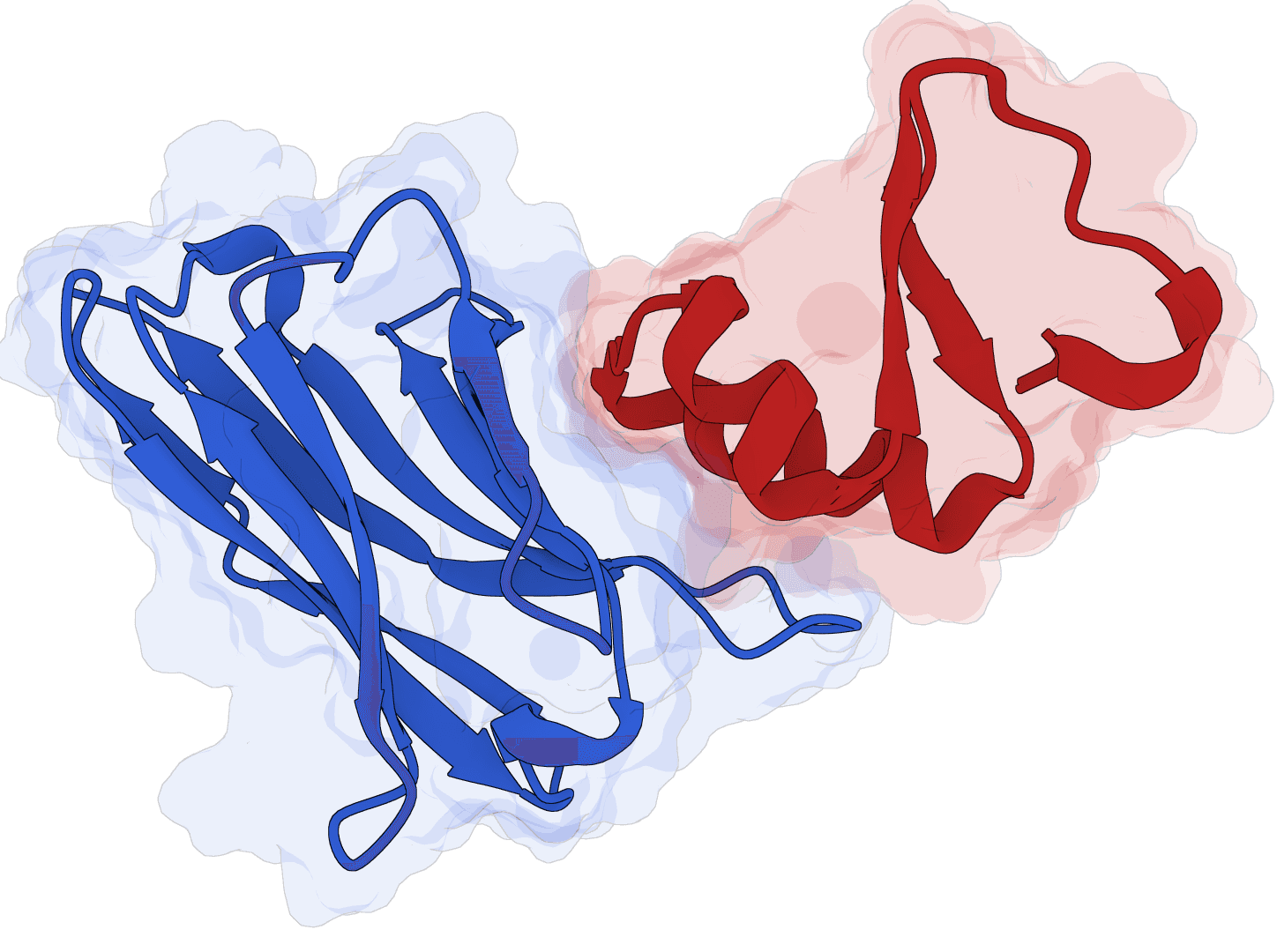
Design VHH nanobody binders using AlphaFold-Multimer with structure templates and sequence conditioning. mBER (Manifold Binder Engineering and Refinement) generates novel VHH antibody sequences that bind to user-specified target proteins.
PepMimic
PepMimic designs short peptides that mimic the binding interface of a known protein binder on its target. From a reference protein complex, a latent diffusion model generates peptide candidates constrained to the target interface, and each candidate is scored by interface-mimicry against the reference binder.
Proteina-Complexa
Design protein binders against a target structure with NVIDIA BioNeMo's Proteina-Complexa generative pipeline.
Genie 3
Generate protein structures and scaffolds with Genie 3, an all-atom SE(3)-equivariant diffusion model. Genie 3 supports unconditional protein generation, motif scaffolding, and hotspot-targeted binder design.
PocketFlow
PocketFlow is a structure-based molecular generative model that designs novel drug-like molecules within protein binding pockets. It uses autoregressive flow modeling with chemical knowledge to generate 100% chemically valid, highly drug-like compounds.
PocketXMol
PocketXMol is a pocket-interacting generative foundation model for small-molecule or peptide docking and design in protein binding pockets.
ProFam
ProFam-1 is a protein family language model for family-conditioned sequence generation. Provide a protein family in FASTA, A2M, or A3M format and generate new sequences with model likelihood scores for downstream ranking and screening.