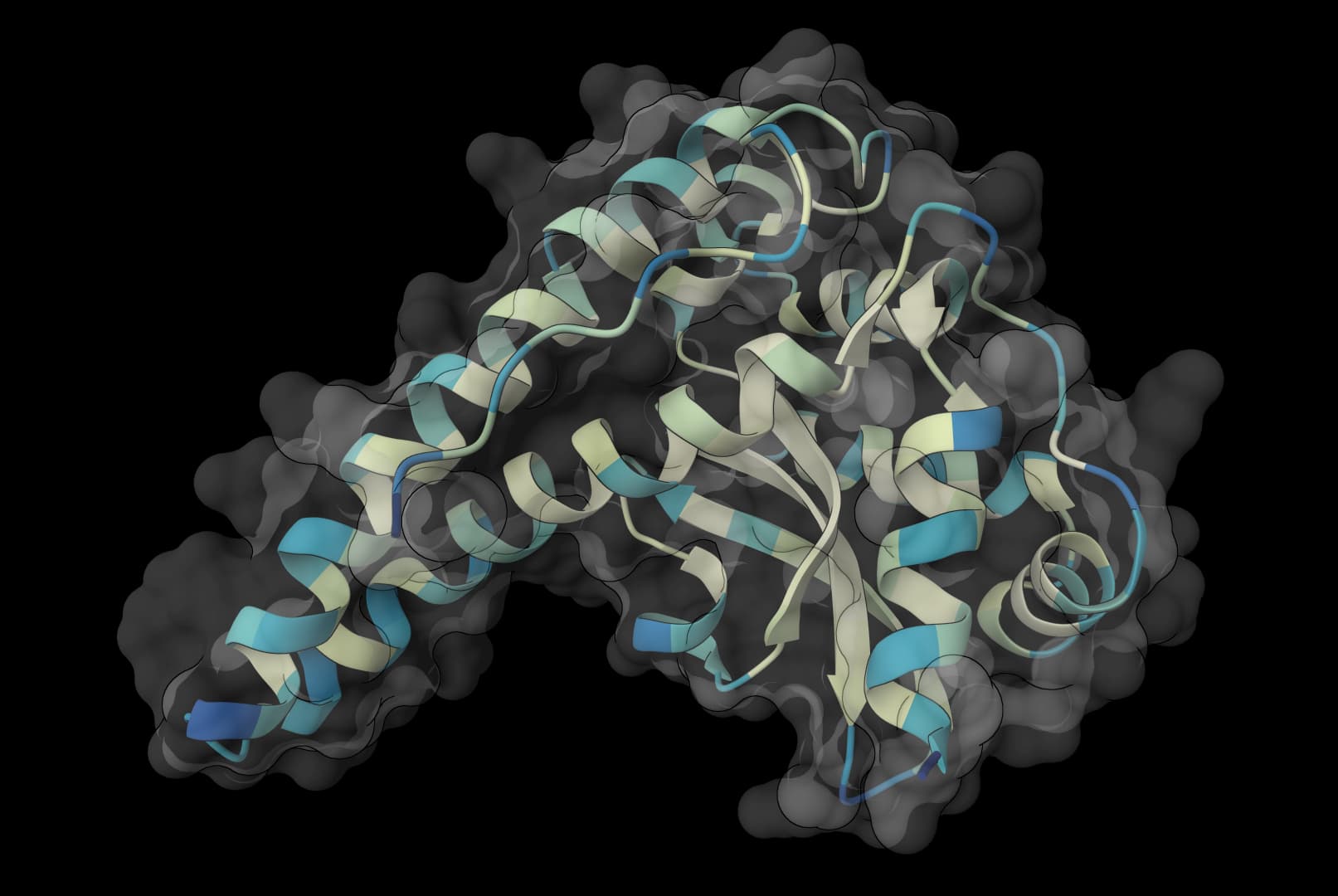
AlphaFold2
Predict protein structures and complexes with single-sequence or MSA-assisted folding.
AlphaFold2 webserver overview
AlphaFold2 is a deep-learning model for predicting protein structures from amino acid sequences. ProteinIQ runs the ColabFold implementation for single-chain monomer and multi-chain AlphaFold2-Multimer prediction.
The webserver accepts protein sequences, query tables, precomputed A3M alignments, protein structures, and RCSB sequence fetches. Optional files supply templates and an initial guess. It returns ranked PDB structures with pLDDT, pTM, ipTM, PAE, and supporting files. Ligands, DNA, and RNA are outside its input scope.
Pricing
AlphaFold2 jobs start at 50 credits. Single-sequence inference runs without an MSA search, while MMseqs2 MSA modes cost 2x the single-sequence calculation.
The final price also depends on sequence length, chain count, models, recycles, random seeds, ensemble runs, and AMBER relaxation, and is calculated before submission.
Inputs
ProteinIQ displays chain IDs so that multi-chain inputs can be tracked in the viewer and result files. Each job requires at least one protein input and accepts up to 10 protein inputs, with a combined limit of 6,000 residues.
Sequence text must use ungapped one-letter protein codes. A precomputed A3M file must contain a valid protein query sequence and alignment.
| Input | Accepted formats | Limits and behavior |
|---|---|---|
| Protein sequence | Raw sequence or FASTA text, .fasta, .fa, or .txt file | Up to 10 protein inputs. Sequence text must use ungapped amino acid codes accepted by AlphaFold2. |
| Precomputed protein MSA | .a3m file | Files up to 10 MB. The A3M query sequence must contain a usable ungapped protein sequence. |
| Query table | .csv or .tsv | Columns id and sequence; each row is a query. Use colons between complex chains. |
| Query structure | .pdb, .cif, .mmcif | Select Sequence from a structure. ColabFold extracts the protein sequences. |
| Template / Initial guess | .pdb, .cif, .mmcif | Optional structure files. Enable Use templates for custom templates. An initial guess requires one query. |
| MSA | .a3m | Optional files referenced by exact filename in a table's a3mpath column. |
| Template hits | .tsv or .txt | Native tab-separated hit records, accompanied by the matching uploaded mmCIF files, named by four-character PDB ID such as 1abc.cif. |
| RCSB protein fetch | PDB entry fetched as FASTA | One RCSB fetch per input. Choose Structure as the query source to upload a structure directly. |
| Job name | Text | Optional label used to identify the run. |
AlphaFold2 accepts protein and protein-complex inputs only. A ligand, DNA sequence, or RNA sequence cannot be submitted as a prediction input; use a multi-molecule model such as Boltz-2 when those components are part of the system.
Settings
The settings below follow the current AlphaFold2 webserver definition. Some fields depend on a parent setting, and Not set means the optional value is left to the native or tier-specific default.
Prediction and model
| Setting | Default or range | Description |
|---|---|---|
Query source | Sequences or alignments | Alternatively read sequences from a supplied structure. |
Multiple input files | Chains of one complex | Separate queries runs each file's queries independently. A multi-record FASTA always retains separate queries. |
Number of recycles | Native model default; explicit 0-12 | Blank preserves the native default: 20 for Multimer v3, 3 for monomer and Multimer v1/v2. 0 disables recycling. |
Early stop tolerance | Native model default | Blank or none preserves the model tolerance, including 0.5 for Multimer v3. -1 disables early stopping. Other finite numeric tolerances pass to ColabFold. |
Number of models | 5; 0-5 | 0 prepares alignments and templates without predicting structures. Positive values select the number of trained models. |
Random seeds | 1; 1-5 | Number of different random seeds used to generate additional structural diversity. |
Ensemble runs | 1; 1-3 | Number of runs with different MSA cluster samplings. More runs increase diversity and runtime. |
Model type | Auto | Auto selects the pTM model for single chains and a multimer model for complexes. Specific options include AlphaFold2 monomer, AlphaFold2-ptm monomer, AlphaFold2-multimer v1, v2, or v3, and DeepFold v1. |
Enable dropout | Off | Enables dropout during prediction to generate more diverse structures that can indicate conformational uncertainty. |
MSA and templates
| Setting | Default or range | Description |
|---|---|---|
MSA mode | Paid default: UniRef+Environmental; free default: No MSA | Selects UniRef+Environmental, UniRef+Environmental env-pair, UniRef only, or No MSA. The three database-search modes cost 2x credits. |
Max MSA sequences | Model default | Blank or none preserves the model configuration. A positive integer sets the MSA cluster count. |
Max extra MSA sequences | Model default | A positive integer limits extra MSA sequences. Native defaults include 5120 for monomer, 2048 for Multimer v3 and 1152 for Multimer v1/v2. |
Max MSA pair | Not set | Advanced override in the form max_seq:max_extra_seq, such as 512:5120. When set, it overrides Max MSA sequences and Max extra MSA sequences. |
Use templates | Off | Queries PDB templates through the MSA server for homologous structures. |
Max templates | 20; options 5, 10, 20, or 50 | Maximum number of templates considered when Use templates is enabled. |
Max template date | Not set | Optional cutoff in YYYY-MM-DD format. Only templates released before the selected date are used. |
Multimer, ranking, and diagnostics
| Setting | Default or range | Description |
|---|---|---|
Pair mode (multimer) | Unpaired+Paired | Chooses Unpaired+Paired, Paired only, or Unpaired only MSA pairing for multi-chain predictions. |
Pairing strategy (multimer) | Greedy | Chooses Greedy or Complete species matching for multimer sequence pairing. |
Ranking metric | Auto | Selects the metric used to order predictions: Auto, pLDDT, pTM, ipTM, or Multimer score. Auto preserves native monomer or multimer ranking behavior. |
Model order | 1,2,3,4,5 | Controls the ColabFold model execution order for reproducible runs or benchmarking. |
Stop at score | Not set | Stops after ColabFold reaches a supplied pLDDT or pTM threshold. When not set, all requested models run. |
Extra pTM metrics | Off | Calculates additional multimer interface metrics, including actifpTM and chain-wise pTM. |
Binary contacts for extra metrics | Off | Uses binary contacts instead of contact probabilities when Extra pTM metrics is enabled. |
Save recycle intermediates | Off | Saves structure predictions from each recycle step for inspecting how the model changes during refinement. |
Use MSA cluster profiles | On | Passes the native cluster-profile option to ColabFold. |
Save raw prediction data | Off | Retains native prediction pickle files for download. |
Save single representations / Save pair representations | Off | Retains native NumPy representation arrays. Pair arrays can be large. |
Relaxation and reproducibility
| Setting | Default or range | Description |
|---|---|---|
AMBER relaxation | Off | Runs OpenMM/AMBER energy minimization on the selected predictions. It can improve side-chain geometry but adds substantial runtime. |
Structures to relax | 0; 0-5 | With AMBER enabled, 0 relaxes all requested models and seeds, matching ColabFold. A positive value selects that many top-ranked predictions. |
Random seed | Not set; native default 0 | Sets a fixed seed for reproducibility. When not set, ColabFold uses its default seed behavior. |
Relax max iterations | 2000 | Maximum OpenMM/AMBER relaxation iterations when AMBER relaxation is enabled. |
Relax tolerance | 2.39 | OpenMM/AMBER relaxation convergence tolerance. |
Relax stiffness | 10.0 | OpenMM/AMBER relaxation stiffness parameter. |
Relax outer iterations | 3 | Maximum outer iterations for OpenMM/AMBER relaxation. |
With the standard settings, AlphaFold2 uses the model's native recycle configuration, 5 models, 1 random seed, 1 ensemble run, Auto model selection, no templates, no dropout, and no AMBER relaxation. Earlier saved jobs retain their original settings.
The default MSA mode depends on account tier: paid runs default to UniRef+Environmental, while free runs default to No MSA and can switch to any MSA mode. Optional fields marked Not set retain their native behavior.
Outputs
Each run includes Viewer, Data, and Files views. The primary PDB structures are ranked by the selected metric, while supporting files preserve confidence data, MSA and template artifacts, relaxation results, and the curated run record.
| Output | Description |
|---|---|
| Ranked PDB structures | Native filenames retain the query, model, seed and rank. Ranks apply within each query. Earlier saved jobs may use prediction_rank01.pdb. |
| 3D structure viewer | Interactive inspection of monomer or multimer structures with chain IDs and confidence coloring. |
| pLDDT | Per-residue confidence on a 0-100 scale, stored in the PDB B-factor column. Higher values indicate greater local confidence. |
| pTM | Global fold confidence on a 0-1 scale where the selected model provides pTM. |
| ipTM | Interface confidence for multimer predictions where the selected model provides ipTM. |
| PAE | Predicted aligned error data for assessing relative positioning between residues, domains, or chains. |
| MSA and template artifacts | ColabFold-generated A3M, JSON, image, and text artifacts when the selected MSA or template workflow produces them. |
| Relaxed structures | AMBER-relaxed structures and their unrelaxed counterparts when relaxation is enabled. |
| Recycle intermediates | Per-recycle structures when Save recycle intermediates is enabled. |
| Run log | A downloadable run.log containing chain and residue counts, selected settings, scientific phases, and ranked confidence summaries. |
Native A3M files retain their #lengths<TAB>cardinalities header. Residue counts include query stoichiometry, excluding homolog rows. Tables may reference uploaded templates by filename through templatepath; server filesystem paths are not accepted. ColabFold 1.6.2 cannot read monomer a3mpath table entries, so submit those A3M files as protein queries instead.
If a later prediction or relaxation fails, completed structure/score pairs and diagnostics remain downloadable. Results without a native rank are identified by query, model and seed; their displayed order does not imply confidence. MSA-only runs have supporting files and no predicted structures.
DeepFold prediction remains unavailable pending verification of permission to use its model weights.
Interpreting AlphaFold2 results
pLDDT describes local residue confidence. pTM describes confidence in the global fold, while ipTM describes confidence in the relative placement of chains.
Values above 90 are very high pLDDT confidence, and values from 70 to 90 generally support a reliable backbone. Values below 50 often identify disorder or flexible regions rather than a failed prediction. PAE complements these scores by showing whether domains or chains are confidently positioned relative to one another.
For multimers, inspect both the chain interface and the scores used for ranking. A high pLDDT can coexist with uncertain relative chain placement, so ipTM and inter-chain PAE are more informative for complex assembly than local confidence alone.
Comparing several ranked models is useful when the target is flexible, lacks homologs, or has multiple plausible oligomeric states. This helps reveal whether the ranking is stable across plausible assemblies.
Important limitations
AlphaFold2 is a protein-only predictor and does not model ligand binding, DNA, RNA, cofactors, or small-molecule effects on structure. Its valid prediction inputs are protein sequences and protein complexes.
MSA-assisted modes generally provide more evolutionary information for natural proteins, while No MSA is useful for fast checks and designed or orphan proteins with few detectable homologs.
Templates can bias a prediction toward a known fold, and AMBER relaxation changes coordinates without validating the biological state. Neither option confirms that the predicted state is biologically populated.
For protein complexes containing non-protein components, use Boltz-2 or Chai-1. For fast single-sequence protein folding, use ESMFold. For a longer walkthrough, see How to use AlphaFold2 online.
Related tools

ESMFold2
Predict protein and protein-complex structures from sequences with ESMFold2 confidence outputs.

RosettaFold3
Open-source structure prediction for proteins, nucleic acids, and ligands

AlphaFlow
Generate protein conformational ensembles from sequence or structure inputs.

ABodyBuilder3
Predict paired antibody variable-domain structures from heavy and light chain sequences.

Boltz-2
Predict biomolecular complex structures and binding affinities for proteins, ligands, DNA, and RNA.

Chai-1
Predict 3D structures for proteins, ligands, DNA, RNA, and multi-component complexes.

ESMfold
Predict protein structures and multimers directly from sequences without an MSA.

ImmuneBuilder
Predict immune receptor structures for antibodies, nanobodies, and T-cell receptors.

IntelliFold 2
Predict controllable biomolecular structures for proteins, ligands, DNA, RNA, and complexes.

LMI4Boltz
Low-memory Boltz inference for biomolecular structure and affinity prediction