Boltz-2
Predict biomolecular complex structures and binding affinities for proteins, ligands, DNA, and RNA.
Input
Boltz-2 webserver overview
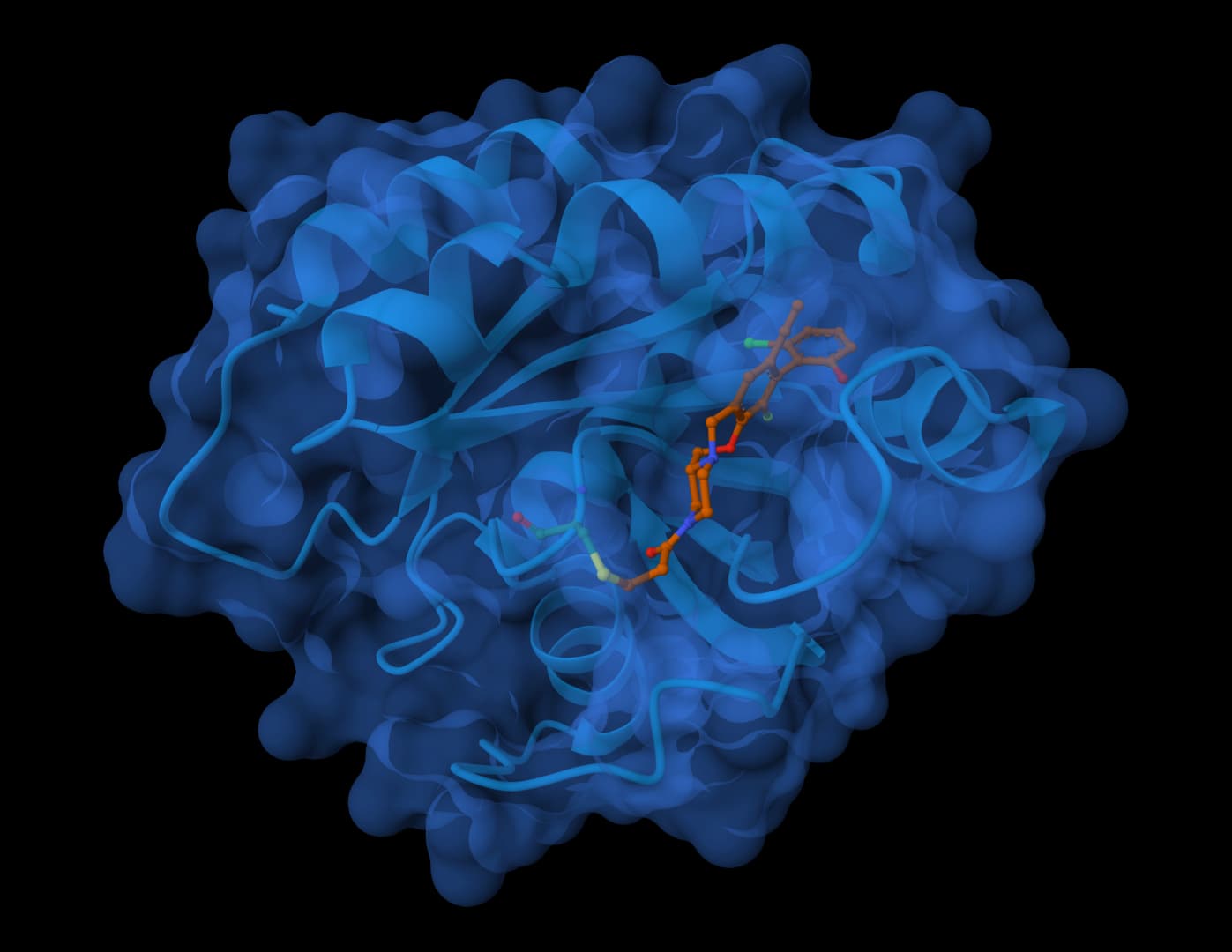
Boltz-2 predicts all-atom 3D structures for biomolecular complexes and estimates binding affinity for protein-small-molecule interactions. The ProteinIQ webserver accepts sequences, ligands, templates, and optional constraints, then returns predicted structures, confidence metrics, and downloadable result files. It supports protein-ligand cofolding, protein complex prediction, protein-DNA and protein-RNA modeling, affinity prioritization, and template- or constraint-guided prediction.
Pricing
Boltz-2 jobs start at 50 credits. The calculator scales mainly with the number and length of input molecules, inference settings, and requested samples, while additional samples have a smaller incremental effect. The exact credit price is calculated before submission.
Inputs
ProteinIQ displays chain IDs for constraint definitions and template mappings. A job must include at least one protein, DNA, or RNA chain; ligands, templates, and precomputed MSAs cannot be submitted by themselves. The total number of residues across all inputs is limited to 5,000, and each small-molecule ligand is limited to 300 heavy atoms.
| Input | Accepted formats | Limits and behavior |
|---|---|---|
| Protein | FASTA or FA text, .fasta or .fa file, .pdb file, or RCSB chain | Up to 10 protein inputs; files up to 50 MB. RCSB fetches require a chain specifier. Protein sequences use single-letter residues. Query PDBs must contain one protein chain and one model, without insertion codes or modified residues. For these cases, submit exact FASTA sequences with residue modifications. Query PDB coordinates are not used as templates. |
| Precomputed protein MSA | A3M or native paired CSV text, .a3m or .csv file | Up to 10 MSAs; files up to 50 MB. Each alignment is assigned to protein chains in submission order. |
| Ligand | SMILES text, .smi or .smiles file, .sdf, .mol, or .mol2 file, or a PubChem record | Up to 10 ligands; files up to 10 MB. Each ligand can contain at most 300 heavy atoms. Use a protein chain instead of a ligand input for peptide ligands. |
| Ligand (CCD) | One CCD code such as ATP, NAD, HEM, or SAH | Up to 10 CCD ligands. Codes are 1-5 alphanumeric characters. This input accepts CCD codes, not custom SMILES or structure files. |
| DNA | FASTA or FA text, .fasta or .fa file | Up to 10 DNA molecules; files up to 10 MB. |
| RNA | FASTA or FA text, .fasta or .fa file | Up to 10 RNA molecules; files up to 10 MB. |
| Template | .pdb or .cif file, or an RCSB structure | Up to 5 templates; files up to 50 MB. CIF and mmCIF templates must include full metadata. Templates act as structural guides and can be assigned to query chains with the template settings below. |
| Job name | Text | Optional label used to identify the run. |
Settings
Native documents
As an alternative to molecule cards, add a Native Boltz document. Paste YAML or upload a YAML or structured FASTA file. One document defines the complete complex and uses the same hosted molecule, residue and ligand limits and credit calculation. YAML accepts native sequences, modifications, CCD component lists, constraints, templates and an optional affinity property. Structured FASTA uses headers such as >A|protein|empty and produces structures without an affinity request.
Upload referenced MSA and template files under Native document assets, named exactly as the document references them. A document that sets msa: msa/A.csv and cif: templates/reference.cif needs uploads named A.csv and reference.cif; each file is placed at its referenced relative path before Boltz runs. Names are case-sensitive. Every referenced file name must be unique and every upload must be referenced. Absolute paths and parent-directory references are rejected. Up to 15 assets of 50 MB each are accepted, with at most 5 templates. Template PDBs require SEQRES records and CIFs require full metadata.
Keep chain-specific constraints, template controls and affinity selection inside the YAML. Do not combine a native document with separate molecule cards. The original document and captured assets are downloadable under inputs/. If a disconnected SMILES ligand triggers the documented affinity exclusion, both the submitted YAML and the resolved structure-only YAML are retained.
The settings below cover prediction, MSA generation, affinity estimation, diagnostics, constraints, templates, and per-molecule controls. Defaults and ranges follow the current Boltz-2 webserver definition. Some advanced fields appear only when their parent option is enabled; unset optional fields use the native model defaults.
Prediction and output
| Setting | Default or range | Description |
|---|---|---|
| Number of samples | 1; 1-20 | Number of independent structure samples to generate. |
| Recycling steps | 3; 1-10 | Number of recycling iterations during structure inference. |
| Sampling steps | 200; 50-500 in 10-step increments | Number of diffusion sampling steps for structure inference. |
| Step scale (temperature) | Native default; 1.0-2.0 in 0.05 steps | Sampling temperature or step scale. When not set, the native default is 1.5 for Boltz-2 and 1.638 for Boltz-1. |
| Output format | CIF | Predicted structures can be returned as CIF or PDB files. CIF is the recommended format. |
MSA generation
| Setting | Default or range | Description |
|---|---|---|
| Generate MSA | Off | Generates an MSA with ColabFold for supported protein inputs. It can improve accuracy but increases runtime. |
| MSA depth | Normal; Shallow 2048, Normal 8192, Deep 16384 sequences | Limits alignment sequences used by the model for uploaded or generated MSAs. Choose Custom maximum to use Max MSA sequences. This controls model input depth, not server search depth. |
| MSA pairing strategy | Greedy | Selects Greedy or Complete pairing for paired MSAs. |
| Max MSA sequences | 8192; 512-16384 in 512-sequence steps | Sets the maximum MSA size. MSA depth overrides this value when a depth preset is selected. |
| Subsample MSA | Off | Subsamples a large MSA to reduce runtime. |
| Subsampled sequences | 1024; 256-4096 | Number of sequences retained when MSA subsampling is enabled. |
| MSA server URL | Not set | Optional custom endpoint for MSA generation. When not set, the default ColabFold endpoint is used. |
| MSA server username | Not set | Optional basic-auth username for a custom MSA server. Use it together with an MSA server password. |
| MSA server password | Not set | Optional basic-auth password for a custom MSA server. Use it together with an MSA server username. |
| MSA API key header | Not set | Optional header name for token authentication with a custom MSA server. Use it with an API key value. |
| MSA API key value | Not set | Optional API token for a custom MSA server. Do not combine token authentication with username and password authentication. |
Affinity, diagnostics, and model
| Setting | Default or range | Description |
|---|---|---|
| MW-corrected affinity | Off | Applies a molecular-weight correction when comparing affinity predictions for ligands of different sizes. |
| Binding affinity | Predict when supported | Choose Structure only to disable affinity while retaining ligand structure prediction. |
| Affinity ligand chain | First ligand | Optional chain ID shown beside a ligand. Only the selected ligand must be unique; duplicate cofactors do not disable its affinity calculation. Disconnected SMILES retain all components but skip affinity. |
| Affinity sampling steps | 200; 50-500 in 10-step increments | Number of diffusion sampling steps used for affinity prediction. |
| Affinity diffusion samples | 5; 1-20 | Number of diffusion samples used for affinity prediction. |
| Save PAE matrix | Off | Writes the full predicted aligned error matrix to the result files. |
| Save embeddings | Off | Writes native single and pair representations to an NPZ file. Pair representations can be large. |
| Save PDE matrix | Off | Writes the full predicted distance error matrix to the result files. |
| Random seed | Not set; integer 0-4294967295 | Leave empty for native random seeding. Zero is a valid fixed seed. API requests must use a JSON number, not a string. |
| Model version | Boltz-2 | Selects Boltz-2 or the legacy Boltz-1 structure-only model. |
| Method conditioning | None | Optional experimental-method conditioning for Boltz-2: X-ray diffraction, electron microscopy (cryo-EM), solution NMR, or molecular dynamics (MD). None disables method conditioning. |
Constraints and templates
| Setting | Default or range | Description |
|---|---|---|
| Use constraint potentials | Off | Constraints are passed to inference either way. When enabled, force=true in pocket or contact constraints adds an inference-time potential; covalent bonds do not use this force flag. |
| Pocket constraints | Not set | Format: binder|contacts|max_distance|force. Example: C|A:45,A:46|6.0|true. Omitted distance defaults to 6 Å and omitted force to false. The force field is strict only when constraint potentials are enabled. |
| Covalent bonds | Not set | Format: chain:residue:atom,chain:residue:atom. Example: A:12:SG,B:1:C22. Supports canonical protein, DNA, and RNA residues plus Ligand (CCD); custom SMILES, MOL, SDF, and MOL2 ligands are not supported here. |
| Contact constraints | Not set | Format: chain:residue,chain:residue|max_distance|force. Omitted distance defaults to 6 Å and omitted force to false. The force field is strict only when constraint potentials are enabled. |
| Enforce template backbone | Off | Applies a template backbone constraint during inference. |
| Template deviation threshold (Å) | 2.0 Å; 0.5-5.0 Å | Maximum allowed template deviation when Enforce template backbone is enabled. |
| Template chain mapping | Not set | Assigns templates to query chains, one mapping per line. Template indices start at 0 in upload order. Example: 0:A,B applies the first template to query chains A and B. Leave blank for automatic matching. |
Per-template options (JSON) accepts an array in upload order, for example [{"chain_id":["A"],"template_id":["B"],"force":true,"threshold":2}]. Here chain_id selects query chains and template_id selects source template chains. Supply equal-length arrays. Each object overrides the corresponding global options. PDB templates require SEQRES records; coordinate-only PDB exports are insufficient.
To add a template, choose Add molecule → Template → Upload and select a PDB or CIF file. Open Template options to assign it to the query chain IDs shown beside the molecule labels. For example, with two protein chains A and B and one uploaded template, enter 0:A,B. Enable Enforce template backbone only when you want the template constraint, then set its deviation threshold in Å.
Per-molecule controls
| Setting | Default or range | Description |
|---|---|---|
| Copies | 1; 1-10 | Available for proteins, ligands, Ligand (CCD), DNA, and RNA. Copies duplicate a molecule and assign separate chain IDs. |
| Cyclic | Off | Available for protein, DNA, and RNA inputs. Marks the molecule as head-to-tail cyclic. |
| Residue modification | None; up to 10 per molecule | Available for protein, DNA, and RNA inputs. Each modification uses a residue position and a CCD code, with no more than one modification at the same position. |
A default run generates one sample with automatic MSA generation off, 3 recycling steps, 200 structure and affinity sampling steps, CIF output, and no confidence filter, diagnostic matrices, or constraints. Adjust the number of samples before increasing low-level sampling settings when the goal is to compare alternative predictions.
Outputs
Each run opens in the structure viewer and includes data and file views for inspecting metrics and downloading results. The available outputs depend on the selected model, inputs, samples, and diagnostic settings.
| Output | Description |
|---|---|
| Predicted structures | Every requested CIF or PDB sample, retaining native filenames and numeric rank. Rank 0 in a native filename is displayed as rank 1. Ordering follows native structure confidence, including runs with affinity. |
| 3D structure viewer | Interactive inspection of the predicted complex and its chains. |
| Confidence metrics | Overall confidence, local confidence, pTM, and ipTM metrics where applicable. |
| Binding probability | affinity_probability_binary for protein-small-molecule complexes; this is a model prediction, not an experimental measurement. |
| Affinity estimate | affinity_pred_value for protein-small-molecule complexes, reported as a predicted log10(IC50) in micromolar units. More negative values indicate stronger predicted binding within a comparison set. |
| Error matrices | PAE and PDE matrices when the corresponding full-matrix settings are enabled. |
| Downloadable files | All structures, full confidence and affinity JSON, per-token pLDDT NPZ, selected matrices and embeddings, generated MSA CSV, the native input YAML and its assets, processed manifest/record JSON, and the curated run log. |
Affinity is one estimate for the run, evaluated from the native rank-0 complex. It is shown with that prediction and preserved in the full affinity JSON, including individual ensemble heads. It is not an independent score for every sampled pose. Workflow outputs include predicted structures, PAE matrices, prediction metrics and supporting files.
Important limitations
Native affinity accepts at most 128 atoms for its selected ligand; select Structure only for larger ligands within the hosted structure limit, or omit the affinity property in native YAML. Custom checkpoints are not supported.
Affinity outputs are intended for prioritization among related protein-small-molecule predictions and are not experimental binding measurements. Other complex types still receive structure and confidence outputs, but they do not receive the same affinity estimate. Memory use increases with the size and number of input chains, so long sequences and many chains can require substantially more resources. Covalent-bond constraints use standardized CCD atom names and are supported for canonical polymer residues and Ligand (CCD) inputs; use the regular ligand input for custom small-molecule structures. For a longer walkthrough with examples, see How to use Boltz-2 online.
Related tools

LMI4Boltz
Low-memory Boltz inference for biomolecular structure and affinity prediction

Boltz-2.1
Structure and binding prediction for proteins, DNA, RNA and ligands.

Chai-1
Predict 3D structures for proteins, ligands, DNA, RNA, and multi-component complexes.

IntelliFold 2
Predict controllable biomolecular structures for proteins, ligands, DNA, RNA, and complexes.

OpenDDE
All-atom biomolecular structure prediction

OpenFold-3
Open-source AlphaFold3-based structure prediction for proteins, ligands, DNA, and RNA

Protenix
Open-source biomolecular structure prediction with Protenix

RosettaFold3
Open-source structure prediction for proteins, nucleic acids, and ligands

ABodyBuilder3
Predict paired antibody variable-domain structures from heavy and light chain sequences.

AlphaFlow
Generate protein conformational ensembles from sequence or structure inputs.