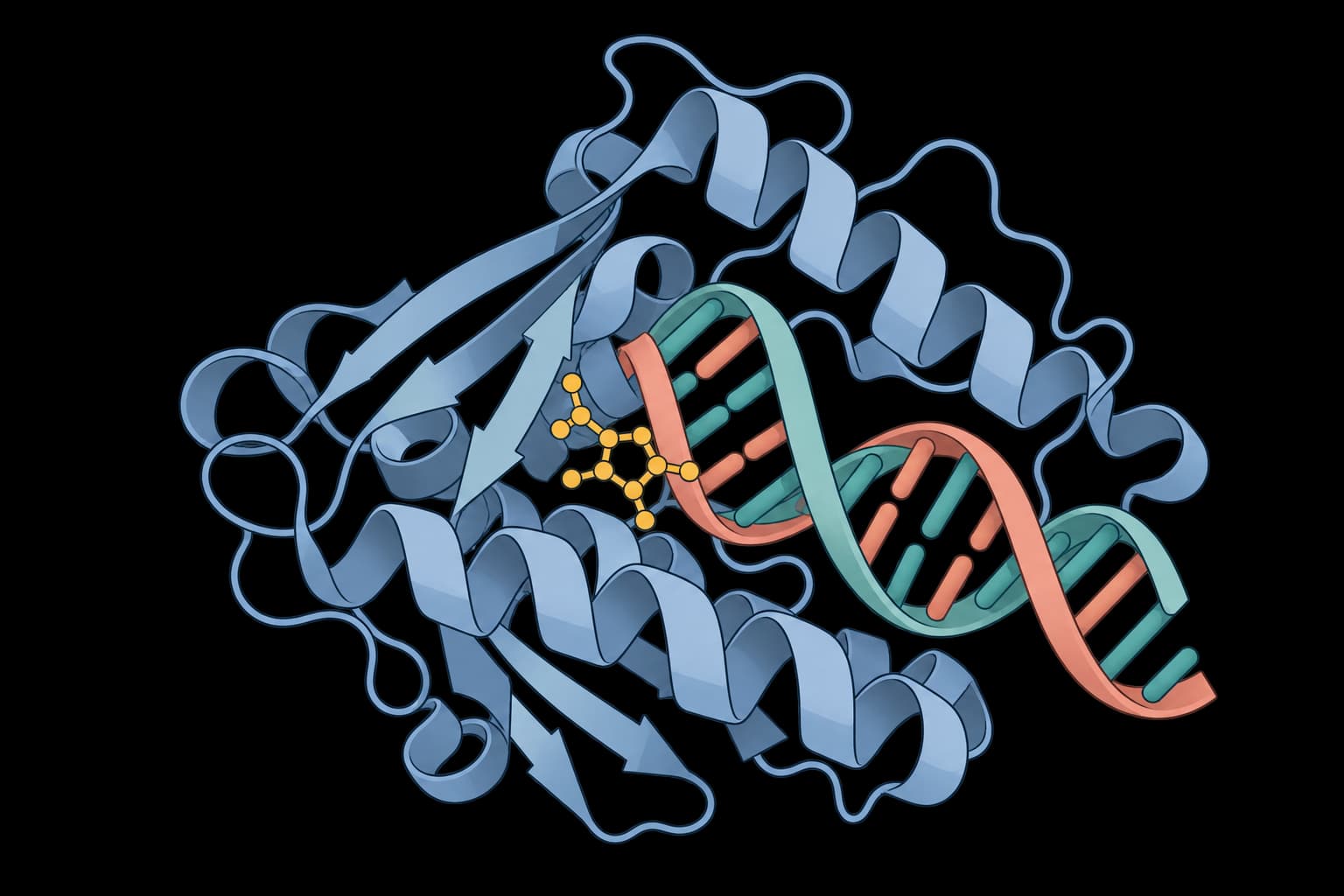
OpenDDE
All-atom biomolecular structure prediction
Input
OpenDDE webserver overview
OpenDDE predicts structures of complexes containing proteins, DNA, RNA, ligands and ions. ProteinIQ uses version 1.1.1, with General and Antibody-antigen models, and returns structures, confidence scores and downloadable run files.
OpenDDE is a preview release. Predictions and numerical reproducibility can change between releases.
Pricing
Runs cost 11 credits per minute of measured runtime. The minimum reservation is 11 credits, not a minimum final charge. Completed runs are charged in proportion to elapsed time, rounded up to a whole credit; unused reserved credits are returned. Set a spending limit before submission. Each batch job is metered separately.
Inputs
Components, the default input mode, combines individual molecules into one predicted complex. At least one protein, DNA, RNA, ligand or ion is required. For example, a protein, a ligand and a magnesium ion entered together belong to the same prediction. Separate FASTA records become separate molecular entities within that complex.
From a structure extracts molecular components from a PDB or CIF file for a new prediction. The supplied coordinates are not held fixed as a receptor or used as a refinement target.
| Input | Accepted formats | Notes |
|---|---|---|
| Protein | Pasted sequence or FASTA; .fasta, .fa | Protein sequences must be ungapped. |
| DNA | Pasted sequence or FASTA; .fasta, .fa | Each record defines one DNA strand; a duplex needs both strands as separate entities. |
| RNA | Pasted sequence or FASTA; .fasta, .fa | Each record defines an RNA entity. |
| Ligand (SMILES or file) | Pasted SMILES; .smiles, .smi, .sdf, .mol, .mol2, .pdb | Structure files supply a ligand conformer. |
| Ligand or ion (CCD) | Pasted code or .ccd | Ligands need the CCD_ prefix, such as CCD_ATP or CCD_NAG_BMA_BGC; ions use codes such as MG. |
| Structure to convert | .pdb, .cif | One structure per prediction job in From a structure mode. |
| Feature and ligand files | .a3m, .hhr, .pdb, .sdf, .mol, .mol2 | Component feature mappings use uploaded filenames; template features use A3M or HHR, not a standalone PDB upload. |
Uploaded files are limited to 50 MiB per file and 50 MiB in total per staged submission. The optional Job name labels the saved run.
Free accounts can submit up to 1,000 residues per job, summed across the submitted protein, DNA and RNA sequences or polymer residues in the first model of a structure. Ligands and feature files do not count toward this residue limit. Paid plans have no plan-wide residue cap. Structure batch mode accepts up to 10 structures, each submitted as a separate prediction job.
Component options
| Parameter | Type | Default | Description |
|---|---|---|---|
| Copies | integer | 1 | From 1 to 10 copies of the component in the complex. |
| Cyclic | boolean | false | Adds a terminal covalent bond to each copy of a protein, DNA or RNA component. |
| Residue position | integer | 1 when added | Position of a residue or base modification, counted from 1. |
| Modification CCD | string | optional | CCD code for that modification without the CCD_ prefix, such as MSE. |
| MSA | string | optional | An unpaired A3M alignment attached to a protein or RNA component. |
The modification editor allows up to 10 modifications per component, with one modification per position. Components with modifications, cyclization or an attached MSA must contain a single sequence. Each chain can have one paired, one unpaired and one template feature file; an attached MSA and a mapped unpaired MSA cannot both target the same chain. Isolated-ion inputs can fail in this OpenDDE release.
Settings
Prediction
| Parameter | Type | Default | Description |
|---|---|---|---|
| Model | enum | General (opendde_v1) | General or Antibody-antigen (opendde_abag). |
| Samples per seed | integer | 5 | Number of predicted structures for each seed; minimum 1. |
| Trunk recycles | integer | 10 | Number of recycling iterations; minimum 1. |
| Diffusion steps | integer | 200 | Number of diffusion sampling steps; minimum 1. |
| Number of seeds | integer | 1 | From 1 to 4294967296 consecutive seeds, subject to the seed range below. |
| Base seed | string | random | Integer from 0 to 4294967295; subsequent seeds increment by one and must remain within that range. |
Leaving Base seed blank chooses a random starting seed. The default configuration produces five predictions. Explicit seeds overrides Base seed and Number of seeds.
Sequence features
| Parameter | Type | Default | Description |
|---|---|---|---|
| Use protein MSA | boolean | true | Enables multiple sequence alignment features, using supplied alignments or automatic search. |
| Use PDB templates | boolean | false | Enables structural template features from supplied template hits or automatic search. |
| Use RNA MSA | boolean | false | Enables RNA alignment features and requires Use protein MSA to remain enabled. |
Uploaded RNA alignments have been tested. Automatic RNA MSA search has not yet been validated for this hosted release.
Advanced settings
| Parameter | Type | Default | Description |
|---|---|---|---|
| Inference precision | enum | FP32 (fp32) | FP32 or BF16 (bf16); changing precision can change numerical results. |
| Full confidence files | boolean | true | Saves detailed atom confidence and pairwise error data for every prediction. |
| Structure downloads | enum | Native CIF (cif) | PDB and native CIF (pdb) adds a PDB export while retaining the original CIF. |
| Claude inference optimization | enum | Off (off) | Published optimization modes: off, exact, fast and big; Fast and Big can change numerical results. |
| Training-Free Guidance | boolean | false | Enables guidance during prediction; this release can fail on single-chain inputs with guidance enabled. |
| Explicit seeds | string | optional | Comma-separated integers from 0 to 4294967295, such as 101,102,103; overrides the other seed settings. |
| Deterministic algorithms | boolean | false | Requests deterministic execution; this does not guarantee identical results across hardware or releases. |
| Triangle multiplication kernel | enum | auto | auto, torch or cuequivariance. |
| Triangle attention kernel | enum | auto | auto, torch or cuequivariance. |
| Cache diffusion variables | boolean | true | Reuses cached variables during diffusion. |
| Fuse diffusion kernels | boolean | true | Enables fused diffusion operations. |
| Enable TF32 | boolean | true | Allows TensorFloat-32 operations where supported. |
PDB export fails if the predicted structure cannot be represented faithfully in that format. Native CIF avoids PDB's format limits.
Component-specific settings
These settings are available in Components mode. Covalent bonds and Component feature files both start empty and use form rows added with Add bond or Add feature file.
Covalent bonds
Each bond links two atoms. The example text shown in empty fields, such as 1, 2, SG or C1, is a placeholder, not a saved value. Entity, position and atom fields need values for the intended bond. Copy fields are optional.
| Parameter | Type | Default | Description |
|---|---|---|---|
| First entity / Second entity | string | required per bond | Entity numbers (entity1/entity2), counted from 1 in component order; each FASTA record is a separate entity. |
| First copy (optional) / Second copy (optional) | integer | optional | Copy numbers (copy1/copy2), counted from 1; blank leaves OpenDDE's default copy handling in place. |
| First residue or ligand part / Second residue or ligand part | string | required per bond | Residue or ligand-part positions (position1/position2), counted from 1. |
| First atom / Second atom | string | required per bond | Atom references (atom1/atom2), such as SG for a cysteine sulfur or the matching ligand atom name. |
The OpenDDE bond reference defines the bond format and ligand atom references.
Component feature files
| Parameter | Type | Default | Description |
|---|---|---|---|
| Chain | string | required per feature file | Chain label shown on the component card, such as A. |
| Feature type | enum | Unpaired MSA (unpaired) | Unpaired MSA (unpaired), Paired MSA (paired) or Template (template). |
| Uploaded filename | string | required per feature file | Exact name of an uploaded feature file, without directory paths. |
For example, an uploaded sequence.a3m is assigned to chain A with Feature type Unpaired MSA. Uploaded asset filenames must be unique. The corresponding MSA or template setting must be enabled for the features to be used.
Structure conversion settings
These settings are available in From a structure mode.
| Parameter | Type | Default | Description |
|---|---|---|---|
| Alternate location | string | first | Selects first, all or a specific alternate location identifier such as A. |
| Biological assembly | string | optional | An assembly ID present in the structure, or all; blank leaves assembly expansion off. |
| Include discontinuous polymer bonds | boolean | false | Includes discontinuous polymer-to-polymer bonds during conversion. |
Outputs
Prediction filenames include the OpenDDE job name, seed and sample rank, for example complex_seed_23_sample_0.cif. Components mode uses complex as the OpenDDE job name; the optional saved-run Job name does not change this filename prefix. New runs use these shorter names; existing results retain their saved filenames.
| Result | Contents |
|---|---|
| Viewer | Interactive display of predicted structures. |
| Confidence | One row per prediction, including job name, seed, rank, confidence metrics and filename. |
| Files | All downloadable structures, confidence files, prepared inputs, generated feature files and logs. |
*_seed_<seed>_sample_<rank>.cif | Native predicted structure for each seed and sample rank. |
*_seed_<seed>_sample_<rank>_confidence.json | Summary metrics, chain metrics and clash flags. |
*_seed_<seed>_sample_<rank>_full_confidence.json | Detailed confidence arrays when Full confidence files is enabled. |
*_seed_<seed>_sample_<rank>.pdb | Additional PDB structure when requested. |
opendde.log, conversion.log | Prediction log and, for structure input, conversion log when produced. |
opendde_input.json | Prepared Components-mode input; structure conversion retains its generated JSON under inputs/converted/. |
opendde_provenance.json | Recorded software, settings and execution information. |
Generated alignments, template hits, search files and other native run files remain available in Files when produced. An unusual filename collision preserves the original path-based filename so no artifact is overwritten.
Predictions are grouped by job and seed. Within each seed, rank 0 is the highest-ranked native sample. Seed order is preserved; predictions from different seeds are not globally reranked. Confidence JSON files retain additional metrics beyond the main table columns.
Understanding results
| Field | Meaning |
|---|---|
pLDDT (plddt) | Mean predicted local confidence across atoms, on a 0 to 100 scale; higher indicates greater local confidence. |
pTM (ptm) | Predicted confidence in overall structure, on a 0 to 1 scale; higher is better. |
ipTM (iptm) | Predicted confidence in relative chain placement, on a 0 to 1 scale; a single-chain input has no interchain interface to assess. |
GPDE (gpde) | Global predicted distance error in Å, weighted by predicted contact probabilities; lower is better. |
ranking_score | Native composite ranking score incorporating pTM, ipTM and a clash penalty; it can be negative and is not a probability. |
has_clash | Flag indicating that the model's clash criterion was met. |
Full confidence files include atom_plddt on a 0 to 1 scale, token_pair_pae and token_pair_pde in Å, and contact_probs. The atom confidence scale differs from the summary pLDDT scale. These confidence estimates describe the prediction and do not establish binding affinity or experimental validity.
Related tools
Chai-1
Predict 3D structures for proteins, ligands, DNA, RNA, and multi-component complexes.
IntelliFold 2
Predict controllable biomolecular structures for proteins, ligands, DNA, RNA, and complexes.
OpenFold-3
Open-source AlphaFold3-based structure prediction for proteins, ligands, DNA, and RNA
Protenix
Open-source biomolecular structure prediction with Protenix
RosettaFold3
Open-source structure prediction for proteins, nucleic acids, and ligands
Boltz-2
Predict biomolecular complex structures and binding affinities for proteins, ligands, DNA, and RNA.
LMI4Boltz
Low-memory Boltz inference for biomolecular structure and affinity prediction
Boltz-2.1
Structure and binding prediction for proteins, DNA, RNA and ligands.
ABodyBuilder3
Predict paired antibody variable-domain structures from heavy and light chain sequences.
AlphaFlow
Generate protein conformational ensembles from sequence or structure inputs.