Predict protein-protein binding affinity from structure
Input
PRODIGY webserver overview
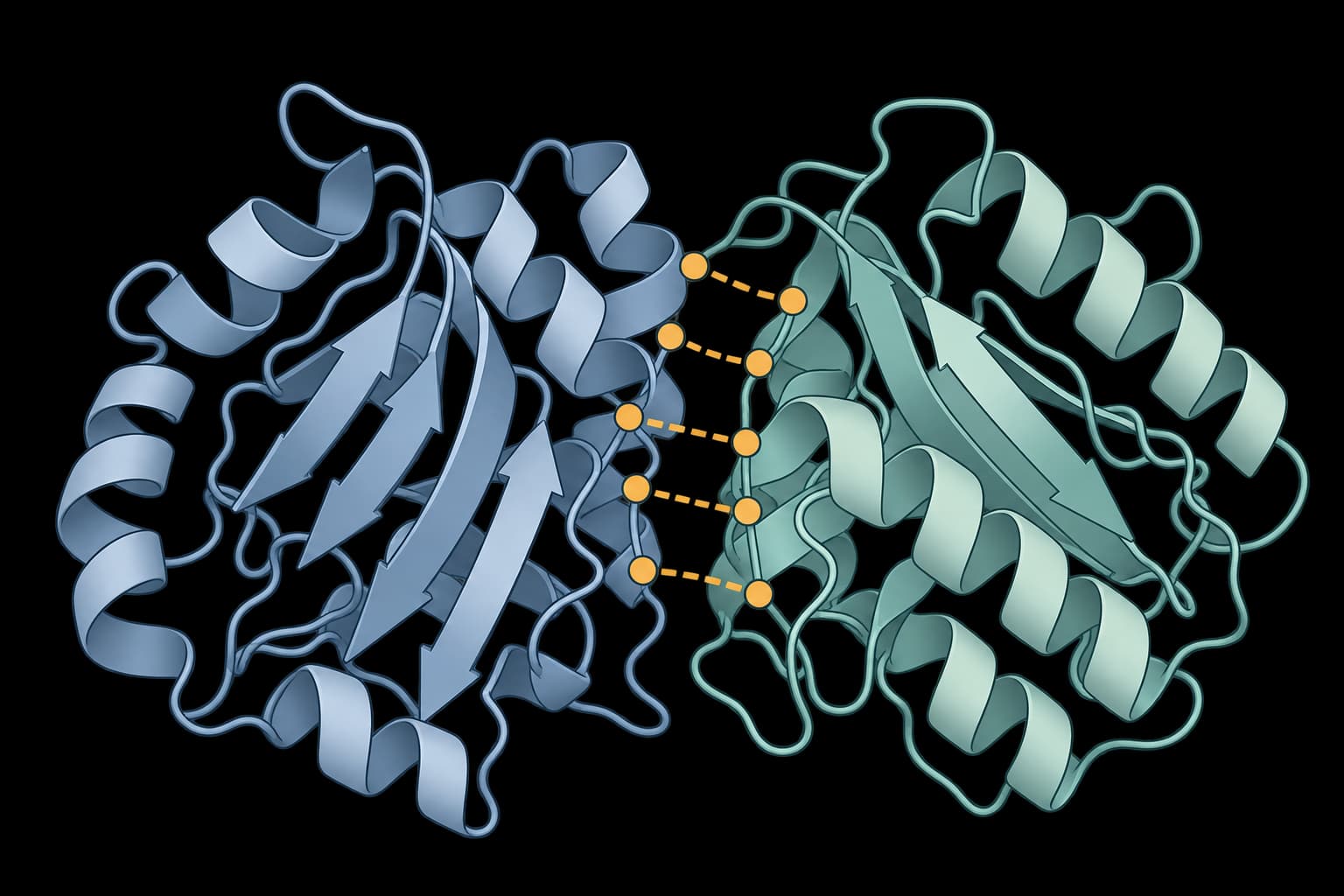
PRODIGY predicts protein-protein binding affinity from the contacts and surface properties of a protein complex. ProteinIQ runs PRODIGY 2.4.0 and returns a results table and a text report. Residue-contact downloads are enabled by default and can be turned off; a PyMOL interface script is optional. The method requires an existing complex structure with interacting protein chains. See the PRODIGY project for the scientific software and references.
Pricing
Each run costs 10 credits, regardless of runtime. Each job in a batch costs 10 credits.
Inputs
| Input | Accepted values and limits |
|---|---|
Protein complex | One PDB file (.pdb or .ent) or mmCIF file with the .cif extension. Maximum 50 MiB (52,428,800 bytes) per file. |
| RCSB PDB ID | Fetches a structure from the Protein Data Bank in PDB format. |
| Multi-model structure | Supported within one file. Models must contain matching sets of chain and residue identifiers. |
| Batch | Up to 10 complex files, with a separate job for each file. |
The selected partners must have intermolecular contacts at the chosen distance cutoff. Chain groups must not repeat a chain. PRODIGY removes solvent, heteroatom residues, hydrogens, and residues with insertion codes during its structure preparation; remaining nonstandard amino acids cause an error. These behaviors follow the PRODIGY 2.4.0 structure parser.
Settings
Prediction
| Parameter | Type | Default | Description |
|---|---|---|---|
Chain selection | string | Blank | Spaces separate partners; commas group chains within one partner. Blank includes all inter-chain contacts. |
Temperature (°C) | number | 25 | Temperature used to calculate the dissociation constant; it does not change the predicted binding affinity. |
Contact distance (Å) | number | 5.5 | Maximum interatomic distance used to identify contacting residues across partner groups. |
Accessibility threshold | number | 0.05 | Relative solvent accessibility threshold used to classify non-interacting surface residues; 0.05 corresponds to 5%. |
Chain selections refer to identifiers in the supplied structure:
| Selection | Contacts included |
|---|---|
A B | Chain A against chain B. |
A,B C | Chains A and B form one partner against C; contacts between A and B are excluded. |
A B C | All three pairings: A against B, A against C, and B against C, combined into one prediction per model. |
' ' B | A chain with a blank identifier against chain B. |
Chain selection controls which contacts enter the prediction. The non-interacting surface calculation uses the entire supplied model, including chains outside the selection, as implemented in the PRODIGY calculation.
Reports and downloads
| Parameter | Type | Default | Description |
|---|---|---|---|
Save contact list | boolean | true | Includes the .ic residue-contact file; enabled by default in ProteinIQ. |
Save PyMOL selection | boolean | false | Includes a .pml interface script that colors the first two partner groups. |
Affinity-only report | boolean | false | Returns the structure identifier and affinity only; the text report prints affinity to three decimal places and omits contact counts, surface percentages, temperature, and dissociation constants. |
Job name | string | optional | A label for identifying the run; it does not affect the calculation. |
Contact and PyMOL downloads remain available when Affinity-only report is enabled.
Outputs
The Results tab contains one row per successfully processed model, in PRODIGY's report order. With Affinity-only report enabled, the table contains only Structure and Binding affinity (kcal.mol-1). The Files tab provides the following downloads:
| File | Availability | Contents |
|---|---|---|
prodigy.txt | Always | PRODIGY's printed report, saved unchanged by ProteinIQ. PRODIGY prints this report to standard output rather than creating a file with this name. |
*.ic | Save contact list enabled | One residue pair per line, with residue name, residue number, and chain identifier for each partner. |
*.pml | Save PyMOL selection enabled | PyMOL commands for displaying and coloring the interface; the complex structure must be loaded separately. |
prodigy-stderr.log | Always | Messages written to standard error. An empty file means nothing was written to that stream; warnings or model errors can still appear in prodigy.txt. |
Contact and PyMOL filenames use the input filename with a different extension. For multi-model files, PRODIGY reuses the same .ic and .pml filenames and overwrites them as models run. These downloads are not separate files for every model. Separate jobs are needed for model-specific contact lists or PyMOL scripts. This follows the PRODIGY 2.4.0 output behavior.
If some models fail while others succeed, the results can contain only the successful models. The report retains the model errors and should be checked before interpreting an ensemble.
Understanding results
| Result field | Meaning |
|---|---|
Structure | Input name and model identifier. |
Binding affinity (kcal.mol-1) | Predicted binding free energy, ΔG; more negative values indicate stronger predicted binding. |
Dissociation constant (M) | Predicted Kd in molar units at the reported temperature; smaller values indicate tighter binding. |
Temperature (°C) | Temperature used for the Kd calculation. |
Intermolecular contacts | Number of contacting residue pairs across the selected partner groups. |
Charged-charged contacts | Contacts between two charged residues. |
Charged-polar contacts | Contacts between a charged residue and a polar residue. |
Charged-apolar contacts | Contacts between a charged residue and an apolar residue. |
Polar-polar contacts | Contacts between two polar residues. |
Apolar-polar contacts | Contacts between an apolar residue and a polar residue. |
Apolar-apolar contacts | Contacts between two apolar residues. |
Apolar NIS (%) | Percentage of apolar residues among the non-interacting surface residues defined by the accessibility threshold. |
Charged NIS (%) | Percentage of charged residues among those non-interacting surface residues. |
The table preserves the precision printed in the report. Standard reports print affinity to one decimal place; affinity-only reports print three. These values are predictions from the supplied complex geometry, not experimental measurements.
Related tools
StaB-ddG
Predict mutation effects on protein binding
AllMetal3D
Predict metal and water binding sites in proteins with 3D CNN models.
LocScale
Physics-informed local sharpening for cryo-EM density maps.
MolProbity
Validate protein structures with clashscore, Ramachandran, rotamer, and geometry checks.
PDBsum
Generate structural summary reports and diagrams for a single protein PDB structure.
pyRMSD
Pairwise RMSD matrices for PDB structure ensembles
SuperWater
Diffusion-based hydration site prediction for protein structures
Aggrescan3D
Analyze aggregation-prone regions in a protein structure.
DeepRank-GNN-esm
Score every protein interface with ESM-2 and a graph neural network
DockQ
Assess docking quality between model and native structures