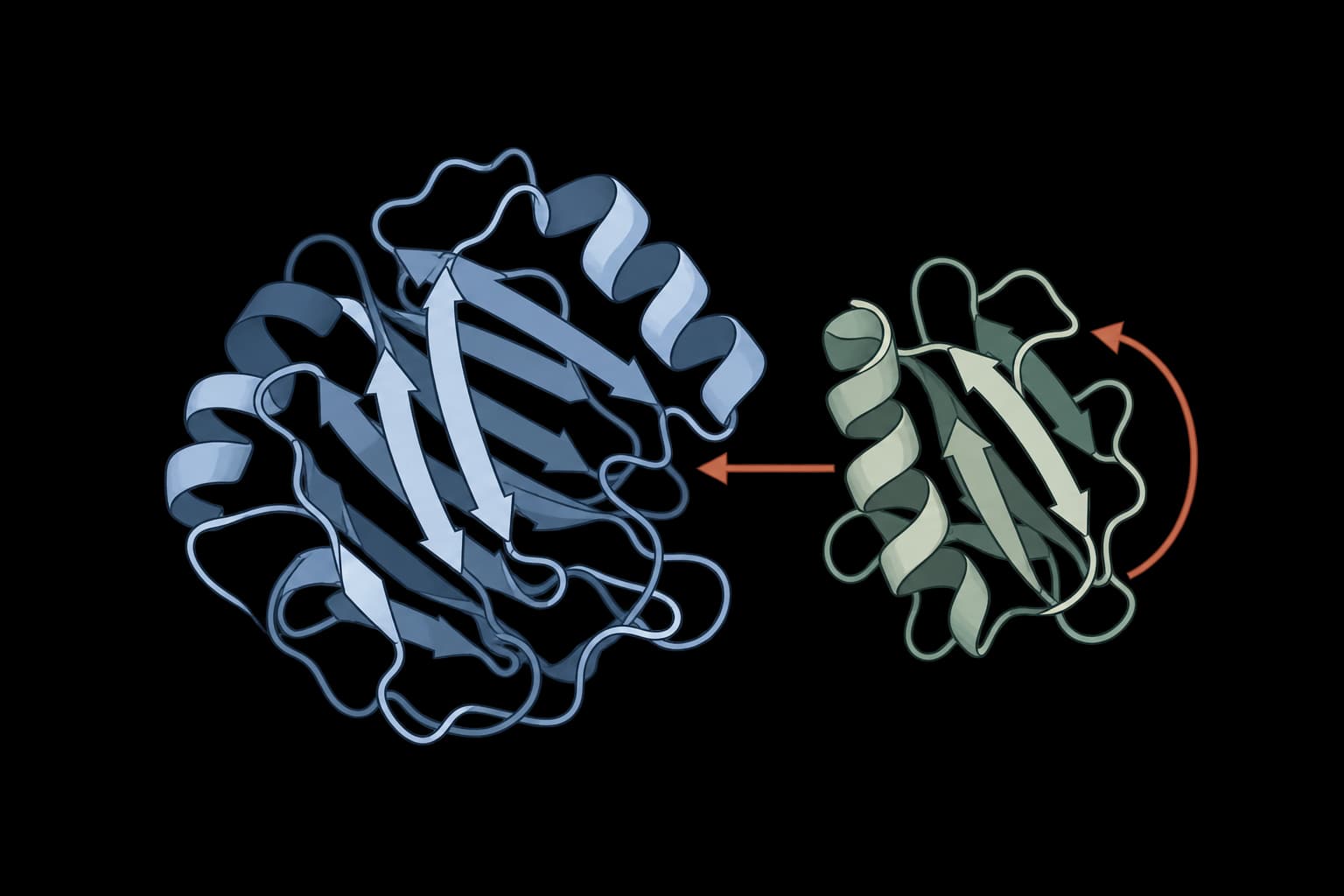
DiffDock-PP
Rigid protein-protein docking with a diffusion model and confidence ranking.
Input
DiffDock-PP webserver overview
DiffDock-PP docks two protein structures using a rigid-body diffusion model. It holds the receptor fixed, samples placements of the other protein, and ranks the resulting poses with a confidence model. ProteinIQ uses the released DIPS score and confidence checkpoints from source revision 25a2890.
The model works with residue-level representations. ProteinIQ also returns a full-atom PDB complex for each ranked pose by applying the model's rigid placement to the submitted structures. The structures are docking candidates, not refined complexes.
Pricing
Runs cost 27 credits per minute of measured runtime. The minimum reservation is 27 credits, not a minimum final charge. Completed runs are charged in proportion to elapsed time, rounded up to a whole credit; unused reserved credits are returned. Set a spending limit before submission. Each batch job is metered separately.
Inputs
Each job requires one receptor protein and one ligand protein. Here, ligand protein means the protein partner being moved during docking, not a small molecule.
| Input | Accepted formats | Requirements |
|---|---|---|
| Receptor protein | .pdb or .ent upload, or a PDB structure fetched from RCSB | One structure with one PDB model, up to 50 MiB and 1,000 protein backbone residues. |
| Ligand protein | .pdb or .ent upload, or a PDB structure fetched from RCSB | One structure with one PDB model, up to 50 MiB and 1,000 protein backbone residues. The form labels this as the smaller partner. |
The input cards can trim a structure before submission. Job name is an optional label for the saved run and does not affect docking.
Settings
Sampling
| Parameter | Type | Default | Description |
|---|---|---|---|
Number of poses (num_samples) | integer | 40 | Sample and rank 1 to 40 poses. |
Random seed (seed) | integer | 0 | Seed for the initial placements and diffusion noise; accepts 0 to 4,294,967,295. |
Advanced sampling
| Parameter | Type | Default | Description |
|---|---|---|---|
Diffusion steps (num_steps) | integer | 40 | Length of the reverse-diffusion schedule, from 0 to 40. The released model was trained with 40. |
Actual steps (actual_steps) | integer | 40 | Steps to run, from 0 to 40. Values above Diffusion steps have no additional effect. A nonzero schedule runs at least one step. |
No noise in the final step (no_final_noise) | boolean | true | Omit random noise from the final reverse-diffusion update. |
Low-temperature sampling factor (temp_sampling) | number | 2.439 | Adjust low-temperature sampling; 1.0 turns it off. |
Temperature psi (temp_psi) | number | 0.216 | Psi parameter for low-temperature sampling. |
Sigma data (translation) (temp_sigma_data_tr) | number | 0.593 | Translation weight used by low-temperature sampling. |
Sigma data (rotation) (temp_sigma_data_rot) | number | 0.228 | Rotation weight used by low-temperature sampling. |
The advanced settings match the released single-pair inference configuration. Leave them at their defaults unless comparing sampling behavior.
Outputs
Viewer displays the ranked full-atom complexes. Data lists each pose's rank, confidence logit and PDB download. Files retains the other run artifacts.
| Download | Contents |
|---|---|
complex_rank01.pdb and subsequent ranked complexes | Full-atom receptor and ligand structures at each sampled rigid-body placement. The number of files matches Number of poses. |
ranked_poses.csv | Rank, confidence logit and complex filename for every pose. |
run_on_pdb_pairs.pkl | Native prediction data, including the input graph and ranked residue-level poses. |
single_pair_inference.yaml | Inference configuration used for the run. |
| Native trajectory PDB files | Reverse-diffusion visualizations with C-alpha traces. These are model sampling steps, not molecular dynamics trajectories. |
provenance.json | Source, checkpoint, runtime, settings and invocation identities. |
diffdock_pp.log | Execution log and diagnostic messages. |
The workflow output provides each full-atom docked complex to compatible structure tools.
Understanding results
The confidence value is a logit from the ranking model. Higher values rank poses ahead of lower values within a run. It is not a probability, binding affinity, or guarantee that a pose is correct. Inspect the structures for clashes and biological plausibility before using them for further analysis.
For the method and checkpoint background, see the DiffDock-PP paper and source repository.
Related tools
AF2Dock
Structure-based protein-protein docking with AF2Dock flow-matching refinement
DFMDock
Dock protein-protein complexes with diffusion-based sampling and confidence ranking.
EquiDock
Dock rigid protein-protein complexes using SE(3)-equivariant geometric modeling.
GeoDock
Flexible protein-protein docking with a multi-track iterative transformer.
ColabDock
Protein-protein docking guided by experimental restraints using AlphaFold2
LightDock
Protein-protein, protein-peptide, and protein-DNA docking using Glowworm Swarm Optimization
ParaSurf
Surface-based deep learning for paratope-antigen interaction prediction
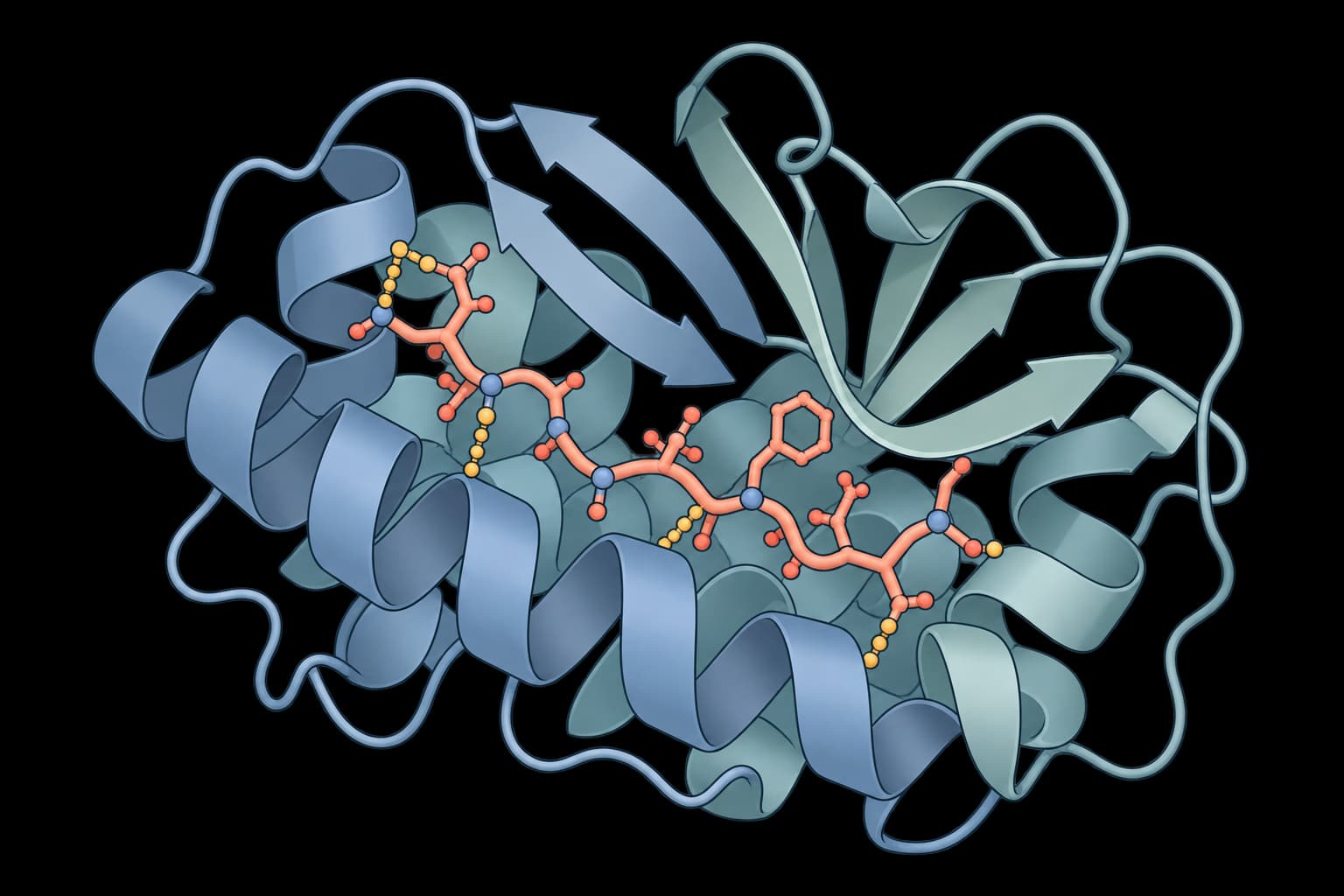
RAPiDock
All-atom protein-peptide docking with unranked samples.
SurfDock
Surface-informed diffusion generative model for reliable and accurate protein-ligand complex prediction
DiffDock-L
Predict protein-ligand binding poses and confidence scores without a predefined binding site.