Boltz Sequence Redesign
Redesign chosen residues on a fixed protein structure.
Input
Boltz Sequence Redesign webserver overview
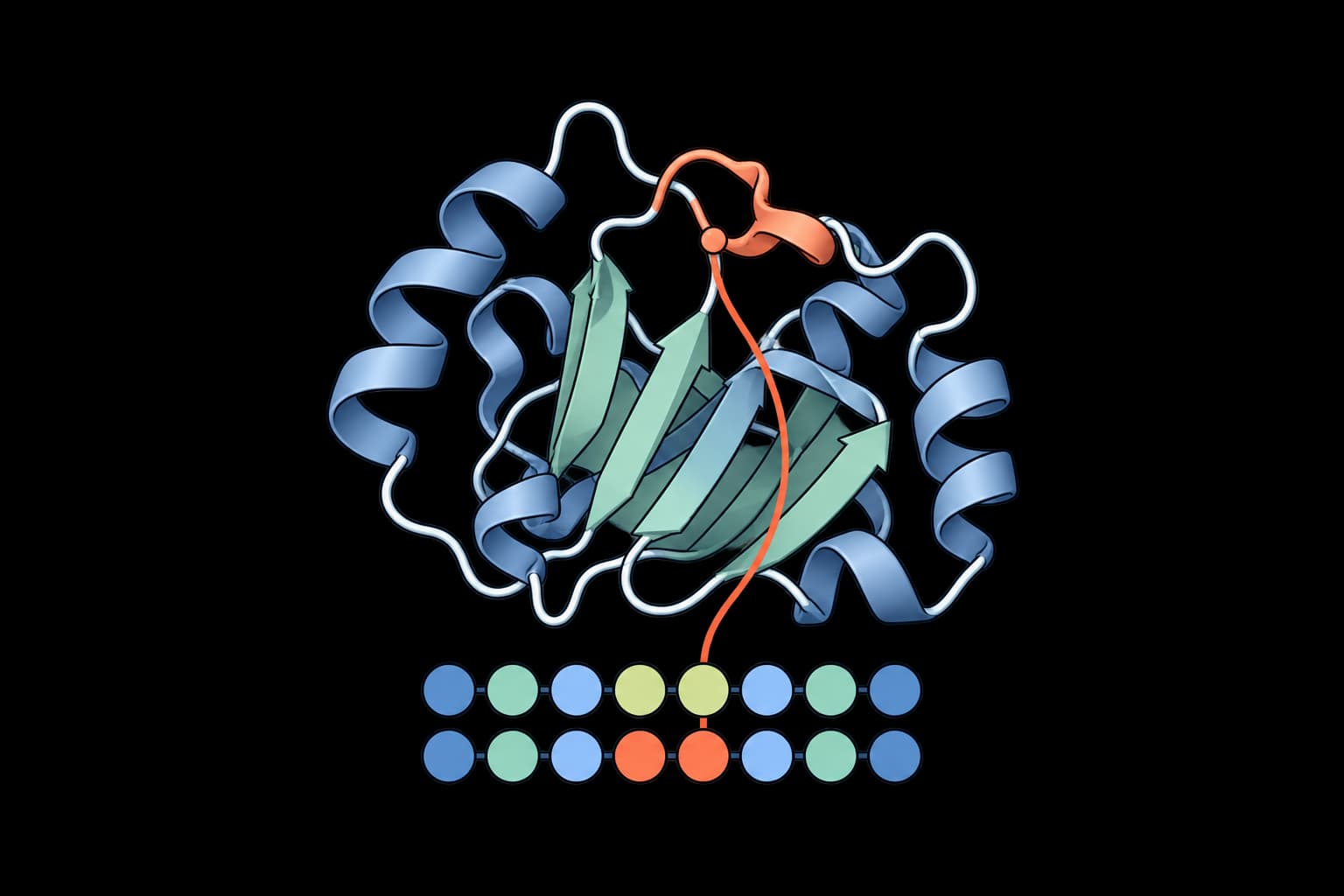
Boltz Sequence Redesign proposes new amino acids for chosen residues of a fixed structure, keeping the rest of the structure as it is. It can redesign a binder chain against the remaining chains, or positions anywhere in the structure. Each design comes back with its sequence, Boltz's scores and a predicted complex.
ProteinIQ sends the job to the hosted Boltz API pipeline and publishes the finished sequences, structures and records. To design a new binder from a target sequence instead, use BoltzProt-1. For open-source inverse folding, see ProteinMPNN and LigandMPNN.
Pricing
Sequence Redesign is billed per design, and each design is priced by the size of the submitted structure in tokens: one per polymer residue in every chain, plus one per non-water ligand heavy atom. The number of redesigned positions does not change the price.
| Structure size (tokens) | 10 designs | 50 designs | 200 designs |
|---|---|---|---|
| Up to 256 | 507 | 2,532 | 10,127 |
| 257 to 512 | 1,013 | 5,064 | 20,254 |
| 513 to 1,024 | 2,026 | 10,127 | 40,507 |
| 1,025 to 2,048 | 4,051 | 20,254 | 81,013 |
| More than 2,048 | 8,102 | 40,507 | 162,026 |
The total is rounded once for the whole job. The design mode and the sequence filters do not change the price. The exact quote is calculated before submission. If Boltz estimates a noticeably higher cost when the job starts, the run is not started and the credits are refunded.
Inputs
| Input | Accepted formats | Limits and behavior |
|---|---|---|
Structure | One .cif, .pdb or .ent file, or a structure fetched from RCSB | Required. One structure per job, one model, up to 50 MB, with at least one polymer chain. PDB files are converted to mmCIF before submission. |
Hydrogens and empty chains are removed before the structure is sent. Job name is an optional label for the saved run.
Settings
Redesign
| Parameter | Type | Default | Description |
|---|---|---|---|
Residues to redesign (redesign_residues) | string | required | Positions to redesign per chain, 1-based, for example B:26-33. The chain prefix can be omitted only when the structure has one chain. |
Design mode (design_mode) | enum | binder | binder redesigns binder chains against the remaining target chains. generic redesigns positions anywhere in the structure. |
Binder chains (binder_chains) | string | conditional | Chains treated as the binder, comma-separated. Required in binder mode. |
Designs (num_designs) | integer | 10 | Sequences to return, from 10 to 200. Each one is billed. |
Binder mode also requires that every redesigned position sits on a binder chain, that at least one chain is left as the target, and that at least five residues are redesigned in total.
Sequence filters
| Parameter | Type | Default | Description |
|---|---|---|---|
Excluded amino acids (excluded_amino_acids) | string | C | Amino acids never placed in designed positions, as single-letter codes separated by commas. |
Maximum hydrophobic fraction (max_hydrophobic_fraction) | number | 1 | Largest fraction of hydrophobic residues in a design, from 0 to 1. 1 turns the filter off. |
Excluded sequence motifs (excluded_motifs) | string | optional | Motifs designs must not contain, one per line or comma-separated. |
Outputs
Viewer shows the predicted complexes. Results lists the designs. Files holds the downloads.
| Download | Contents |
|---|---|
boltz_redesign_0001_<name>.cif onwards | Predicted complex for each design, numbered by rank. |
boltz_redesign_sequences.fasta | Designed sequences, with the chain IDs in each header. |
boltz_redesign_results.csv | The results table. |
boltz_redesign_results.json | Boltz's run and per-result records. |
The FASTA sequences and the predicted complexes can be passed to other tools in workflows.
Understanding results
Each row carries a rank, the design ID, the designed sequence and chains, Boltz's own metric columns, any warnings Boltz attached and the matching structure file. Ranks follow the order Boltz returns, so rank 1 is its top-scoring design. Nested metrics are flattened into columns joined by underscores.
Positions outside the redesigned selection keep their original amino acids, so comparing a design against the input sequence shows exactly what changed. Scores order designs within one run and are not measured stability or binding.
Related tools
AntiFold
Design antibody sequences from structure with AI-powered inverse folding
BoltzProt-1
Protein, peptide, nanobody and antibody binder design.
EvoDiff
Generate protein sequences de novo, scaffold fixed motifs, or inpaint selected regions.
Genie 3
All-atom SE(3)-equivariant diffusion for unconditional generation, motif scaffolding, and binder design.
Humatch
Humanize antibodies with optimal V-gene matching.
IgDesign
Design antibody CDR loops from antibody-antigen complex structures using inverse folding.
ODesign
Design all-atom protein binders with controlled target sites, lengths, and interaction parameters.
PocketFlow
Generate novel drug-like molecules in protein binding pockets using AI-powered structure-based design.
PocketXMol
Generate docking poses, drug-like molecules, and peptides inside protein binding pockets with PocketXMol.
ProFam
Family-conditioned protein sequence generation from FASTA, A2M, or A3M input