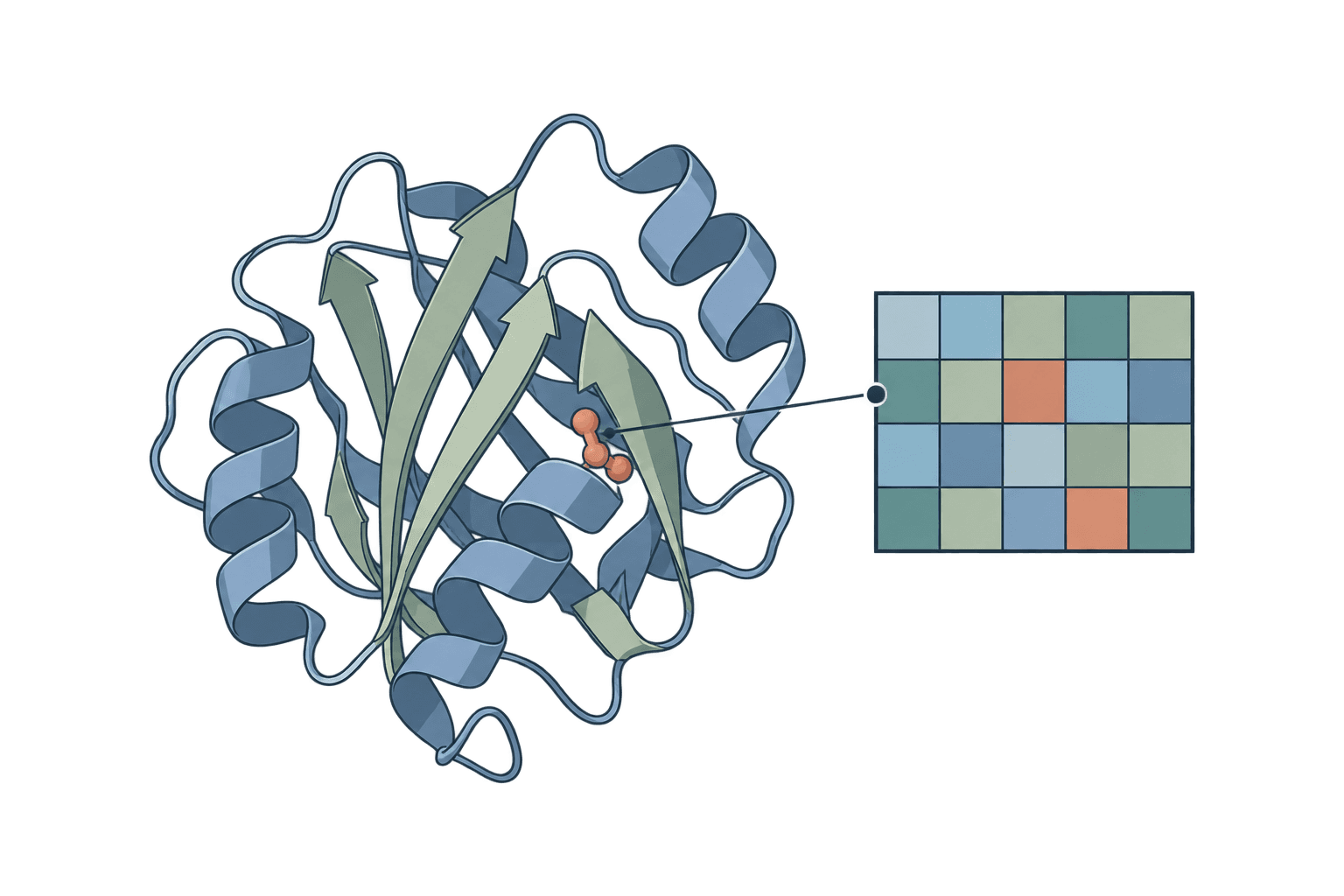
RaSP
Predict protein stability changes across single amino acid substitutions.
Input
Not available for new jobs
RaSP webserver overview
RaSP predicts the effects of single amino acid substitutions on protein stability from a PDB structure. Predict stability runs saturation mutagenesis for the selected chain. Format existing predictions runs the standalone CSV formatter to add MutateX and Rosetta mutation names without rerunning prediction.
The scientific version is RaSP commit 2677eba. New jobs are temporarily unavailable while validation is completed.
Pricing
Each job costs 20 credits in either mode. The quote is shown before submission. In a batch, each input file becomes a separate job.
Inputs
| Operation | Input | Limit and requirements |
|---|---|---|
| Predict stability | One PDB structure | Up to 50 MiB. Upload a file or fetch a structure from RCSB or AlphaFold. Enter the chain selection. |
| Format existing predictions | One CSV | Up to 50 MiB. Required columns: variant, wt_AA, pos, mt_AA, chainid, and score_ml. The native prediction CSV can be used directly. |
AlphaFold fetching defaults to model version 4. A different version can be selected before fetching. Unavailable versions produce an acquisition error; no newer model is substituted automatically.
PDB filenames must use letters, digits, dots, hyphens, or underscores and start with a letter or digit. CSV filenames may also contain spaces and Unicode characters. Path traversal and control characters are rejected. Captured input bytes are retained with the results; structure preparation belongs to the native prediction workflow.
Settings
| Parameter | Type | Default | Description |
|---|---|---|---|
| Operation | enum | predict | predict runs inference; postprocess formats an existing CSV. |
| Chain to analyze | string | Required for prediction | Native chain selection, such as A. Residue numbering is retained. |
| Inference device | enum | cpu | Prediction only. cuda selects GPU inference. CSV formatting uses CPU. |
| CPU threads | integer | 1 | Prediction only. A positive integer passed to the native thread setting. |
| Add MutateX and Rosetta formatting | boolean | false | Prediction only. Adds the formatted CSV after inference while retaining the original prediction CSV. |
Outputs
| Output | Availability | Contents |
|---|---|---|
| Native stability predictions | Prediction | Native CSV and a table retaining residue identifiers, substitutions, scores, ordering, and self substitutions. |
| Formatted predictions | CSV formatting, or optional after prediction | Native post_processed_*.csv and a table with RaSP_ddG, mutatex_name, rosetta_name, residue fields, chain, and the native unnamed index column. |
| Structures and quality report | Prediction | Captured input PDB, selected-chain PDB, prepared PDB, and quality_control.txt. |
| Input CSV | CSV formatting | Original captured CSV, unchanged. |
| Logs and provenance | Both modes | Native log, source and model identity, executed commands, settings, input hashes, and a separate resource report. |
CSV formatting renames score_ml to RaSP_ddG and creates mutation names for MutateX and Rosetta. It does not calculate new stability scores or run either application. Native CSV files preserve the original writer's precision; the displayed tables provide numeric scores and retain identifiers as text.
If native execution fails, available input files, quality reports, and logs are retained to explain the failure.
Related tools
EvoIF
Score single and multi-site protein mutations with evolutionary and inverse-folding profiles.
ThermoMPNN
Predict mutation ΔΔG values and identify stabilizing substitutions for protein engineering.
Aggrescan3D
Analyze aggregation-prone regions in a protein structure.
CANYA
Predict protein aggregation nucleation propensity from amino acid sequences.
PROPKA 3
Predict pKa values of ionizable groups in proteins based on 3D structure.
Protein-Sol
Predict protein solubility from sequence with feature-level and windowed profile outputs.
TNP
Characterize nanobody developability with sequence, structure, and surface-property metrics.
AllMetal3D
Predict metal and water binding sites in proteins with 3D CNN models.
DeepSP
Generate 30 sequence-derived spatial descriptors for paired antibody variable domains.
DeepViscosity
Screen paired antibody Fv sequences for high-concentration viscosity risk.