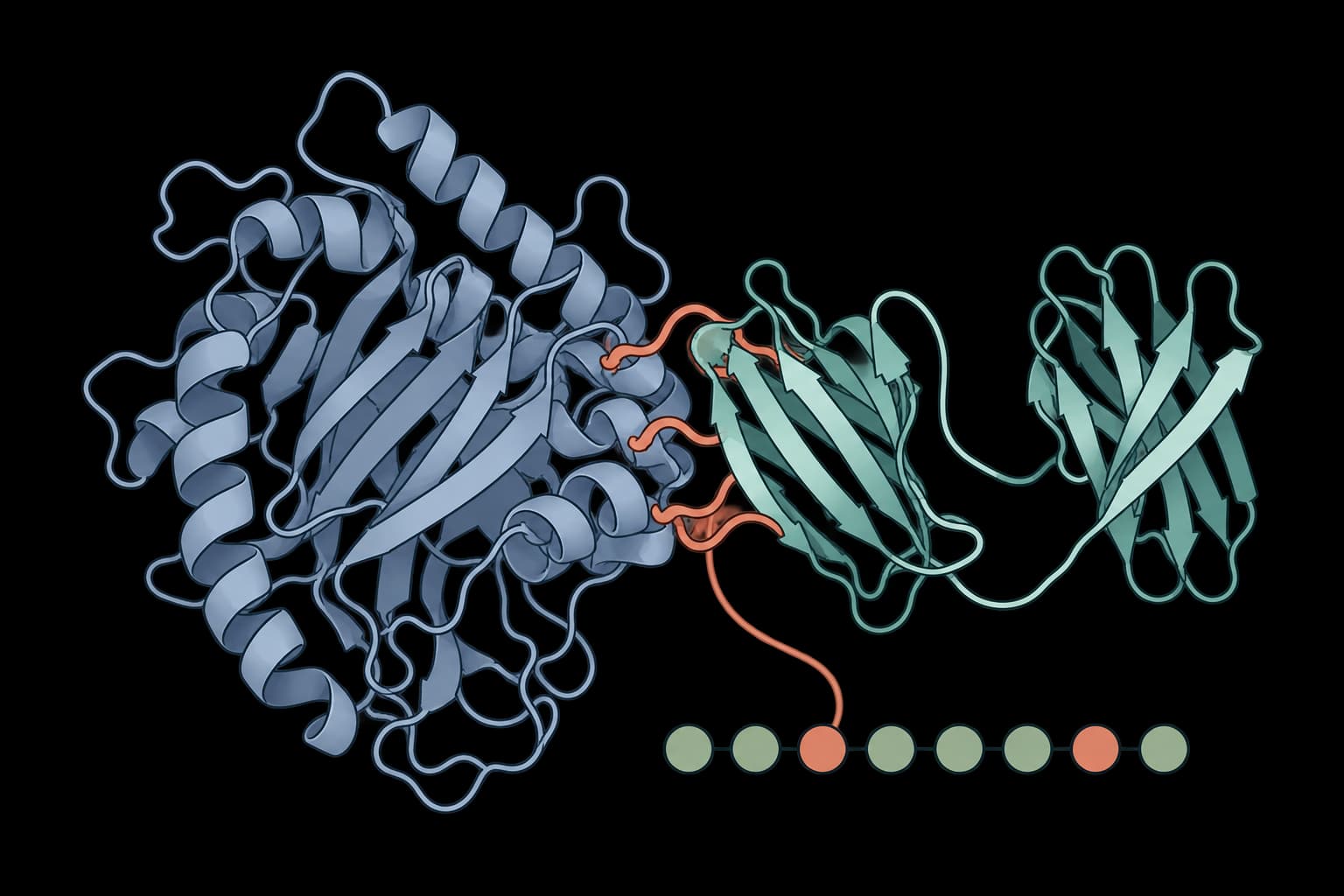
ESMFold2 Binder Design
Design minibinders and antibody scFvs against a protein target.
Input
ESMFold2 Binder Design
Design minibinders and antibody scFvs against a target protein using Biohub ESM release 3.4.1.post1. Each trajectory runs the published 150-step optimization and scores candidates with the native models. Download every candidate, optimization trajectory, scoring result, and predicted complex.
Pricing
Runs use metered billing at 42 credits per minute. The reservation shown before submission estimates 20 minutes per candidate per trajectory, with a minimum reservation of 42 credits. Unused reserved credits are returned after settlement. A run stops when its credit budget is exhausted; the maximum runtime is 12 hours.
Inputs
| Input | Formats | Requirements |
|---|---|---|
| Target sequence | Text, .txt, .fasta, .fa | One uppercase protein sequence using canonical amino acids. Omit when using a target preset. |
| Custom binder template | Text, .txt, .fasta, .fa | One template using uppercase amino acids for fixed positions and # for positions to design. Omit when using a binder preset. |
Each uploaded file can be up to 10 MiB. Target presets are cd45, ctla4, egfr, pd-l1, and pdgfr. Binder presets are minibinder, trastuzumab_framework_vhvl, atezolizumab_framework_vhvl, and ocankitug_framework_vhvl. A custom input requires a name different from these preset names.
A custom binder template must include at least one # position to design. Hotspots must match the residue and one-based position in your supplied target or the selected preset sequence.
In batch mode, each target and template combination becomes a separate job. With a target preset, omit target inputs and supply the custom templates to batch.
Settings
| Parameter | Type | Default | Description |
|---|---|---|---|
| Target name or preset | string | custom-target | Name for the supplied target, or an available target preset. |
| Binder template name or preset | string | minibinder | Available binder preset or a custom template name. |
| Design trajectories | integer | 1 | Independent optimization runs. Seeds increase by one between runs. |
| Candidates per trajectory | integer | 1 | Candidates optimized together. Larger batches need more GPU memory. |
| Seed | integer | 0 | Nonnegative random seed. |
| Additional scoring models | boolean | true | Runs the published 15 additional scoring checkpoints. Increases runtime. |
| Antibody scoring | enum | auto | Automatic recognition, antibody, or minibinder scoring. Must match a selected binder preset. |
| Target hotspot residues | JSON array | [] | Residue letter and one-based target position, for example ["L150"]. |
| Epitope contact distance | number | 12 | Contact distance in angstroms. |
| Deterministic execution | boolean | false | Requests deterministic PyTorch algorithms where supported. |
Outputs
| Output | Contents |
|---|---|
| Selected designs | Published selection results and selection.parquet, including the minibinder pI filter and native ranking. Selection can be empty. |
| All scoring results | Native critic scores in JSON and TSV, including logits in the JSON download. |
| Structures | Native PDB files for scored and selected binder-target complexes. |
| Sequences | Binder FASTA and complete target-binder candidate sequences in JSON. |
| Run files | Optimization trajectories, original inputs, pinned model and source identities, settings, and complete run log. |
Scores describe predicted structural confidence and model preferences. They do not establish experimental binding or affinity. All candidates remain downloadable even when none pass the published selection filter.
The Biohub binder design notebook describes the design and selection protocol.
Related tools
BoltzGen
Design protein, peptide, and nanobody binders against protein or small-molecule targets.
BoltzProt-1
Protein, peptide, nanobody and antibody binder design.
mBER
Design VHH nanobody binders using structure-guided modeling.
RFantibody
Design antibody and nanobody binders with an end-to-end RosettaCommons pipeline
AntiFold
Design antibody sequences from structure with AI-powered inverse folding
Humatch
Humanize antibodies with optimal V-gene matching.
IgDesign
Design antibody CDR loops from antibody-antigen complex structures using inverse folding.
Proteo-R1
Design antibody CDRs with Proteo-R1 reasoning, diffusion, and optional framework inpainting.
BindCraft
Design de novo protein binders for target surfaces using structure-guided sequence generation.
EvoPro
Genetic algorithm-based protein binder optimization using AlphaFold2 and ProteinMPNN