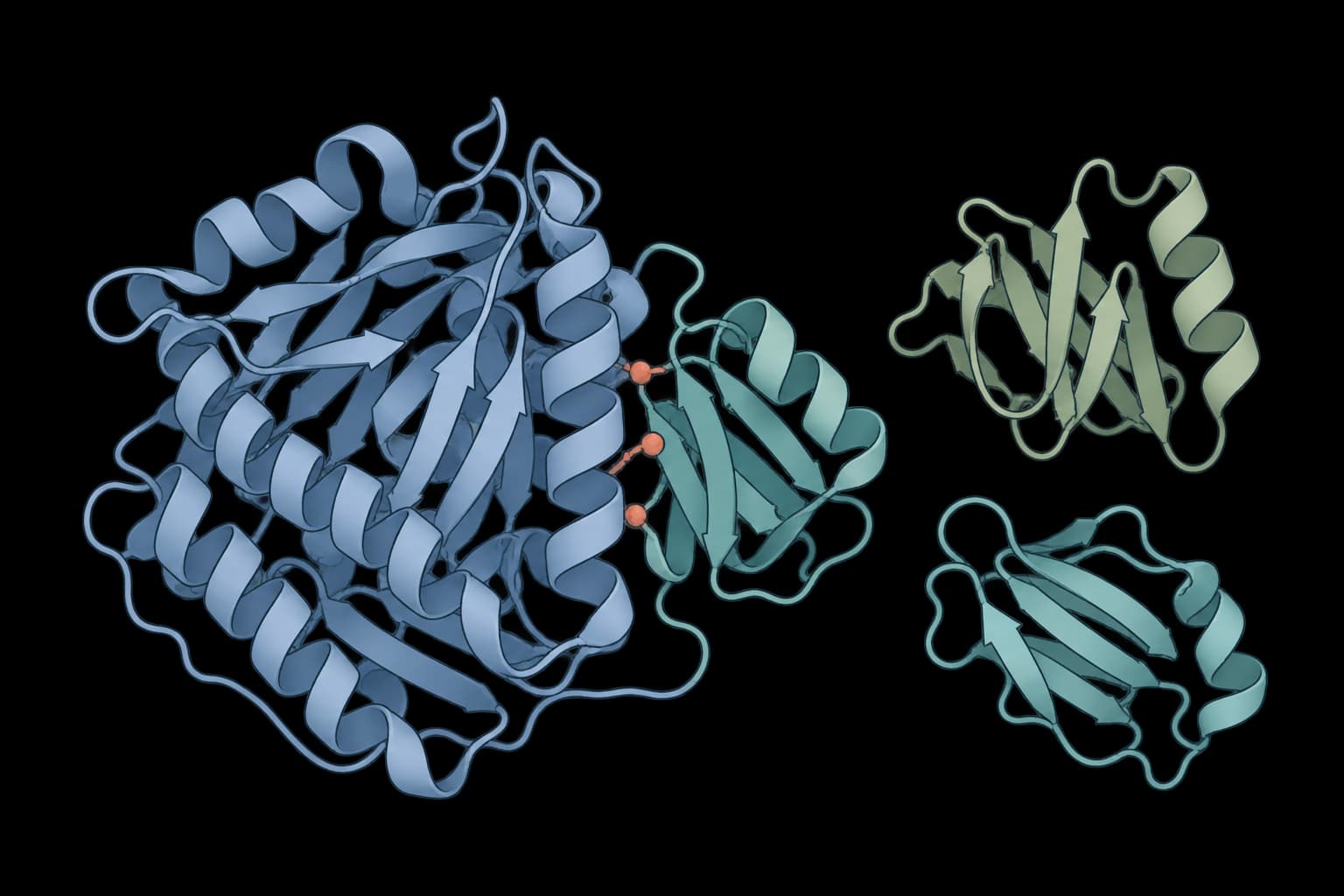
Boltz Protein Screen
Rank candidate binder sequences against a protein target.
Input
Boltz Protein Screen webserver overview
Boltz Protein Screen scores candidate binder sequences against a protein target and ranks them, returning a predicted complex for each candidate. A job takes up to 500 binders.
ProteinIQ sends the job to the hosted Boltz API pipeline and publishes the finished table, structures and records. To generate binders instead of supplying them, use BoltzProt-1.
Pricing
Each binder is priced by the size of the target plus that binder in tokens. A token is about one residue, so the complex size is the total target length plus the candidate's length. Candidates of different lengths can fall in different bands, and the job total is the sum, rounded once.
| Complex size (tokens) | 1 binder | 10 binders | 100 binders | 500 binders |
|---|---|---|---|---|
| Up to 256 | 51 | 507 | 5,064 | 25,317 |
| 257 to 512 | 102 | 1,013 | 10,127 | 50,633 |
| 513 to 1,024 | 203 | 2,026 | 20,254 | 101,266 |
| 1,025 to 2,048 | 406 | 4,051 | 40,507 | 202,532 |
| More than 2,048 | 811 | 8,102 | 81,013 | 405,064 |
For example, a 200-residue target screened against three 60-residue binders is 260 tokens per pair, so the job costs 304 credits. Epitope selection does not change the price.
The exact quote is calculated before submission. If Boltz estimates a noticeably higher cost when the job starts, the run is not started and the credits are refunded.
Inputs
| Input | Accepted formats | Limits and behavior |
|---|---|---|
Target protein | FASTA text, .fasta, .fa or .txt file, or a UniProt sequence | Required. Up to 10 chains, files up to 10 MB, one sequence each. Chain IDs are assigned A, B, C in submission order. |
Binder sequences | Multi-FASTA text, or a .fasta, .fa or .txt file | Required. One file per job, up to 500 records and 50 MB. One record per candidate, in single-letter amino acid codes. |
Each binder is placed on its own chain and scored against the target separately. Repeated FASTA names get a numeric suffix such as _2 so each row stays traceable. Each target input accepts 1 to 10 copies, and each copy becomes its own chain. Job name is an optional label for the saved run.
Settings
| Parameter | Type | Default | Description |
|---|---|---|---|
Epitope residues (epitope_residues) | string | optional | Target residues the binder should contact, as 1-based positions, for example A:10,12-15; B:3. Without a chain prefix the first target chain is used. |
Non-binding residues (non_binding_residues) | string | optional | Target residues the binder should avoid, in the same format. |
Outputs
Viewer shows the predicted complexes. Results lists the ranked binders. Files holds the downloads.
| Download | Contents |
|---|---|
boltz_protein_screen_0001_<name>.cif onwards | Predicted complex for each binder, numbered by rank. |
boltz_protein_screen_results.csv | The results table. |
boltz_protein_screen_results.json | Boltz's run and per-result records. |
The predicted complexes can be passed to other structure tools in workflows.
Understanding results
Each row carries a rank, the binder ID, the binder sequence and its chain, Boltz's own metric columns, any warnings Boltz attached and the matching structure file. Ranks follow the order Boltz returns, so rank 1 is its top-scoring candidate. Nested metrics are flattened into columns joined by underscores. The sequence column holds the binder only; the target chains are kept in the structure files.
Scores order candidates within one run. They are model confidence values, not measured binding affinities.
Related tools
AF2BIND
Predict protein ligand-binding residues from AlphaFold2 pair representations
SPRINT
Rank compound libraries with SPRINT protein and ligand co-embeddings.
Boltz Small Molecule Explore
Budgeted search of a large SMILES library against a protein target.
Boltz Small Molecule Screen
Rank your SMILES library against a protein target.
CatPred
Predict enzyme kcat, Km and Ki from sequences and SMILES, with uncertainty.
DLKcat
Predict enzyme kcat values from protein sequences and substrate structures or names.
SMRTnet
Predict small molecule-RNA interactions using RNA secondary structure with deep learning
AF2Dock
Structure-based protein-protein docking with AF2Dock flow-matching refinement
ColabDock
Protein-protein docking guided by experimental restraints using AlphaFold2
DFMDock
Dock protein-protein complexes with diffusion-based sampling and confidence ranking.