Boltz Small Molecule Screen
Rank your SMILES library against a protein target.
Input
Boltz Small Molecule Screen webserver overview
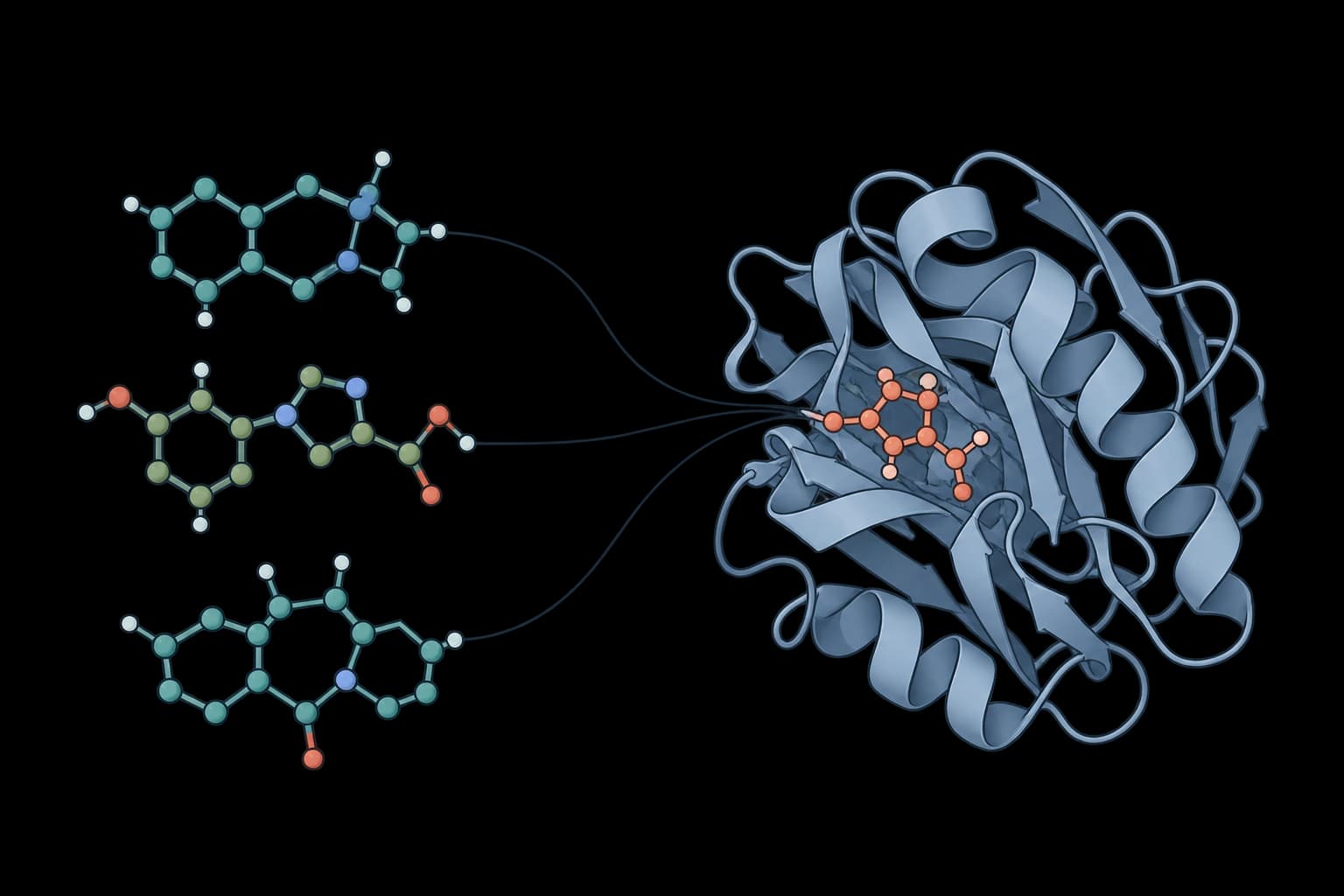
Boltz Small Molecule Screen scores a SMILES list you supply against a protein target and returns the molecules ranked, each with a predicted complex. A job takes up to 1,000 molecules.
ProteinIQ sends the job to the hosted Boltz API pipeline and publishes the finished table, structures and records. To search a make-on-demand catalog instead of your own list, use BoltzMol-1. To sample a much larger library under a fixed budget, use Boltz Small Molecule Explore.
Pricing
The screen costs a flat rate per molecule submitted. The total is rounded once for the whole job.
| Molecules | Credits |
|---|---|
| 1 | 51 |
| 10 | 507 |
| 100 | 5,064 |
| 500 | 25,317 |
| 1,000 | 50,633 |
Target size, molecule size, reference ligands and filters do not change the price. Filters remove molecules from the results, not from the quote. The exact quote is calculated before submission. If Boltz estimates a noticeably higher cost when the job starts, the run is not started and the credits are refunded.
Inputs
| Input | Accepted formats | Limits and behavior |
|---|---|---|
Target protein | FASTA text, .fasta, .fa or .txt file, or a UniProt sequence | Required. Up to 10 chains, files up to 10 MB, one sequence each. Chain IDs are assigned A, B, C in submission order. |
Molecules to screen | Pasted text, or a .csv, .tsv, .smi, .smiles or .txt file | Required. One list per job, up to 1,000 molecules and 50 MB. |
Reference ligand | One SMILES string, a .smi or .smiles file, or a PubChem compound | Optional. Up to 10 known binders that guide scoring. |
The molecule list can take any of these forms:
- One SMILES per line. Molecules are named
mol_1,mol_2and so on. name<TAB>SMILESorname,SMILESon each line.- A CSV or TSV table whose header has a
smilescolumn. Theidornamecolumn, when present, supplies the molecule IDs.
For a drug repurposing screen, choose Load from dataset in the upload menu and pick molecules from the FDA-approved drug library. They arrive as a named list, and the picker stops at the job's molecule limit.
Repeated names get a numeric suffix such as _2 so each row stays traceable. Each target input accepts 1 to 10 copies, and each copy becomes its own chain. Job name is an optional label for the saved run.
Settings
Target
| Parameter | Type | Default | Description |
|---|---|---|---|
Pocket residues (pocket_residues) | string | optional | Binding-pocket residues as 1-based positions, for example A:45,48-52. Without a chain prefix the first target chain is used. |
Molecule filters
| Parameter | Type | Default | Description |
|---|---|---|---|
Structural alert filter (structural_alert_filter) | enum | recommended | Boltz's own SMARTS catalog filter level: recommended, extra, aggressive or disabled. |
Lipinski filter (lipinski_filter) | boolean | false | Removes molecules that break Lipinski's rule of five. |
Maximum molecular weight (lipinski_max_mw) | number | 500 | Largest molecular weight kept, in Da. Applies when the Lipinski filter is on. |
Maximum LogP (lipinski_max_logp) | number | 5 | Largest LogP kept. Applies when the Lipinski filter is on. |
Maximum H-bond donors (lipinski_max_hbd) | integer | 5 | Most hydrogen-bond donors kept. Applies when the Lipinski filter is on. |
Maximum H-bond acceptors (lipinski_max_hba) | integer | 10 | Most hydrogen-bond acceptors kept. Applies when the Lipinski filter is on. |
Allow one violation (lipinski_allow_single_violation) | boolean | false | Keeps molecules that break at most one Lipinski rule. |
Additional alert catalog (alert_catalog) | enum | none | One RDKit structural-alert catalog: PAINS, PAINS A, PAINS B, PAINS C, BRENK, NIH, or a CHEMBL catalog. |
Excluded SMARTS (excluded_smarts) | string | optional | SMARTS patterns to exclude, one per line or comma-separated. |
Outputs
Viewer shows the predicted complexes. Results lists the ranked molecules. Files holds the downloads.
| Download | Contents |
|---|---|
boltz_sm_screen_0001_<name>.cif onwards | Predicted complex for each scored molecule, numbered by rank. |
boltz_sm_screen_results.csv | The results table. |
boltz_sm_screen_results.json | Boltz's run and per-result records. |
The scored molecules, the CSV table and the predicted complexes can be passed to other tools in workflows.
Understanding results
Each row carries a rank, the molecule ID, its SMILES, Boltz's own metric columns, any warnings Boltz attached and the matching structure file. Ranks follow the order Boltz returns, so rank 1 is its top-scoring entry. Nested metrics are flattened into columns joined by underscores.
Molecules removed by the filters do not appear in the results, so the row count can be lower than the number submitted. The run summary reports both numbers. Scores order candidates within one run and are not measured affinities.
Related tools
Boltz Small Molecule Explore
Budgeted search of a large SMILES library against a protein target.
AF2BIND
Predict protein ligand-binding residues from AlphaFold2 pair representations
Boltz ADME
LogD, permeability and solubility predictions for small molecules.
SPRINT
Rank compound libraries with SPRINT protein and ligand co-embeddings.
BoltzMol-1
Small-molecule design against a protein target from purchasable chemical space.
CatPred
Predict enzyme kcat, Km and Ki from sequences and SMILES, with uncertainty.
DLKcat
Predict enzyme kcat values from protein sequences and substrate structures or names.
PandaDock
Physics-based molecular docking with CPU-optimized hierarchical algorithms
PLIP
Profile protein-ligand interactions from a PDB complex structure.
PoseBusters
Validate generated and docked ligand poses with structure, chemistry, and reference-pose checks.