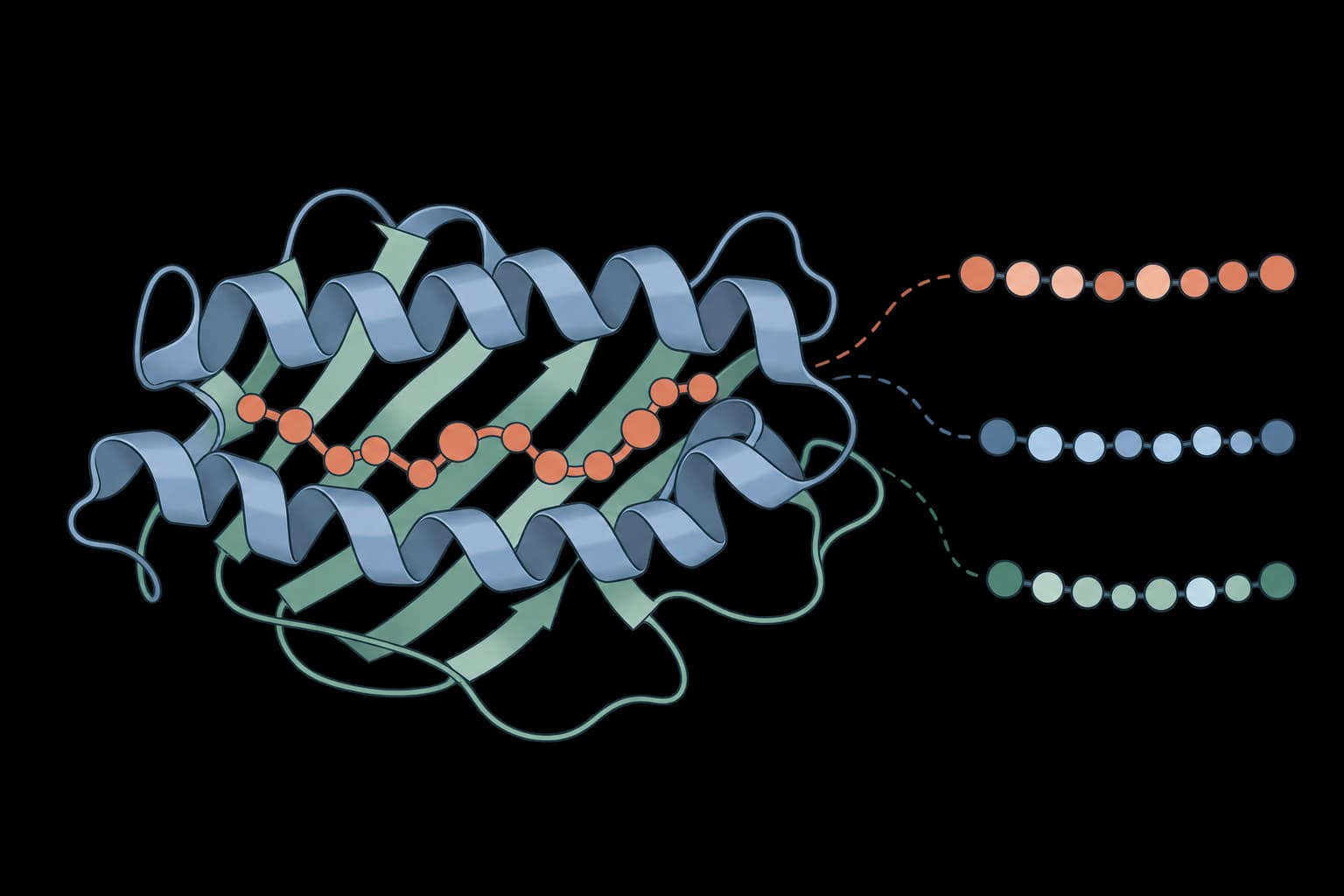
DeepImmuno
Score, compare, and generate peptide candidates with the official DeepImmuno models.
Input
What is DeepImmuno?
DeepImmuno combines a convolutional model that scores peptide-HLA immunogenicity with a generative adversarial network (GAN) that proposes candidate peptides. ProteinIQ also supports the official DeepImmuno web app's fixed HLA-panel ranking workflow.
Immunogenicity and MHC binding are related but distinct. A peptide can bind an MHC molecule without activating T cells. DeepImmuno addresses the latter question by scoring a peptide-HLA pair after presentation is assumed.
How does DeepImmuno work?
Sequence encoding
DeepImmuno represents amino acids with physicochemical features from the AAindex1 database, reduced with principal component analysis. Peptides and HLA paratopes are combined into the feature matrix used by the convolutional model.
The model accepts 9-mer and 10-mer peptides. Its source encoder accepts the 20 standard amino-acid one-letter codes, X, and -; X is mapped to the same placeholder representation as -.
HLA paratopes
The model package includes 62 HLA-A, HLA-B, and HLA-C paratopes. When a well-formed class I allele is not an exact member of that table, the source method selects the nearest available paratope within the same locus. ProteinIQ reports both the requested allele and the effective paratope so this substitution remains visible.
CNN score
Each peptide-HLA pair passes through the pretrained DeepImmuno-CNN model. The returned score is a model output, not a calibrated probability or a direct measurement of biological response.
HLA panel ranking
Panel mode evaluates each peptide against the same 11 HLA alleles used by the official DeepImmuno web app and returns the five highest CNN scores. HLA-A*0202 and HLA-A*6802 are retained from that panel and visibly resolved to the nearest paratopes available in the model package.
GAN generation
Generation mode runs the source deepimmuno-gan.py entrypoint and its pretrained wassGAN_G.pth checkpoint. The source command always emits one stochastic batch of 64 ten-residue candidates for HLA-A*0201. Its native immunogenicity value is a fixed generation label of 1, not a CNN score.
Inputs
| Input | Description |
|---|---|
Peptide Sequences | Prediction: up to 1,000 peptides of exactly 9 or 10 residues in raw, FASTA, or paired CSV/TSV form. HLA panel ranking: up to 100 peptide-only records in raw or FASTA form. Generation: no input. |
Supported layouts:
- Raw text: one peptide per non-empty line.
- FASTA: one or more records; full FASTA headers are preserved as sequence identifiers.
- CSV/TSV: exactly two columns,
peptideandHLA allele, with an optional header. HLA values in the table take precedence over the HLA settings.
Longer proteins must be converted into candidate 9-mer or 10-mer windows before submission.
Settings
| Setting | Description |
|---|---|
DeepImmuno mode | Score submitted peptide-HLA pairs, rank the official HLA panel, or generate the source model's fixed batch of 64 candidates. Default: peptide-HLA scoring. |
HLA assignment mode | Single HLA for all peptides applies one allele to every peptide. One HLA per peptide reads one allele per line from the override field. Paired CSV/TSV input supplies its own alleles. |
HLA allele | Exact source paratope used in single mode. Default: HLA-A*0201. |
Per-sequence HLA alleles | One class I allele per line, in peptide order. Standard forms such as HLA-A*0201, HLA-A*02:01, and A0201 are accepted. |
ProteinIQ classification cutoff | Creates a derived immunogenic or non-immunogenic label from the model score. It does not change the score. Default: 0.5, matching the paper benchmark. |
The classification cutoff is a reporting convenience, not an absolute biological threshold. Compare candidates within an appropriate experimental design and validate prioritized peptides experimentally.
Exact HLA paratopes
The selector contains all 62 paratopes distributed with the pinned DeepImmuno source:
| Locus | Exact paratopes |
|---|---|
| HLA-A | A*0101, A*0201, A*0203, A*0205, A*0206, A*0207, A*0224, A*0301, A*0362, A*1101, A*2301, A*2402, A*3001, A*3003, A*6801, A*9234, A*9235, A*9253 |
| HLA-B | B*0602, B*0702, B*0801, B*1402, B*1501, B*1557, B*1801, B*2703, B*2705, B*2709, B*2713, B*3501, B*3505, B*3508, B*3901, B*4001, B*4002, B*4044, B*4102, B*4104, B*4201, B*4202, B*4402, B*4403, B*4405, B*4601, B*5101, B*5301, B*5701, B*5703, B*5706, B*5712, B*5801, B*8102, B*8103, B*9234 |
| HLA-C | C*0102, C*0304, C*0401, C*0517, C*0602, C*0756, C*1510, C*1604 |
Well-formed class I alleles outside this exact set can be submitted through the per-sequence field or a paired table. Results mark them as nearest-paratope and identify the effective HLA paratope.
Output
The result spreadsheet contains prediction rows, top-five panel rows, or generated peptides according to the selected mode:
| Column | Description |
|---|---|
Sequence ID | Full FASTA header, table row identifier, or generated peptide identifier. |
Peptide | Normalized peptide sequence. |
Requested HLA Allele | Allele submitted for the prediction. |
Effective HLA Paratope | Exact source paratope used for encoding. |
HLA Resolution | exact or nearest-paratope. |
DeepImmuno Score | Continuous model output between 0 and 1. |
HLA Rank | Rank from 1 to 5 within one peptide's official HLA-panel scan. |
Source Generation Label | Fixed source GAN label of 1; this is not a CNN score. |
ProteinIQ Classification | Derived label based on the selected cutoff. |
Classification Cutoff | Cutoff used to derive that label. |
Downloadable files include:
- the native CNN or GAN result table;
- a detailed TSV with identifiers, effective alleles, scores, and classifications;
- the prepared source input CSV for CNN modes, including all 11 evaluated pairs in HLA panel mode;
- a provenance JSON file with the source commit, model assets, runtime versions, and HLA resolution;
- a run log.
Workflow outputs provide prediction rows, five ranked HLA rows per input peptide, or all 64 generated peptide sequences according to the selected mode.
Limitations
- Only 9-mer and 10-mer peptides are supported.
- Prediction accepts at most 1,000 peptides. HLA-panel mode accepts 100 peptides, expands them to 1,100 source CNN evaluations, and returns up to 500 ranked rows.
- GAN generation is fixed by the source program at 64 ten-residue
HLA-A*0201candidates and does not accept a requested count, seed, or HLA setting. - A score does not establish immune response, safety, or clinical effectiveness.
- The model does not directly account for antigen processing, expression, MHC abundance, or an individual's T cell repertoire.
- Nearest-paratope rescue is an approximation. Treat rescued allele results with additional caution.
- Training data reflect the sampling and experimental biases of the underlying immunogenicity assays.
Reference
Li G, Iyer B, Prasath VBS, Ni Y, Salomonis N. DeepImmuno: deep learning-empowered prediction and generation of immunogenic peptides for T-cell immunity. Briefings in Bioinformatics. 2021;22(6):bbab160. doi:10.1093/bib/bbab160
Related tools
TLimmuno2
Transfer learning-based MHC-II immunogenicity prediction for CD4+ T cell epitopes
CleaveNet
Predict MMP cleavage z-scores, evaluate substrates, and generate conditional peptides.
TNP
Characterize nanobody developability with sequence, structure, and surface-property metrics.
DeepSP
Generate 30 sequence-derived spatial descriptors for paired antibody variable domains.
DeepViscosity
Screen paired antibody Fv sequences for high-concentration viscosity risk.
EvoIF
Score single and multi-site protein mutations with evolutionary and inverse-folding profiles.
RaSP
Predict protein stability changes across single amino acid substitutions.
ThermoMPNN
Predict mutation ΔΔG values and identify stabilizing substitutions for protein engineering.
Aggrescan3D
Analyze aggregation-prone regions in a protein structure.
Molecular descriptors
Calculate RDKit physicochemical descriptors, drug-likeness scores, rule violations, and structural fingerprints from SMILES.