| Pocket |
The cavity on the protein where the ligand sits, usually the active site |
| Pose |
One predicted position, orientation and shape of the ligand in the pocket |
| Search box |
The cube you draw around the pocket; Vina, smina and GNINA only look inside it |
| Blind docking |
Docking with no box, so the method has to find the pocket as well as the pose |
| [RMSD](/guides/rmsd) |
The average distance in ångströms between a predicted pose and the crystal pose; under 2 Å counts as a success |
| Exhaustiveness |
How long the search runs; higher is slower and finds the best pose more reliably |
What each engine asks you to bring differs mainly in the pocket (Table 3). Every engine takes a protein structure and a ligand; the question is whether you have to say where to look.
| AutoDock Vina |
PDB ID or file |
SMILES, PubChem compound or file |
Box from a bound ligand, chosen residues, coordinates or the whole protein |
| smina |
PDB ID or file |
SMILES, PubChem compound or file |
Reference ligand, manual box of 10 to 50 Å per axis, or the whole receptor |
| GNINA |
PDB ID or file |
SMILES, PubChem compound or file |
Reference ligand, or the whole protein |
| DiffDock |
Structure, PDB ID or sequence (folded with ESMFold first) |
SMILES or file |
None |
## AutoDock Vina: the baseline
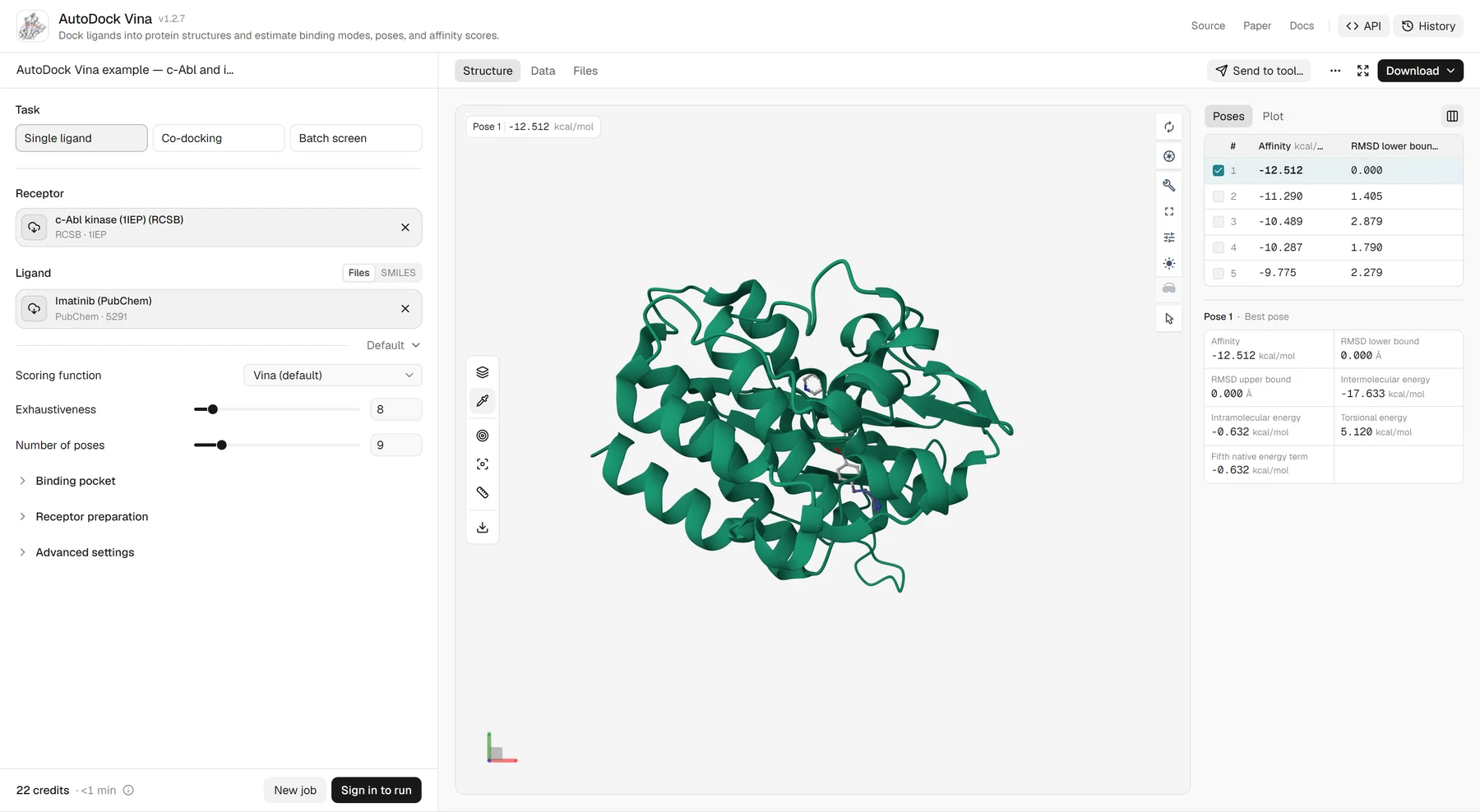
[AutoDock Vina](/app/autodock-vina) comes from Oleg Trott and Arthur Olson at Scripps Research, and it is still the program most published docking studies use. A run needs a receptor, a ligand and a box around the pocket. Version 1.2 added simultaneous docking of several ligands, hydrated docking, zinc metalloprotein parameters, the AutoDock4 scoring option and Python bindings.
Its strength is that it is fast, free and expected by reviewers. Its poses hold up better than its scores. On the Astex Diverse set in the PoseBusters study, Vina given a box around the crystal ligand placed 58% of ligands within 2 Å, and 56% were also physically valid. The kcal/mol number is a [Vina score](/guides/vina-score): useful for comparing poses of one ligand, not something you can convert to a Kd.
Preparing the inputs is the usual stumbling block when you run it locally: both molecules must be converted to PDBQT files and the box coordinates chosen by hand. The hosted tool does both for you, and the [AutoDock Vina tutorial](/guides/autodock-vina-tutorial) walks through the local route step by step. In the public [imatinib and c-Abl example](/app/autodock-vina?jobId=cge7gsamwpeuxmhkandolpdw), the top pose scores −12.512 kcal/mol.
## smina: Vina with the scoring function exposed
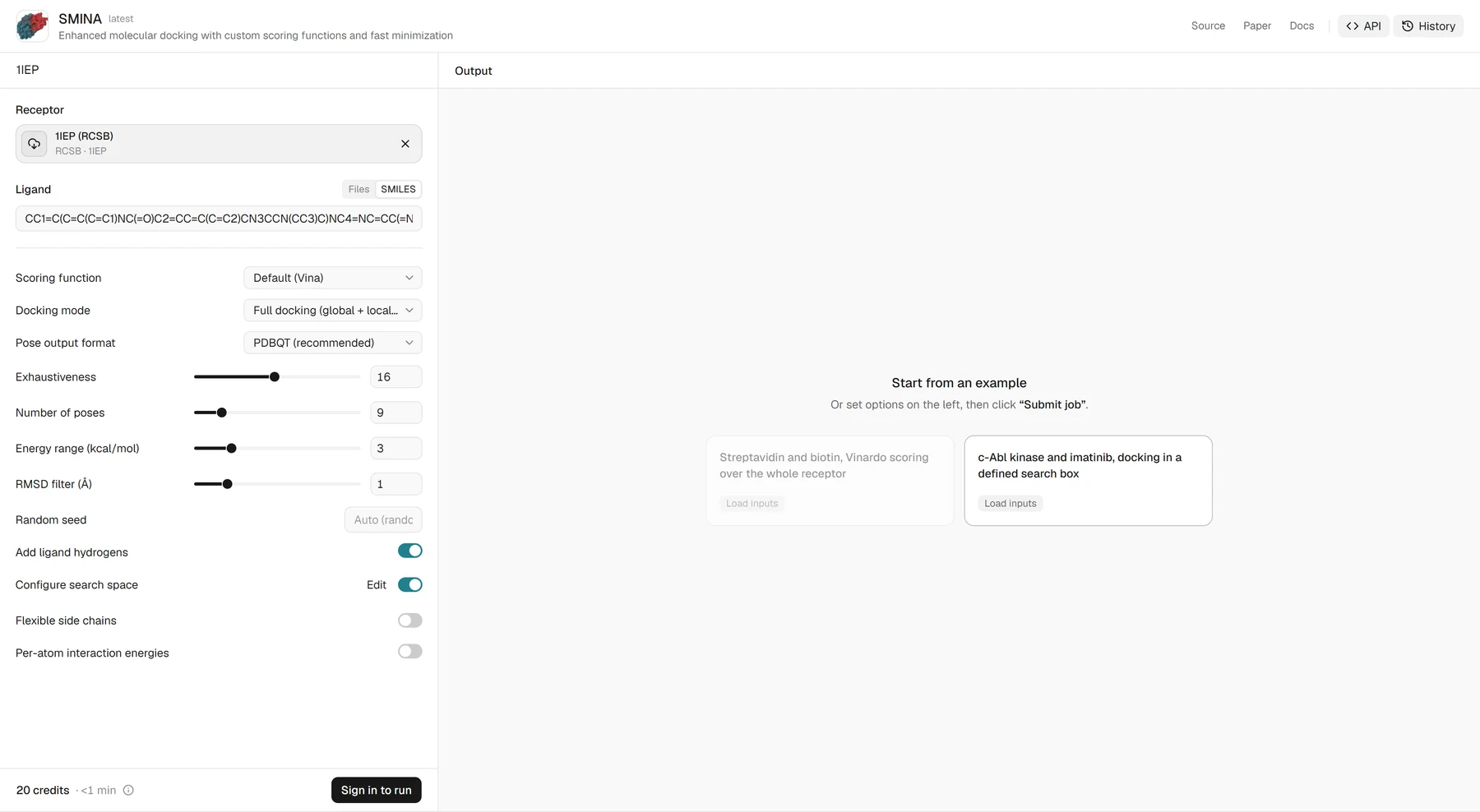
David Koes's group at the University of Pittsburgh built smina as a fork of Vina for scoring function development and fast energy minimization. It keeps Vina's search and adds a choice of built-in scoring functions, user-defined scoring files and per-atom term output. In the CSAR 2011 exercise, Koes and colleagues used it to fit a custom function that sampled low-RMSD poses better than Vina's default when cross-docking.
Vina 1.2 has absorbed much of what once set smina apart. It now offers Vinardo, a Vina-based function with different terms and weights, alongside AutoDock4 scoring, and it can score or locally optimize a pose without a full search. What smina still adds is custom scoring: your own terms and weights, the dkoes functions and a table of how each atom contributes to the score.
That makes smina the right choice for a narrow set of jobs. Rescoring or minimizing poses from another program with a Vina-family function, testing a modified scoring function and extracting per-atom terms for analysis are all easier there. For a first docking run it adds nothing over Vina. It also adds little to a consensus: Vina, Vinardo and smina share one set of assumptions, so agreement between them is weak evidence.
## GNINA: the same search with a second opinion
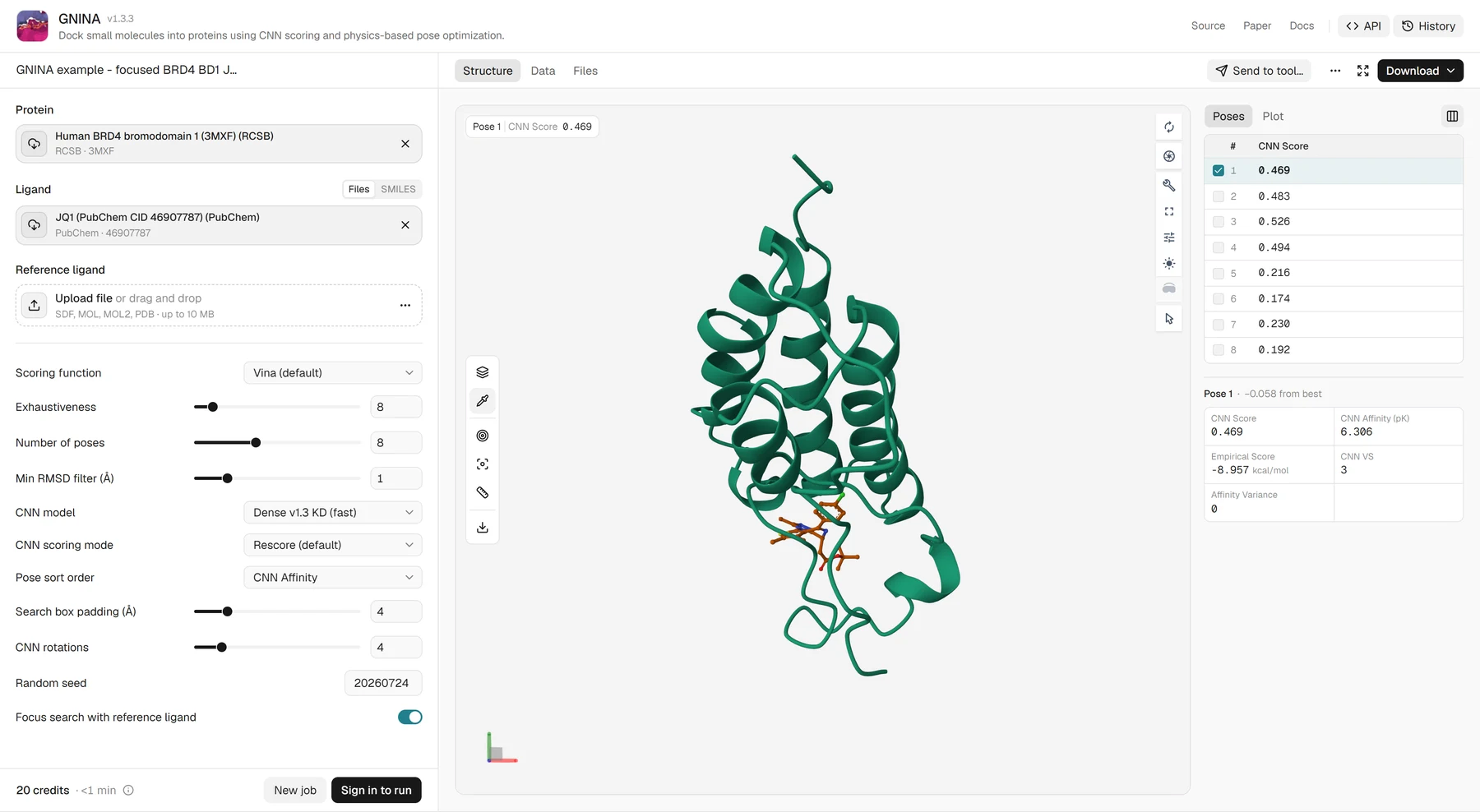
[GNINA](/app/gnina) (pronounced NEE-na) keeps the smina search and scores every pose twice, with the empirical function and with 3D convolutional neural networks (CNNs) trained on crystal structures. The networks give two outputs: a CNN score from 0 to 1 for how likely the pose is correct, and a CNN affinity in pK units. The [GNINA CNN score](/guides/gnina-cnn-score) guide covers how to read them.
The gain is in choosing the right pose. In the GNINA 1.0 redocking tests, the top-ranked pose was within 2 Å of the crystal pose 73% of the time, against 58% for Vina; in the harder cross-docking test the figures were 37% and 27%. The search itself is unchanged, so GNINA cannot rank a pose the search never produced.
The trade-off is flexibility on the hosted side. The command-line program is built with CUDA 12.0 or newer and also offers [covalent docking](/guides/covalent-docking) and flexible residues. The hosted version runs on a GPU and docks one ligand into one rigid receptor, without covalent or flexible-residue options and without manual box coordinates.
## DiffDock: no box required
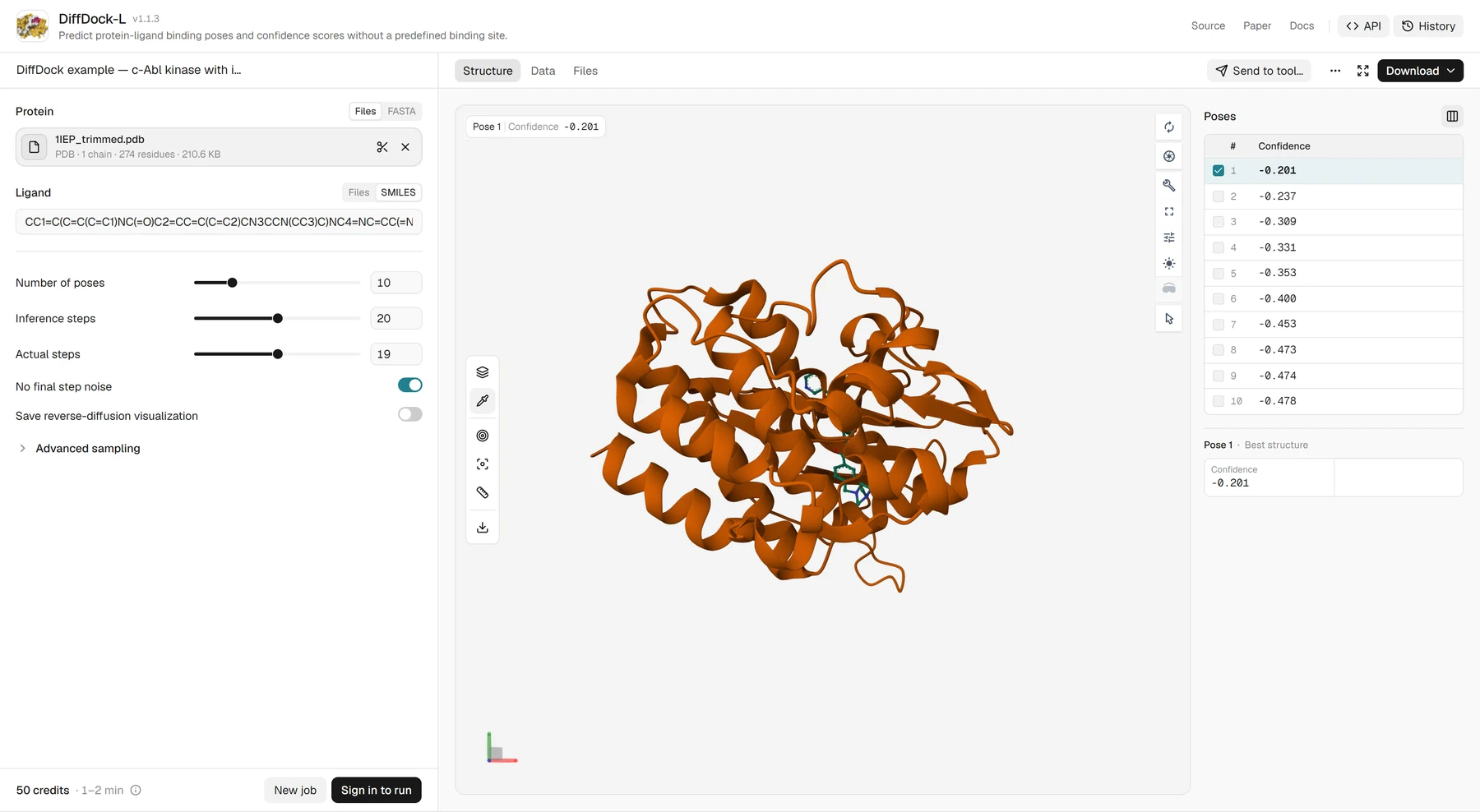
DiffDock treats docking as generation. Gabriele Corso and colleagues at MIT start each sample from a random position, orientation and set of torsion angles, refine it by reverse diffusion, and rank the results with a separate confidence model. The protein stays rigid, and the ligand's 3D geometry is regenerated from its chemistry, so uploaded coordinates do not change the result.
The blind-docking benchmark is where it earns its place (Figure 6). On PDBBind, with every method asked to find the pocket as well as the pose, DiffDock placed the top-ranked pose within 2 Å for 35.0% of complexes with 10 samples and 38.2% with 40, against 22.9% for GNINA, 21.8% for Glide and 18.7% for SMINA. The authors report about 10 s per complex for DiffDock on a GPU, against roughly 127 s for GNINA on 16 CPU cores.
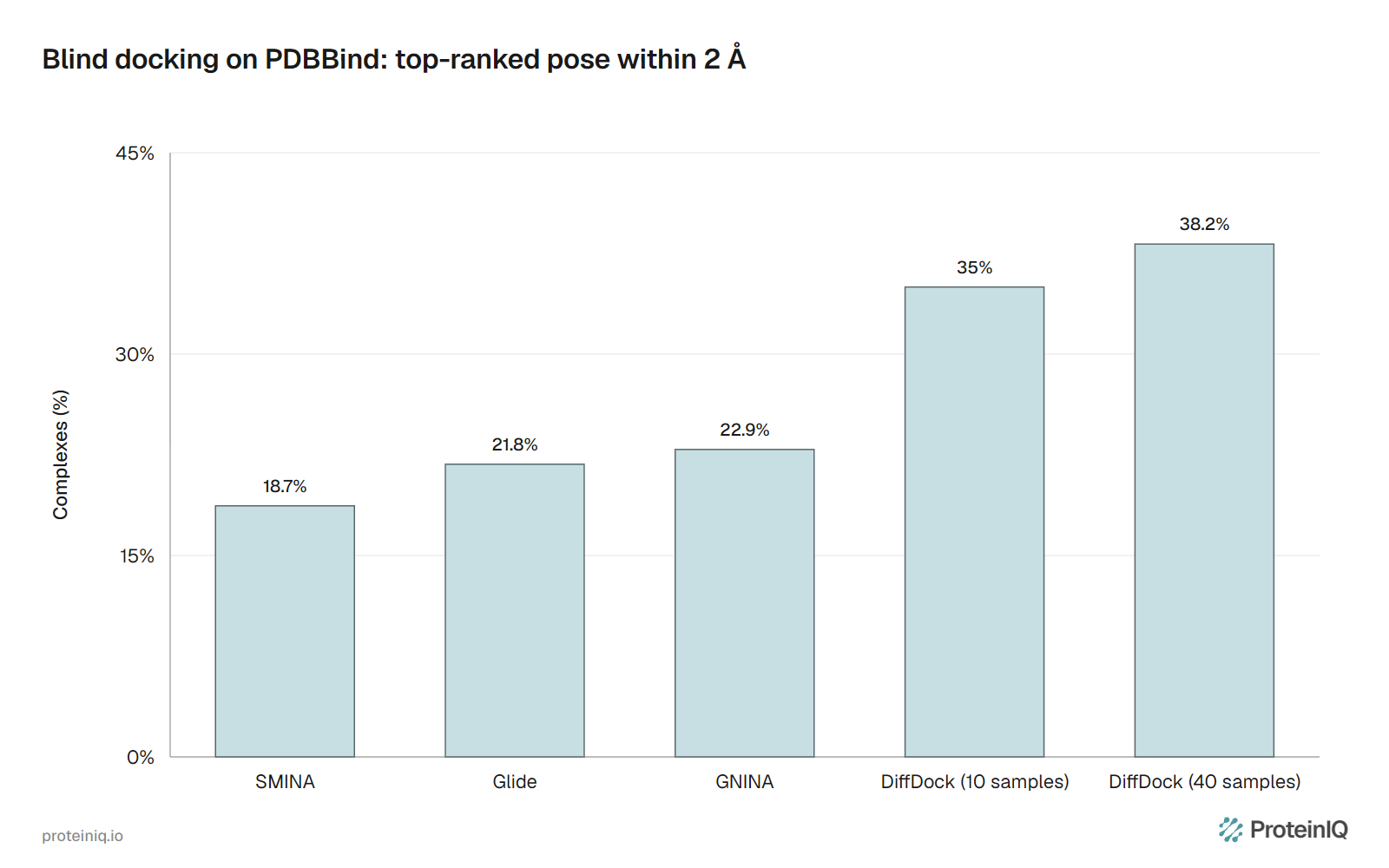
Predicted structures are where the gap widens. Starting from [ESMFold](/app/esmfold) models instead of crystal structures, DiffDock still reached 21.7% top-1 success in that table, while GNINA and SMINA fell to low single digits. The current DiffDock-L model, the one the hosted tool runs, raised PDBBind top-1 to 43.0% and accuracy on unseen protein domains from 7.1% to 22.6%.
The catch is geometry. In PoseBusters, the original DiffDock placed 72% of Astex Diverse ligands within 2 Å, but only 47% were both close and physically valid. In the example above, all ten poses are close to the crystal ligand, yet the confidence value of −0.201 is on a scale of its own and cannot be compared with Vina's kcal/mol.
## Why the winner depends on the benchmark
DiffDock leads the Vina family when the pocket is unknown, and Vina leads on physical validity when the pocket is given. Both results are correct, because the benchmarks ask different questions (Table 4).
| Known pocket, one dependable answer |
[AutoDock Vina](/app/autodock-vina) |
Rescore with GNINA and check the pose |
| Known pocket, top pose keeps landing wrong |
[GNINA](/app/gnina) |
Compare the CNN scores of the top few poses |
| Unknown pocket |
[DiffDock](/app/diff-dock) |
Redock in the proposed pocket with Vina or GNINA |
| Predicted or unbound protein |
DiffDock |
Compare with [DynamicBind](/app/dynamic-bind) if the pocket may need to move |
| Custom scoring terms or per-atom contributions |
[smina](/app/smina) |
Validate the function against known binders |
| Thousands of ligands |
Vina through the [API](/docs/api), or [AutoDock-GPU](/app/autodock-gpu) |
CNN-rescore only the top fraction with GNINA |
The engines combine better than they compete. A typical sequence lets DiffDock propose the site on a protein whose pocket is unknown, docks the ligand there with Vina, rescores the poses with GNINA and runs [PoseBusters](/app/posebusters) on the survivors. The [blind docking](/use-cases/blind-docking) page covers the first step, and [consensus docking](/use-cases/consensus-docking) explains when agreement between programs is worth trusting.
Before trusting any of them on a new target, redock the native ligand: take a protein structure that already has a ligand bound, remove the ligand, dock it back and measure the [RMSD](/guides/rmsd) to the crystal pose. If an engine cannot reproduce that pose within 2 Å on your protein, its prediction for a new ligand deserves less weight.
## Your first docking run
The quickest way to learn the difference is to dock a known drug into its own crystal structure, where the right answer exists. Imatinib in the c-Abl kinase domain (PDB 1IEP) is the example used throughout this guide.
1. Open [AutoDock Vina](/app/autodock-vina) and leave the task on single ligand.
2. Enter 1IEP as the receptor. The tool fetches it from the RCSB by PDB ID.
3. Search for imatinib as the ligand, which fetches it from PubChem, or paste its SMILES string.
4. Leave the binding pocket on its automatic setting, which builds the search box around the ligand already in the crystal structure, and run the job.
5. Read the pose table. The top pose should score about −12.5 kcal/mol, and the RMSD column shows how far each other pose sits from pose 1.
To run the same job locally with Meeko and the `vina` command, the [AutoDock Vina tutorial](/guides/autodock-vina-tutorial) covers every step and the settings behind each one.
Then try the same inputs in another engine to see what changes. DiffDock needs no box and returns a confidence instead of kcal/mol; GNINA adds a CNN score to the same kind of table. The Send to tool button on a result passes the poses to another tool such as [PoseBusters](/app/posebusters), which checks that bond lengths, clashes and geometry are physically sensible.
Three habits save first-time users the most trouble. Do not compare scores across engines, because kcal/mol, CNN pK values and diffusion confidences are on different scales. Look at the next few poses as well as the top one. And treat every score as a ranking aid, not a measured binding affinity.
## What each engine costs and limits on ProteinIQ
ProteinIQ prices jobs in credits, and a free account gets 200 credits a month. A single drug-sized ligand costs 20 credits in Vina, smina and GNINA and 50 in DiffDock, but the ways the price grows differ (Table 6).
| AutoDock Vina |
20 credits at exhaustiveness 8 |
Exhaustiveness 32 costs 40 and 64 costs 57; co-docking five ligands costs 500 |
Up to 10 ligands in a batch, 5 in co-docking |
| smina |
20 credits at exhaustiveness 8, 16 or 32 |
Multi-record ligand files: 100 records cost 221 credits at exhaustiveness 8 |
Exhaustiveness up to 32; ligands with metals refused |
| GNINA |
20 credits with default CNN rescoring |
Full CNN scoring of every pose costs 1,865 credits for JQ1; ligands over 20 rotatable bonds raise the quote |
One ligand and one rigid receptor per job |
| DiffDock |
50 credits |
Nothing: the price is flat across settings and receptor size |
Rigid protein; each run starts from new random poses |
The practical consequence is that GNINA's default rescoring is nearly free to add, while its slowest scoring modes are not. If you plan to screen, rescore the top slice of a Vina run, not the whole library.
## Frequently asked questions
### Is smina the same as AutoDock Vina?
No. smina is a fork of Vina maintained by David Koes's group, built to support custom scoring functions and fast minimization. It uses Vina's search, so poses come out similarly, but it can score with functions Vina does not ship and report per-atom contributions.
### Is GNINA better than AutoDock Vina?
For choosing among poses, yes in the published tests: top-ranked poses within 2 Å rose from 58% to 73% in redocking and from 27% to 37% in cross-docking. It shares Vina's search, so it will not find poses Vina misses, and installing it locally means a CUDA-enabled Linux build.
### Is DiffDock better than AutoDock Vina?
It depends on what you give them. DiffDock wins when the pocket is unknown, because it searches the whole protein quickly, but Vina places ligands more validly when you supply the pocket. Use DiffDock to find the site and Vina or GNINA to refine it.
### Is AutoDock the same as AutoDock Vina?
No. AutoDock usually means AutoDock4, which uses grid maps, a genetic algorithm and a force-field score. Vina is a separate 2010 program with its own score and search, reported about two orders of magnitude faster. Vina 1.2 can also use the AutoDock4 scoring function.
### Which docking engine is fastest?
DiffDock reported about 10 s per complex on a GPU for blind docking, against roughly 127 s for GNINA with 16 CPU cores. That compares a whole-protein search; once a pocket is defined, Vina, smina and GNINA are fast enough that the choice rests on accuracy rather than speed.
### Do I need a GPU to run these?
Not on ProteinIQ, where the GPU engines run on hosted hardware. Locally, DiffDock needs a CUDA GPU, GNINA is built with CUDA and runs best on one, and Vina and smina run on a CPU.