| Origin |
Genes in the cell's own genome |
Long double-stranded RNA from a virus or an experiment, or a synthetic duplex |
| Precursor |
Hairpin of about 70 nucleotides (pre-miRNA), cut from a longer primary transcript |
Long double-stranded RNA, or a ready-made 21-nucleotide duplex |
| Processing |
Drosha in the nucleus, then Dicer in the cytoplasm |
Dicer only, or none for a synthetic duplex |
| Length |
About 22 nucleotides |
21 to 23 nucleotides |
| Pairing with the target |
Partial in animals, anchored on the seed; near-perfect in plants |
Complete across the guide strand by design |
| Targets |
Hundreds of mRNAs per miRNA |
One intended mRNA, plus off-targets through seed matches |
| Effect on the target |
Translational repression and mRNA decay in animals; cleavage is unusual |
Cleavage by Argonaute2 |
| Typical use |
Natural gene regulation; a target for anti-miR drugs |
Gene knockdown in the lab; approved drugs |
## Where RNA interference came from
Two lines of work converged. In 1993 the Ambros lab reported that the worm gene lin-4 encodes a small RNA complementary to sequences in the lin-14 mRNA, the first miRNA.
In 1998 Fire, Mello and colleagues injected double-stranded RNA into the nematode Caenorhabditis elegans and found it far more effective at silencing a gene than either strand alone. Only a few molecules per cell were needed, which suggested a catalytic or amplifying step rather than simple one-to-one binding. The pair received the 2006 Nobel Prize in Physiology or Medicine.
The lines met on size. Both small RNAs and the products of double-stranded RNA silencing turned out to be about 22 nucleotides long, and both were produced by the same family of enzyme, Dicer. In 2001 Elbashir and colleagues showed that synthetic 21-nucleotide duplexes silence genes in human embryonic kidney and HeLa cells, which turned RNA interference into a tool for mammalian cells.
## How miRNAs and siRNAs are made and loaded
A miRNA gene is transcribed as a long primary transcript containing a hairpin. In the nucleus the enzyme Drosha cuts out a stem-loop of about 70 nucleotides, the pre-miRNA, and in the cytoplasm Dicer cuts that into a duplex of about 22 nucleotides. An siRNA skips the first step. Dicer cuts a long double-stranded RNA into 21 and 22 nucleotide pieces, or the duplex is synthesized directly and delivered into the cell.
Either duplex is then handed to Argonaute, which keeps one strand, the guide, and discards the other, the passenger. Schwarz and colleagues showed that the choice follows base-pair stability: the stability of the pairs at each strand's 5' end decides which strand enters the silencing complex. That is the first place where duplex free energy decides a biological outcome, for miRNAs and siRNAs alike.
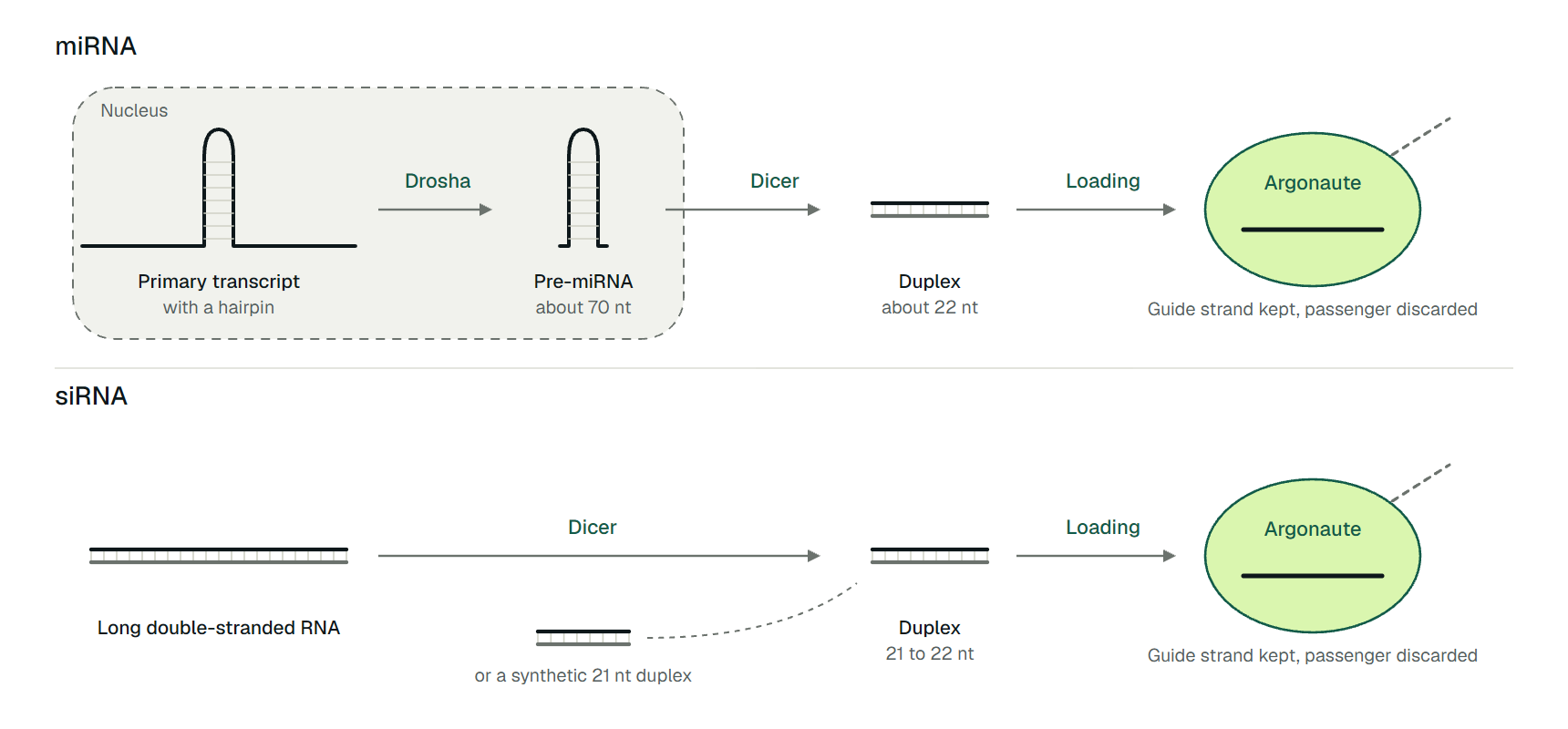
The loaded protein sets a limit on what happens next. In mammals only Argonaute2 cuts RNA, and cells lacking it cannot respond to an siRNA. Cutting also needs extensive pairing between guide and target, which a seed match alone does not provide.
## How a small RNA recognizes its target
In animals the guide recognizes its target mostly through the seed, nucleotides 2 to 7 or 2 to 8 counted from the 5' end. Requiring Watson-Crick pairing to the seed sharply cuts false positives in target prediction.
Canonical sites match the seed plus one or two neighboring positions, 7 or 8 nucleotides in all, while 6-nucleotide seed matches are marginal and usually less effective. Extra pairing near the 3' end of the guide can support a site but rarely rescues a seed mismatch; in the TargetScan analysis it accounted for under 2% of conserved sites.
Seed pairing is cheap and common, so a single miRNA has many targets. Friedman and colleagues estimated that more than 60% of human protein-coding genes have been under selective pressure to keep pairing to miRNAs, based on over 45,000 conserved sites in human 3' untranslated regions. Animal miRNAs most often act by translational repression, by destabilizing the mRNA (which shortens its [half-life](/guides/how-long-does-mrna-last-in-a-cell)), or both.
Extensive pairing changes the outcome. When the match runs through the center of the guide, Argonaute can adopt a conformation that positions its active site for cleavage. In plants that is the normal mode, so many plant miRNA targets can be found by searching for near-complementary messages. In animals it happens at a few endogenous sites and at the intended site of an siRNA.
## How many miRNAs miRBase counts
The miRNA registry miRBase counts 46,603 hairpin precursors and 74,463 mature miRNAs from 323 species in release 23.1, dated September 2026. The previous full release, version 22 of March 2018, held 38,589 hairpins and 48,860 mature miRNAs from 271 species. We counted the human entries in the release 23.1 FASTA files on November 11, 2026: 1,861 hairpins and 2,789 mature sequences with the hsa prefix.
Those totals count annotations, not validated functional miRNAs. When Kozomara and colleagues mapped 5.5 billion small-RNA sequencing reads to miRBase 22, the data supported between 20% and 65% of annotations in well-studied animal genomes, and more than 200 sequences were removed.
Relative to release 23, version 23.1 deleted 589 hairpins and 1,078 mature sequences as misannotated. Before trusting the predicted targets of a miRBase entry, check that sequencing reads support it in the tissue you study.
## Why an siRNA also acts like a miRNA
The seed does not care about the rest of the guide. Jackson and colleagues profiled human cells treated with siRNAs and found signatures specific to each siRNA, not to its intended target, including silencing of genes that shared as few as 11 contiguous nucleotides with the siRNA.
Birmingham and colleagues then showed that overall sequence identity contributed little to off-targeting except for near-perfect matches. Off-targeted genes instead carried one or more perfect 3' UTR matches to the hexamer or heptamer seed of the antisense strand, positions 2 to 7 or 2 to 8.
So a single siRNA guide behaves differently on different mRNAs, and Figure 2 follows one guide strand across the three kinds of target it meets.
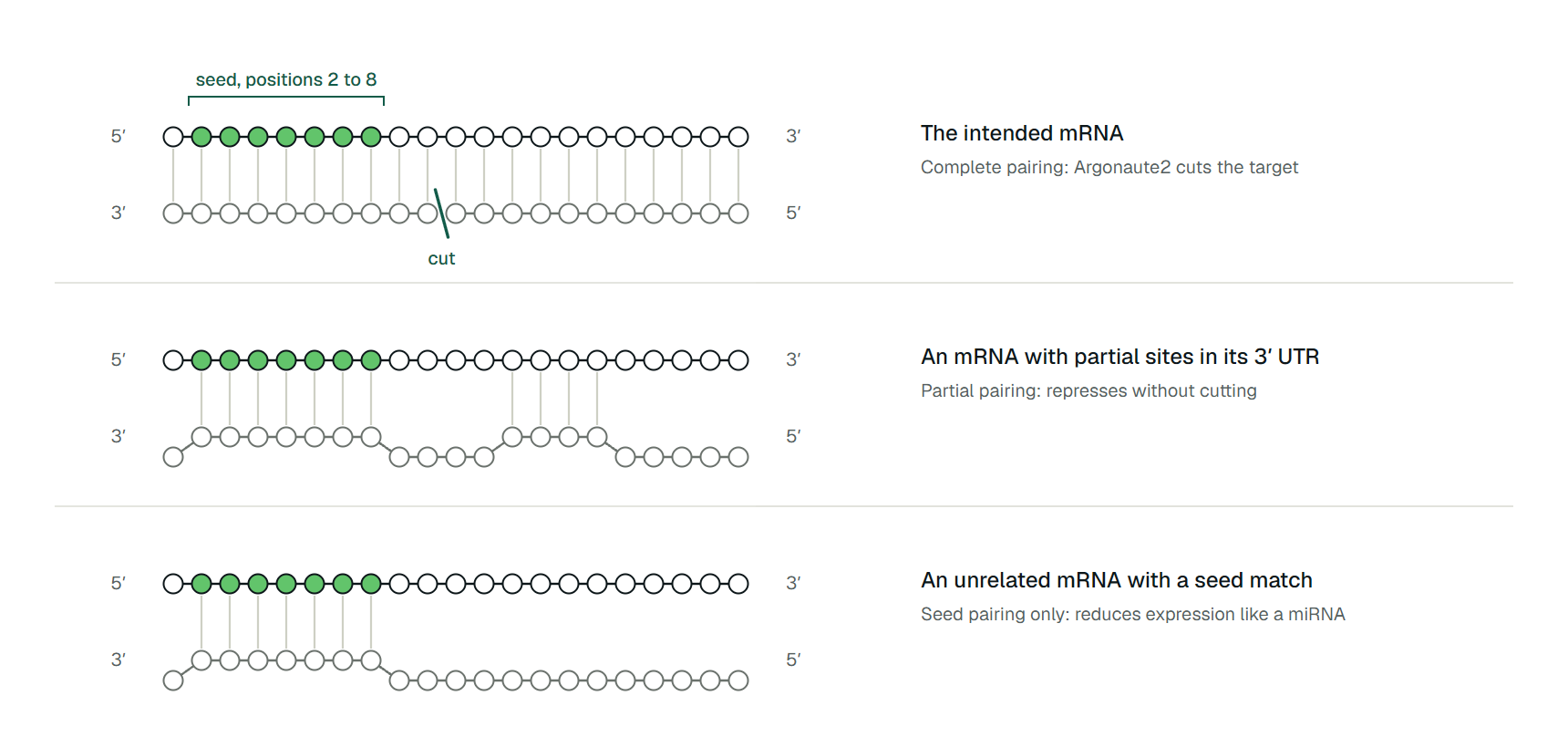
Against the intended mRNA, Argonaute2 cuts the target, and one loaded complex can act on many copies. Against an mRNA with several partial sites in its 3' UTR, the pairing is interrupted by bulges and mismatches, and the target is repressed without being cut, by a cooperative mechanism distinct from cleavage.
Against an unrelated mRNA with a seed match of six or seven nucleotides at positions 2 to 8, expression drops like it does for a miRNA target, which is the off-target signature seen in profiling. A clean phenotype from one siRNA therefore does not show that it hit only one gene. Check for seed matches in the 3' UTRs of other expressed genes.
## What duplex free energy can tell you
Base-pair stability can be estimated. The Turner nearest-neighbor model assigns a free-energy change to each stacked pair, loop and mismatch, and the 2004 parameter set is the standard in the ViennaRNA Package. For two RNAs it gives the energy of the best duplex: a more negative number means a more stable helix at the chosen temperature. Strand selection by 5' end stability, described above, is a statement about the same base-pair stability.
[RNAduplex](/app/rnaduplex) applies this to two sequences. It finds the lowest-energy set of intermolecular base pairs between a miRNA or siRNA and a candidate target, and reports the binding site and the hybridization free energy. It ignores any folding inside either strand, which keeps it fast enough to screen many pairs and suits a first pass over candidate sites.
The catch is that a duplex energy describes two free strands in solution. In a cell the guide sits inside Argonaute, and the target is folded and bound by proteins. Because RNAduplex allows only intermolecular pairs, a site buried in the target's own [secondary structure](/guides/rna-secondary-structure) can look better than it is. Nor can a two-strand calculation represent Argonaute itself reshaping to allow extensive pairing, as in Bartel's model.
Each missing term has its own ViennaRNA program. Table 2 lists what each one adds and what it still cannot see.
| Where does this guide bind best on this target, and how strongly? |
[RNAduplex](/app/rnaduplex) |
Structure inside either RNA, and the Argonaute protein |
| Is the site open, or does the target have to unfold first? |
[RNAup](/app/rnaup) |
Proteins on the mRNA, and Argonaute |
| Where along a long mRNA does a short guide bind, given accessibility? |
[RNAplex](/app/rnaplex) |
Proteins on the mRNA, and Argonaute |
| Does the guide fold on itself or pair with its own duplex partner? |
[RNAcofold](/app/rnacofold) |
Whether a stable duplex represses anything in a cell |
Treat the energy as a ranking aid. A site that scores well and sits in an accessible 3' UTR deserves an experiment; a site that scores well alone does not predict repression.
## Approved siRNA drugs
As of October 29, 2026, eight of the 25 [oligonucleotide drugs the FDA has approved](/guides/approved-oligonucleotide-drugs) are siRNAs, from patisiran in August 2018 to plozasiran in November 2025 (Table 3). Each is a duplex built for full complementarity to a single liver mRNA, so each works the siRNA way: Argonaute2 cuts the target. Patisiran uses a lipid nanoparticle for delivery; the other seven carry a GalNAc sugar cluster that pulls them into liver cells.