# AlphaFold 2 vs AlphaFold 3: what changed and which to run

> AlphaFold 3 predicts ligands, nucleic acids and modified residues that AlphaFold 2 cannot, but for a single protein chain with relatives the older model is already close to the crystal structure. We scored 46 AlphaFold 2 models against structures released after June 2023, and compare the architecture, the published gains, the new failure modes and the access terms.

## What is the difference between AlphaFold 2 and AlphaFold 3?

AlphaFold 2 predicts the structure of a protein from its sequence and an alignment of related sequences, and AlphaFold-Multimer extends it to complexes of protein chains. AlphaFold 3 predicts the joint structure of any mix of proteins, nucleic acids, small molecules, ions and modified residues, and it generates the atoms with a diffusion model instead of AlphaFold 2's structure module.

For one protein chain, the upgrade matters less than the version number suggests. We scored 46 [AlphaFold Database](/app/alphafold-database-download) models, all built by AlphaFold 2, against X-ray structures released between June 2023 and June 2025, years after AlphaFold 2's training data stopped in April 2018. The median TM-score was 0.99 and 44 of the 46 reached 0.90 or more, including 10 of the 11 proteins with no earlier PDB entry at 90% identity. One protein, a sea hare enzyme with only four members in its sequence cluster, scored 0.42.

The published gains of AlphaFold 3 sit elsewhere, in molecules AlphaFold 2 could not model at all and in interfaces. The largest of them, for antibody and antigen, was measured after ranking 1,000 seeds per interface instead of the usual 5, which is 200 times as many samples.

So the right version depends on what you put in: one chain, a complex with a ligand, or an antibody. The input also decides who is allowed to run the model.

## What changed inside the model

AlphaFold 3 keeps the outline of its predecessor, a large trunk that builds a pairwise picture of the complex and a second stage that turns it into coordinates, but it replaces both parts. The authors cut the alignment processing down to a small module and let a diffusion model place atoms directly. That let them drop the stereochemical losses and most special handling of bonding patterns, and accept arbitrary chemical components.

![Two pipelines side by side. AlphaFold 2 runs protein chains and their alignment through a 48-block Evoformer and a structure module on residue frames and torsion angles. AlphaFold 3 runs proteins, nucleic acids, ligands, ions and modified residues through a four-block alignment module, 48 pairformer blocks and a diffusion module on raw atom coordinates.](/images/guides/alphafold-2-vs-3/architecture.webp "**Figure 1. The two models side by side.** Equal stages share a column, and the lime boxes mark the structure generators, the largest change. The Evoformer spans two columns because it does the work that AlphaFold 3 splits between its alignment module and pairformer. Schematic. Sources: Jumper et al. (2021), Evans et al. (2021) and Abramson et al. (2024).")

  <caption><strong>Table 1. AlphaFold 2 and AlphaFold 3 compared.</strong> Architecture, data and outputs as described by the authors. AlphaFold-Multimer is the complex version of AlphaFold 2.</caption>
  <thead>
    <tr>
      <th scope="col">Feature</th>
      <th scope="col">AlphaFold 2</th>
      <th scope="col">AlphaFold 3</th>
    </tr>
  </thead>
  <tbody>
    <tr>
      <td>Molecules</td>
      <td>Protein chains (AlphaFold-Multimer for complexes)</td>
      <td>Proteins, DNA, RNA, ligands, ions, modified residues</td>
    </tr>
    <tr>
      <td>Alignment processing</td>
      <td>48 Evoformer blocks work on the alignment and the pair representation together</td>
      <td>A four-block alignment module, then 48 pairformer blocks that see only the pair and single representations</td>
    </tr>
    <tr>
      <td>Structure generation</td>
      <td>Structure module on residue frames and side-chain torsion angles</td>
      <td>Diffusion module on raw atom coordinates</td>
    </tr>
    <tr>
      <td>Stereochemistry</td>
      <td>Stereochemical losses in training</td>
      <td>Stereochemical losses removed; chirality handled by a ranking penalty and several seeds</td>
    </tr>
    <tr>
      <td>Disordered regions</td>
      <td>Extended, ribbon-like loops</td>
      <td>Can invent compact structure; reduced by training on AlphaFold-Multimer v2.3 predictions</td>
    </tr>
    <tr>
      <td>Confidence outputs</td>
      <td>pLDDT, PAE, pTM and, in Multimer, ipTM</td>
      <td>pLDDT, PAE and a distance error matrix, with ipTM used to rank interfaces</td>
    </tr>
    <tr>
      <td>Training structures</td>
      <td>PDB entries released up to 30 April 2018</td>
      <td>PDB entries released up to 30 September 2021</td>
    </tr>
  </tbody>

Two consequences follow from the table. A later training cutoff means more complexes, ligands and nucleic acids to learn from, which is part of why the newer model is better on them. And because the diffusion model is generative, it no longer shares AlphaFold 2's habit of drawing an uncertain region as a loose ribbon, a difference that matters when you read a [pLDDT](/guides/plddt) plot.

## How close AlphaFold 2 gets on a single chain

We drew entries at random from the 2,663 X-ray structures in the Protein Data Bank that were released between June 2023 and June 2025, resolved at 2.0 Å or better, with one protein chain per asymmetric unit, 80 to 300 residues and a UniProt reference. Of the first 150 we drew, 47 mapped to UniProt sequences shorter than 50 or longer than 400 residues and 22 had no AlphaFold Database entry, which left 81 entries.

Several were the same protein (lysozyme and FABP4 alone supplied 21), so we kept the first entry for each UniProt accession, leaving 46 proteins.

For each protein we downloaded the AlphaFold Database model and aligned it to chain A of the crystal structure with US-align 20260527, the build behind ProteinIQ's [US-align](/app/usalign) tool. Scores are [TM-scores](/guides/tm-score-vs-rmsd) normalized by the length of the crystal chain. The database's own metadata names an AlphaFold 2 pipeline for every one of the 46 models (44 AlphaFold Monomer v2.0, one v2.3 and one ColabFold 1.5.2).

Figure 2 sorts the 46 models by score. Thirty-eight matched the crystal backbone at 0.95 or more, and six more landed between 0.90 and 0.95 with small shifts in loops or domain positions. One model kept the fold with a clear error, and one had a different fold from the crystal structure.
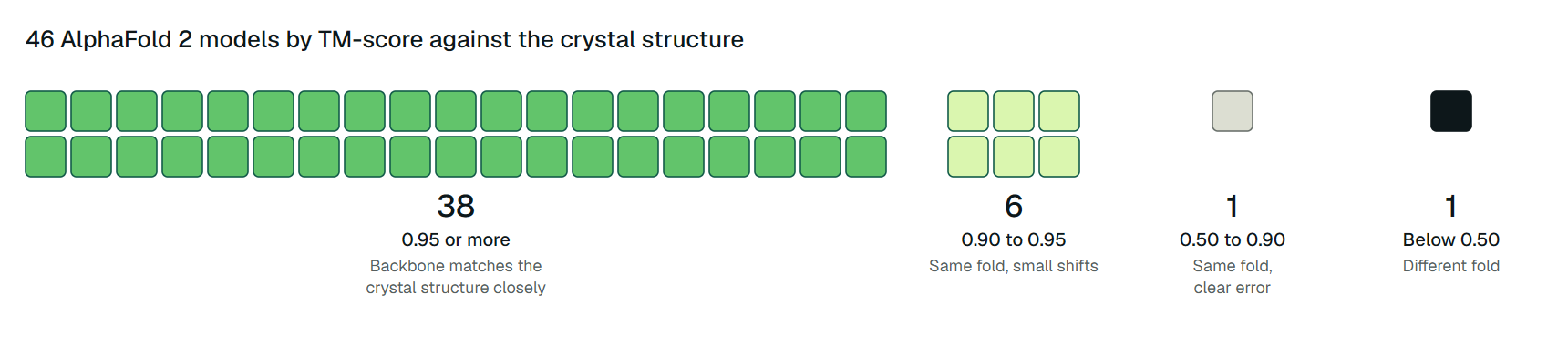
![A unit chart of 46 squares, one per protein, grouped by TM-score: 38 at 0.95 or more, 6 from 0.90 to 0.95, 1 from 0.50 to 0.90 and 1 below 0.50.](/images/guides/alphafold-2-vs-3/tm-score-units.webp "**Figure 2. AlphaFold 2 models of 46 proteins released after June 2023.** One square is one protein. We calculated TM-scores with US-align against X-ray structures from the PDB; entries were drawn at random and deduplicated by UniProt accession, and proteins without an AlphaFold Database entry were left out. Squares are grouped by band and carry no order within a band.")

Most of these entries were new structures of proteins already in the PDB, which is an easier job than a new fold, because AlphaFold 2 can use solved templates. So we searched the PDB for the closest entry released before June 2023 for each protein. For 35 proteins one existed at 90% identity or better, and AlphaFold 2 averaged a TM-score of 0.976 on them. For the other 11, whose closest earlier entry was at most 71% identical or missing, the median was 0.991, with 10 of the 11 at 0.90 or more.

The weakest case is the useful one. The 1.4 Å structure 8IN4 is a hydrolysis-enhancing protein from the sea hare *Aplysia kurodai*, and its sequence cluster at 50% identity holds four proteins in UniProt. AlphaFold 2 aligned only 125 of its 207 crystal residues, at 4.23 Å RMSD, for a TM-score of 0.42. The closest earlier PDB entry covered only 21% of its sequence, at 43% identity, so a template could not have rescued it. The model's own confidence did flag the problem: its mean pLDDT was 74.7, against a median of 92.7 across the other 45.

That matches what the AlphaFold 2 authors reported: accuracy falls substantially when the median alignment has fewer than about 30 sequences and gains little once it passes about 100. The AlphaFold 3 paper says its dependence on alignment depth is very similar to that of AlphaFold-Multimer v2.3, so a protein with few relatives stays hard in both. We did not run AlphaFold 3 on these 46 proteins, so we make no claim about its score on 8IN4.

## Where AlphaFold 3 is better

Ligands are the clearest gain, and the one that makes [co-folding a ligand with its protein](/guides/alphafold-docking-vs-cofolding) a rival to docking. On PoseBusters, a benchmark of 428 protein-ligand complexes, AlphaFold 3 outperformed AutoDock Vina without being given the protein structure or the pocket, while Vina was given information from the solved structure (Fisher's exact test, P = 2.3 × 10<sup>−13</sup>).

That evaluation used a model trained only on structures released up to 30 September 2019, so no benchmark complex was in training. Chai Discovery's comparison puts AlphaFold 3 at 76% of ligands within 2 Å.

The paper reports further gains over AlphaFold-Multimer v2.3, the baseline in those tests rather than the original monomer model: higher DockQ success on protein-protein interfaces (paired Wilcoxon test, P = 1.8 × 10<sup>−18</sup>), higher single-chain LDDT (P = 1.7 × 10<sup>−34</sup>) and much higher accuracy on protein-nucleic acid complexes than nucleic acid specific predictors.

A P value says a gain is consistent across chains, not that it is large; the paper shows the size in its Figure 1c.

Antibodies carry the catch. The gain was measured on predictions top-ranked out of 1,000 seeds, each AlphaFold 3 seed with five diffusion samples: 5,000 candidate structures per interface against 25 for the typical 5 seeds. Quality on low-homology antibody interfaces climbs with the number of seeds (n = 65 clusters).

![Two grids of dots, one dot per candidate structure: 25 for five seeds with five samples each, and 5,000 for 1,000 seeds with five samples each.](/images/guides/alphafold-2-vs-3/seed-sampling.webp "**Figure 3. Candidate structures per interface.** The antibody gain was measured on the right-hand grid, 200 times the structures in the left-hand one. One ink dot marks the top-ranked structure in each grid; its position carries no meaning. Source: Abramson et al. (2024).")

So the advantage depends on how many seeds you can afford. A model that accepts contact restraints, such as [Chai-1](/app/chai-1), is the other way to narrow an antibody interface.

## Where AlphaFold 3 fails

The authors list the failures themselves. The diffusion model sometimes invents structure in disordered regions, and although the invented parts usually get very low confidence, they can lack the ribbon look AlphaFold 2 gave them.

Chirality is violated in 4.4% of PoseBusters predictions even with a ranking penalty, and atoms occasionally overlap, in some homomers to the point that whole chains sit on top of each other. A clean [MolProbity](/app/molprobity) or [PoseBusters](/app/posebusters) report is worth running on every co-folded ligand.

Neither version models motion. Multiple seeds do not approximate the solution ensemble, and the paper gives E3 ubiquitin ligases as an example: they open in the apo state and close on a ligand, yet AlphaFold 3 predicts only the closed state for both. For a protein that moves, a sampler such as [BioEmu](/app/bioemu) answers a different question than either AlphaFold.

## Who can run which

Access is the second difference. AlphaFold 2, ColabFold and the AlphaFold Database allow commercial use. AlphaFold 3 weights are limited to non-commercial organizations and the outputs inherit that limit, so a company needs a Google Cloud license or one of the [open models with the same design](/guides/protein-structure-prediction-software). The [AlphaFold license guide](/guides/alphafold-license-commercial-use) sets out each version's terms.

Running AlphaFold 3 yourself is also heavy. Its installation notes call for an NVIDIA GPU with compute capability 8.0 or higher, up to 1 TB of disk and an 80 GB A100 or H100 for inputs of up to 5,120 tokens. Single chains need none of that: a precomputed model or an [AlphaFold2](/app/alphafold-2) job covers them.

  <caption><strong>Table 2. Which AlphaFold version to start with.</strong> Recommendations follow the evidence above; the last column is the cheap check to run on the result.</caption>
  <thead>
    <tr>
      <th scope="col">Your input</th>
      <th scope="col">Start with</th>
      <th scope="col">Check</th>
    </tr>
  </thead>
  <tbody>
    <tr>
      <td>One chain with many relatives</td>
      <td>The AlphaFold Database model, or AlphaFold 2</td>
      <td>Mean pLDDT; the one weak model in our test (TM-score 0.42) had a mean of 74.7</td>
    </tr>
    <tr>
      <td>One chain with few relatives</td>
      <td>Either, with the expectation of a weak model</td>
      <td>pLDDT below 80 and low-confidence domain placement in the PAE plot</td>
    </tr>
    <tr>
      <td>Protein complex, commercial work</td>
      <td>AlphaFold-Multimer in AlphaFold 2</td>
      <td>ipTM and the interchain PAE, not one number</td>
    </tr>
    <tr>
      <td>Ligand or nucleic acid, academic work</td>
      <td>AlphaFold Server (AlphaFold 3)</td>
      <td>Chirality and clashes in the ligand</td>
    </tr>
    <tr>
      <td>Ligand or nucleic acid, commercial work</td>
      <td>An open AlphaFold 3 style model</td>
      <td>Whether the ligand pose passes PoseBusters</td>
    </tr>
    <tr>
      <td>Antibody and antigen</td>
      <td>AlphaFold 3 with many seeds, or a restrained open model</td>
      <td>Rank across all seeds by interface confidence</td>
    </tr>
  </tbody>

In practice, the check matters more than the version. A model that has never seen your protein can fail confidently in either one, and the cheapest guard is to read [structure confidence](/guides/structure-prediction-confidence) from local to global, from pLDDT through the [PAE](/guides/pae) map to [ipTM](/guides/iptm-vs-ptm), before you trust a pose or an interface.

## AlphaFold and AlphaFold-style tools on ProteinIQ

Start with a model you can already download, then predict, then check it against whatever experimental structure exists. AlphaFold 3 itself is not hosted here; the open models that follow its design are.

- Download a precomputed AlphaFold 2 model: [AlphaFold database download](/app/alphafold-database-download)
- Predict a chain or a protein complex with AlphaFold 2: [AlphaFold2](/app/alphafold-2)
- Co-fold a ligand, DNA or RNA with an open model: [Boltz-2](/app/boltz-2), [Chai-1](/app/chai-1), [OpenFold3](/app/openfold-3), [Protenix](/app/protenix) or [RosettaFold3](/app/rosettafold3)
- Compare a prediction with a crystal structure: [US-align](/app/usalign)
- Score an interface against a reference: [DockQ](/app/dockq)
- Check geometry and clashes: [MolProbity](/app/molprobity)

## Frequently asked questions

### Is AlphaFold 3 more accurate than AlphaFold 2?

For complexes with ligands, nucleic acids and antibodies, yes, and AlphaFold 2 cannot model ligands or nucleic acids at all. The paper reports significant gains over AlphaFold-Multimer v2.3 on protein-protein interfaces and single chains, but the antibody gain was measured after ranking 1,000 seeds. For one protein chain with many relatives, AlphaFold 2 models matched crystal structures at a median TM-score of 0.99 in our test.

### Can I use AlphaFold 3 commercially?

Not through the free route. The weights are limited to non-commercial organizations and the terms bar use on behalf of a company. Commercial teams use AlphaFold 3 through a Google Cloud license, or use an open model such as Boltz-2 or Chai-1 under a permissive license.

### Does AlphaFold 3 still need a multiple sequence alignment?

Yes. It processes the alignment with a much smaller module than AlphaFold 2, but the paper reports a very similar dependence on alignment depth, so proteins with few relatives are still predicted less accurately.

### Which AlphaFold should I use for a single protein?

Start with the AlphaFold Database model if your protein is there, and otherwise run AlphaFold 2. It allows commercial use, runs on a modest GPU, and reached a TM-score of 0.90 or more on 44 of 46 recently solved proteins in our test.

### Is AlphaFold-Multimer still worth using?

For complexes of protein chains in commercial work, yes, because its weights are open. AlphaFold 3 beats it on interface success and antibody complexes in the paper's tests, so academic users with a ligand, a nucleic acid or an antibody should try the server first.
